
Castelvecchio in Verona, where a medieval fortress became an art museum
Published on 08/14/2026 at 14:27 | Editorial responsibility: Rafael Müller, Editor-in-Chief AD HOC NEWS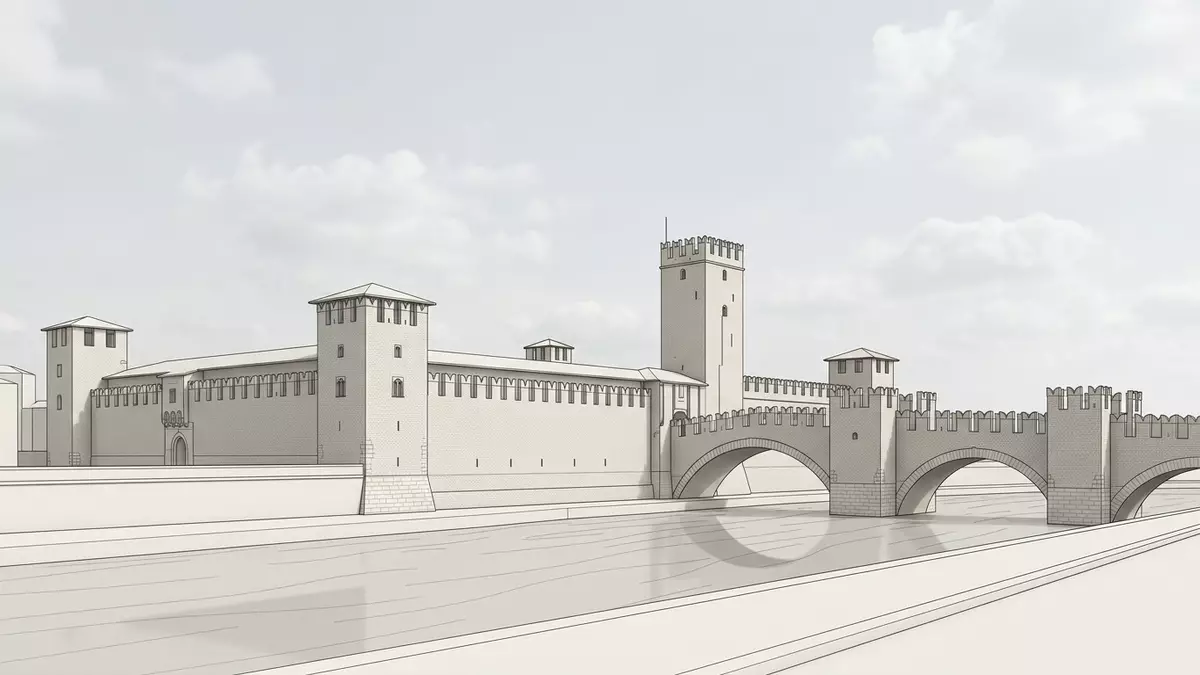
Castelvecchio in Verona is a red-brick medieval fortress on the Adige River whose thick walls and courtyards now house the city’s civic art museum. Built in the fourteenth century for the Scaliger lords and reshaped in the mid-twentieth century by architect Carlo Scarpa, it brings together a military stronghold, a bridge over the river and an influential museum installation in a single complex.
A Scaliger stronghold on the Adige
Castelvecchio stands in the historic centre of Verona, close to Corso Cavour and aligned with the Adige at a bend in the river. It was raised in the middle of the fourteenth century under Cangrande II della Scala, part of the ruling Scaliger dynasty that controlled Verona during the late Middle Ages.built in the fourteenth century The castle is laid out as a fortified residence with enclosed courtyards, surrounding walls and towers that once formed the most important defensive construction of the Scaliger family in the city.Scaliger military construction
The brick battlements run along the river-facing side, while stout towers rise towards the old town, marking the castle on the skyline. Inside, the complex is divided into several courts, including the Corte d’Armi, a larger rectangular place-of-arms to the north, and more residential areas to the south around the palace wing.Corte d’Armi courtyard The highest tower anchors the central court and gives the fortress its vertical emphasis over the surrounding roofs.
From fortress to civic museum
Over the centuries Castelvecchio moved from strictly military use to become one of Verona’s principal cultural sites. Under Venetian rule it served as a barracks, armoury and arsenal, with some spaces used as prisons, while in the Napoleonic era parts of the structure were heavily transformed for military storage.Venetian barracks and arsenal In the twentieth century restoration campaigns repaired damaged sections and prepared the castle for a different role.
Since 1923 the fortress has housed Verona’s civic art museum, bringing medieval architecture and curated collections under one roof.Civic Art Museum since 1923 Between 1958 and 1964 architect Carlo Scarpa oversaw a major restoration and museum reorganisation, integrating new walkways, display walls and staircases into the historic fabric.restored between 1958 and 1964 His work at Castelvecchio is now recognised as a key project in twentieth-century museum design, studied for the way it sets sculptures and paintings against stone, brick and carefully framed views.
Art, architecture and the bridge over the Adige
Inside the museum galleries visitors encounter detached frescoes, medieval and early Renaissance paintings, sculpture and jewellery from Verona and the wider Veneto. Works by artists such as Pisanello, Giovanni Bellini, Vittore Carpaccio, Andrea Mantegna and Peter Paul Rubens are displayed in sequences that lead through halls, towers and smaller rooms within the former palace wing.works by Pisanello and Bellini Stone sculptures are often set on Scarpa’s finely detailed supports, which lift them away from the walls and reveal the surfaces of the castle behind.
Castelvecchio is closely linked to the fortified Ponte Scaligero, also known as the Castelvecchio Bridge, which carries the same red brick and merlons out across the Adige.Ponte Scaligero over the Adige The bridge connects the castle to the river’s opposite bank and extends its defensive reach, giving a clear sense of how the medieval stronghold once commanded this stretch of Verona. From the castle’s ramparts and bridge approaches, the view takes in the curve of the Adige, neighbouring districts and other landmarks of the city.
Visiting Castelvecchio: what travellers from Western Europe should know
- Castelvecchio stands on Corso Castelvecchio near Corso Cavour, on the right bank of the Adige in Verona’s historic centre, a short walk from Piazza Bra and the Roman arena.
- The fortress interior includes several staircases, uneven stone surfaces and elevated walkways through the galleries and towers, so a visit involves climbing steps and moving between different levels.
- The official language is Italian and the currency is the euro.
Searching for Castelvecchio on social platforms
These links open searches for Castelvecchio on each platform.Frequently asked questions about Castelvecchio
Where is Castelvecchio in Verona?
Castelvecchio stands beside the Adige River in Verona’s historic centre, near Corso Castelvecchio and Corso Cavour, a short distance from Piazza Bra.
What can visitors expect inside Castelvecchio?
Visitors walk through medieval courtyards, towers and halls that house the civic art museum, with painting, sculpture and frescoes displayed within Carlo Scarpa’s twentieth-century restoration.
What makes Castelvecchio distinctive among Verona’s sights?
Castelvecchio combines a fourteenth-century Scaliger fortress, the fortified Ponte Scaligero bridge and an influential museum installation, offering architecture, art and river views in one connected ensemble.


