
Catedral de Mallorca and Palma’s soaring Gothic nave
Published on 09/22/2026 at 19:37 | Editorial responsibility: Rafael Müller, Editor-in-Chief AD HOC NEWS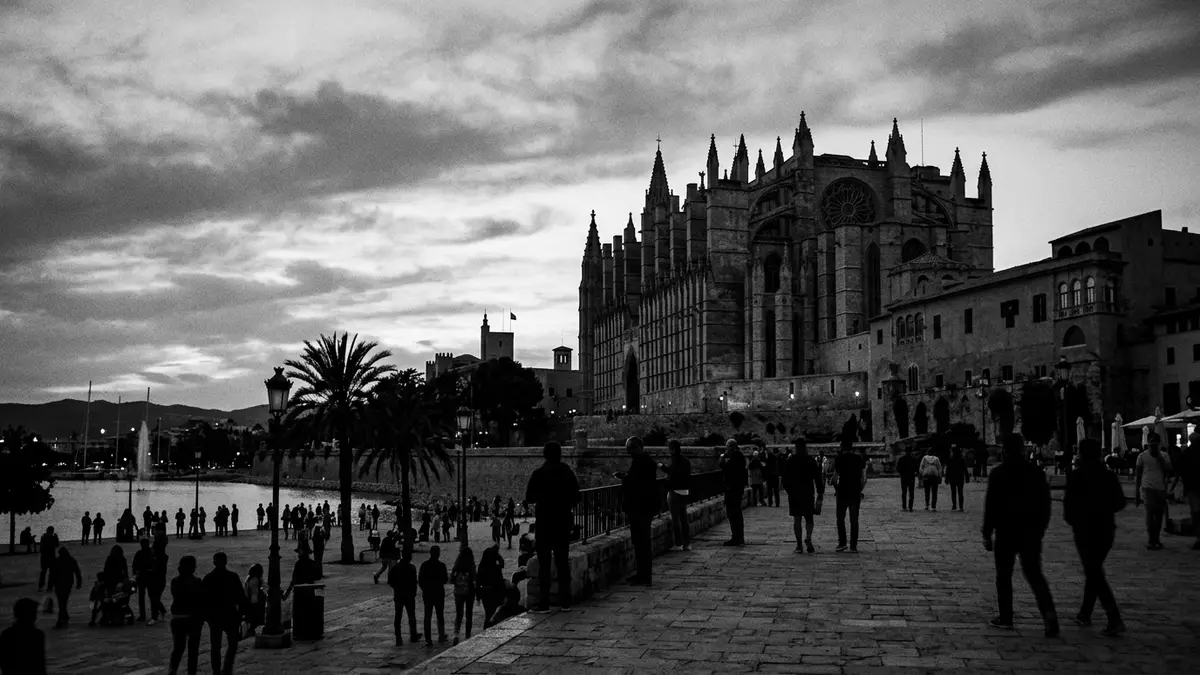
Catedral de Mallorca rises beside the Bay of Palma as a long Gothic church of pale stone, coloured glass and soaring interior space. Its central nave reaches 44 metres, while the building’s history stretches from James I of Aragon in 1229 into the seventeenth century.
Catedral de Mallorca: a nave built on a vast scale
The cathedral belongs to the Mediterranean Gothic tradition, with a broad plan, pointed arches, ribbed vaults and tall supporting columns. The central nave rises above the side aisles, creating a powerful contrast between the vertical interior and the massive exterior walls.
The building measures about 109 metres in length and 39 metres in width. Its main nave is approximately 44 metres high, and fourteen large columns divide the central space from the side aisles. These proportions give the interior its defining architectural character. the cathedral’s dimensions record the scale of the structure.
From James I to the seventeenth century
The first documents connected with the cathedral date from 1230, shortly after James I of Aragon took Mallorca in 1229. Construction developed in stages, with chapels, royal spaces, the eastern end and the great nave forming parts of a long building history.
The work continued across the thirteenth, fourteenth, fifteenth and sixteenth centuries. The main building was declared complete in 1601, while work on the cathedral continued into the 1630s. The result is a medieval foundation with later additions and alterations. the cathedral’s long history places the building within a tradition extending across four centuries.
Stone, glass and changing interior spaces
Catedral de Mallorca combines Gothic masonry with coloured windows, carved portals, chapels and royal associations. The Portal del Mirador is linked with Guillem Sagrera, whose work belongs to the cathedral’s later medieval development.
Twentieth-century interventions added another layer. Antoni Gaudí worked on the interior between 1904 and 1914, when the choir was moved towards the sanctuary and a wrought-iron baldachin was installed above the high altar. In 2007, Miquel Barceló completed a ceramic mural in the Chapel of the Blessed Sacrament. Gaudí’s interior work and Barceló’s mural place modern interventions beside the Gothic fabric.
The cathedral’s setting adds a clear urban relationship to the architecture. It stands in Palma’s historic centre beside the sea, close to the Almudaina Palace and the old city walls. From the surrounding streets, the exterior reads as a continuous stone mass; inside, the nave opens into a high sequence of arches, columns and chapels.
Visiting Catedral de Mallorca: what travellers from Western Europe should know
- Catedral de Mallorca stands in Palma’s historic centre beside the Bay of Palma and near the Almudaina Palace. Palma’s city streets and public transport connect the cathedral with the wider urban area.
- The interior contains a long central nave, side aisles, chapels and stone flooring. Visitors encounter steps and uneven historic surfaces in parts of the building.
- The cathedral is an active place of Christian worship. Its architectural spaces include the sanctuary, royal chapels and the Chapel of the Blessed Sacrament.
- The official language is Spanish and the currency is the euro.
Searching for Catedral de Mallorca on social platforms
These links open searches for Catedral de Mallorca on each platform.
Frequently asked questions about Catedral de Mallorca
Where is Catedral de Mallorca?
Catedral de Mallorca stands in Palma, Mallorca, beside the Bay of Palma and near the Almudaina Palace in the historic centre.
What can visitors see inside?
The interior contains a 44-metre central nave, side aisles, chapels, royal spaces, coloured glass and the Chapel of the Blessed Sacrament.
What makes Catedral de Mallorca distinctive?
Its defining feature is the combination of a vast Mediterranean Gothic nave with later work by Antoni Gaudí and a ceramic mural by Miquel Barceló.


