
Catedral de Santiago de Compostela and the weight of pilgrimage
Published on 08/22/2026 at 06:25 | Editorial responsibility: Rafael Müller, Editor-in-Chief AD HOC NEWS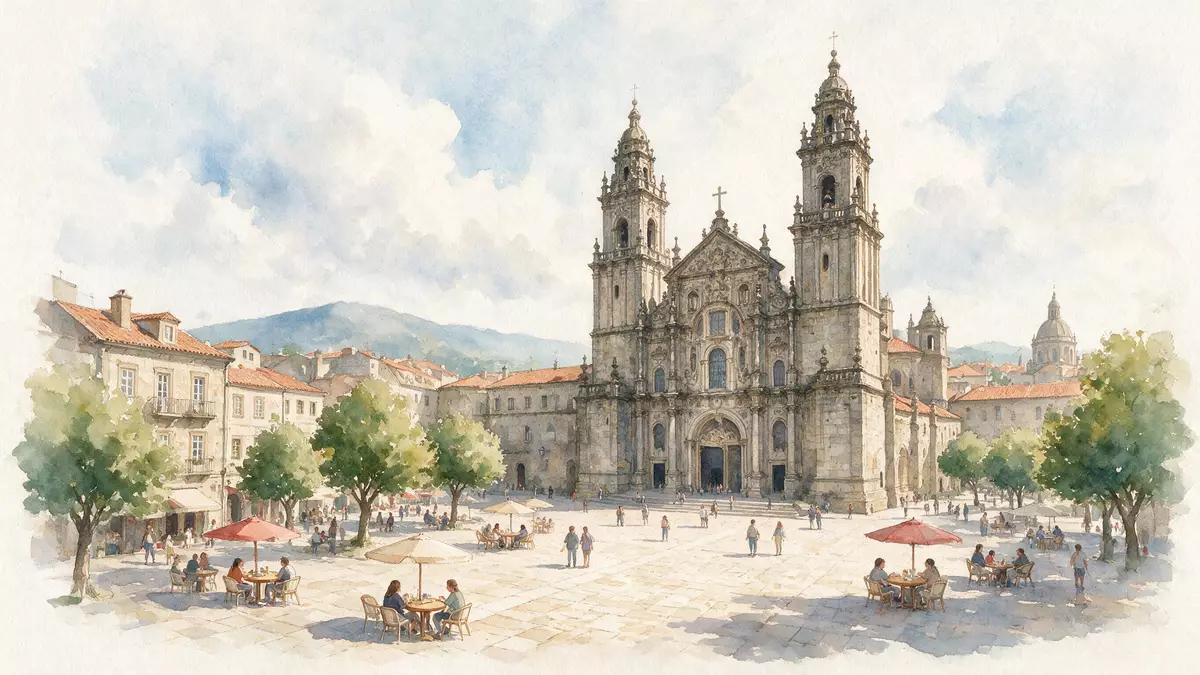
Catedral de Santiago de Compostela in Santiago de Compostela is a Romanesque cathedral layered with later additions, built as a monumental setting for the cult of Saint James and for the pilgrims who walk the Camino.
A Romanesque core shaped in the age of the Camino
The cathedral stands on the Plaza do Obradoiro at the western edge of Santiago de Compostela’s historic centre, forming the focal point of the city’s World Heritage ensemble.World Heritage ensemble Work on the Romanesque church began in 1075, during the reign of Alfonso VI of León and Castile, under the direction of the masters Bernard the Elder and Roberto.Romanesque church began in 1075 The main phase of construction ran through the late eleventh and early twelfth centuries, giving the building its massive granite walls, round-arched arcades and Latin-cross ground plan.
This Romanesque core remains legible in the interior, with its wide nave leading to the transept and the sanctuary where the shrine of Saint James the Great is located.shrine of Saint James the Great Later centuries added layers in other styles: Gothic and Renaissance chapels along the perimeter and Baroque remodelling of the western front. The result is a building that carries the visual memory of several periods of Galician and Spanish architecture while preserving a recognisable Romanesque skeleton.
The Baroque Obradoiro façade and the surrounding spaces
The most theatrical encounter with Catedral de Santiago de Compostela is from the Plaza do Obradoiro, where a Baroque façade rises in front of the Romanesque structure.Plaza do Obradoiro This front, with its towers and deep sculptural ornament, was added in the eighteenth century and frames the main entrance used by many visitors. It masks part of the older west end, yet the heavy masonry and deep-set openings hint at the church behind. The square itself is paved and largely open, giving space for the arrival of pilgrims and for views across to the surrounding palaces and university buildings.
Stepping inside from this side reveals a different atmosphere, shaped by stone, dim light and the rhythm of the arcades. Side aisles run parallel to the nave, leading towards chapels and secondary altars. The crossing under the central dome forms the point where the great thurible known as the Botafumeiro can be hung for its swings along the transept. Above, the vaults rise on clustered supports, and the structural stone is left visible over much of the interior, conveying the age of the building more directly than the more exuberant exterior.
Saint James, the crypt and the Botafumeiro
Catedral de Santiago de Compostela is closely tied to the cult of Saint James the Great, whose reputed tomb lies beneath the main altar in a crypt that pilgrims visit after completing their route.tomb lies beneath the main altar The building serves both as archiepiscopal seat and as destination of the Camino de Santiago pilgrimage system, which has brought travellers from across Europe since the Middle Ages.destination of the Camino de Santiago Access routes within the church reflect this dual role, with circulation towards the shrine and spaces reserved for liturgical functions existing side by side.
High above the floor, at the crossing, the Botafumeiro hangs from a rope and pulley system fixed under the dome when in use.Botafumeiro hangs from a rope This giant thurible, made of metal and silver-plated, stands around 1.5 to 1.6 m tall and weighs in the region of 54 to 80 kg when empty, depending on the specific data set.giant thurible When it is swung along the length of the transept on major liturgical occasions, it traces a long arc under the vaults, connecting the geometric clarity of the stone structure with the movement of ritual.
Visiting Catedral de Santiago de Compostela: what travellers from Western Europe should know
- Catedral de Santiago de Compostela stands in the old centre of Santiago de Compostela in north-west Spain, with the main front opening onto the Plaza do Obradoiro.
- The interior involves significant walking on stone floors and movement up and down steps, including stairways to the crypt and to some of the elevated viewing points.
- The cathedral is part of a wider complex that includes cloisters, museum areas and chapels, so a visit can include both the main nave and more enclosed side spaces.
- The official language is Spanish and the currency is the euro.
Searching for Catedral de Santiago de Compostela on social platforms
These links open searches for Catedral de Santiago de Compostela on each platform.
Frequently asked questions about Catedral de Santiago de Compostela
Where is Catedral de Santiago de Compostela located?
The cathedral is in Santiago de Compostela in Galicia, in the north-west of Spain, facing the Plaza do Obradoiro in the historic centre.
What should visitors expect inside the cathedral?
Visitors encounter a Romanesque nave with side aisles, chapels, the crypt associated with Saint James and, on certain occasions, the suspended Botafumeiro thurible overhead.
What makes Catedral de Santiago de Compostela distinctive among European cathedrals?
Its role as terminus of the Camino de Santiago, the combination of Romanesque structure with Baroque west front and the presence of the Botafumeiro give it a character tied strongly to pilgrimage.


