
Centre Pompidou and its inside?out Paris silhouette
Published on 08/18/2026 at 13:18 | Editorial responsibility: Rafael Müller, Editor-in-Chief AD HOC NEWS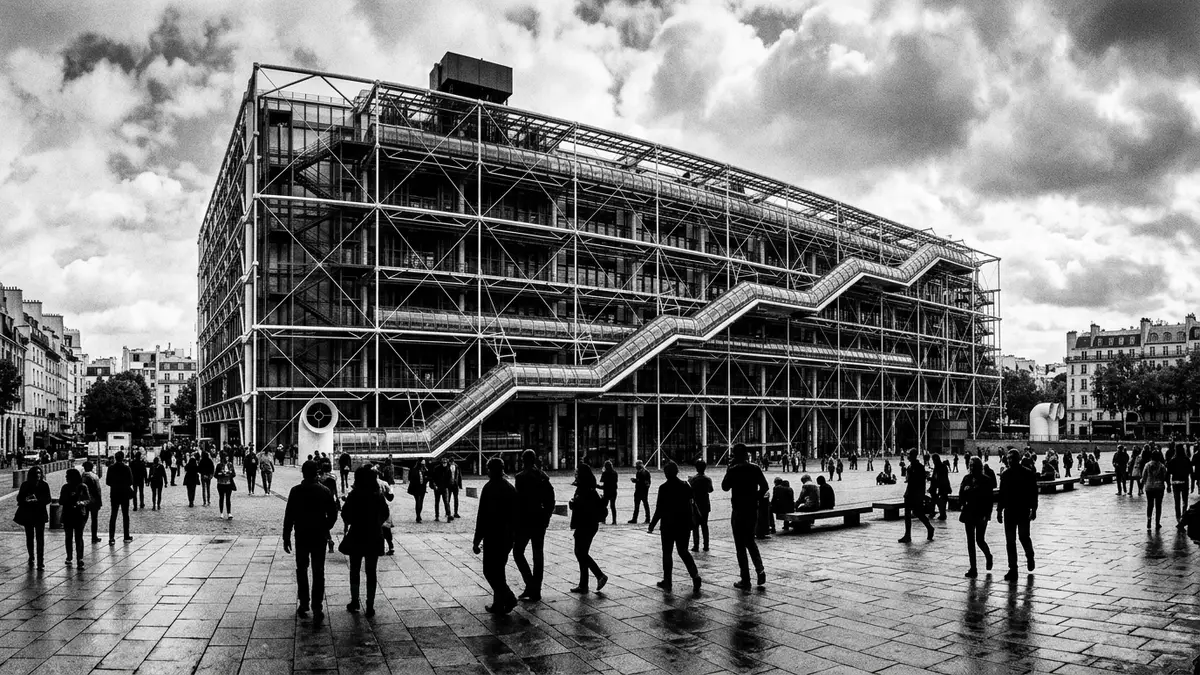
Centre Pompidou in Paris stands on the edge of the historic Marais with a silhouette that turns conventional museum architecture inside out. Conceived in the early 1970s and inaugurated in 1977, it combines an experimental steel and glass structure with one of Europe’s major collections of modern and contemporary art.
An inside?out machine for culture
Centre Pompidou was commissioned under the presidency of Georges Pompidou as a national centre for art and culture in the Beaubourg district of the 4th arrondissement. The winning design came from architects Renzo Piano and Richard Rogers, working with Gianfranco Franchini and engineering firm Ove Arup & Partners, in an international competition judged in 1971.Georges Pompidou National Centre of Art and Culture The building was officially opened on 31 January 1977 by President Valéry Giscard d’Estaing, marking the arrival of high?tech architecture in the historic core of Paris.formally opened on 31 January 1977
The structure stretches as a large steel frame clad in glass, its trusses and floors forming an enormous open container for cultural programmes. Mechanical and circulation systems are expressed on the exterior rather than hidden, giving the building the industrial character that made it a landmark of high?tech and postmodern architecture in the late twentieth century.high?tech architectural landmark Visitors approaching across the plaza see escalator tubes and colour?coded ductwork mounted on the façade, with clear views back across the roofs of Paris from the upper levels.inside?out design with exterior escalator
Colour, dimensions and layout
The exterior is organised as a vast frame running roughly 166 m along the Rue Beaubourg, around 60 m across, and about 42 m high.length, width and height of the building Within this envelope, ten levels of around 7,500 m² each are suspended from steel beams and supported by regularly spaced pillars, creating column?free floors that can be reconfigured as exhibitions and performance spaces change.100,000 m² high?tech container for art
The services on the outer face follow a colour code that has become part of Centre Pompidou’s identity: blue for air systems, green for water, yellow for electrical conduits and red for circulation elements such as lifts and escalators.colour?coded external services These lines run across the façades like oversized graphic strokes, while behind them glazed walls reveal the depth of the floors. On the roof, walkways and plant enclosures frame views towards landmarks including the Eiffel Tower and the church towers of the Right Bank.
Museum, library and performance spaces
Beyond its structural bravura, Centre Pompidou is defined by the institutions it brings together under one roof. The Musée national d’art moderne occupies over 12,000 m² for permanent collections, with additional floors set aside for temporary exhibitions of painting, sculpture, installation and media art from the twentieth and twenty?first centuries.museum collection and exhibition areas The museum’s holdings run into tens of thousands of works, including pieces by artists such as Picasso, Matisse, Kandinsky and Miró, and the building’s open floor plates allow large?scale installations to be shown without internal structural obstacles.modern and contemporary collection and open interior
A vast public reading library, the Bibliothèque Publique d’Information, occupies several storeys with reading rooms extending across the width of the building and seating for thousands of users.public reading library area and capacity Alongside the museum and library, there are cinemas, a performance theatre, a conference room and specialised spaces such as the Kandinsky Library for documentation and research, as well as IRCAM, a centre for music and acoustic research located partly beneath the plaza.national cultural centre with multiple institutions
Visiting Centre Pompidou: what travellers from Western Europe should know
- Centre Pompidou stands on Rue Beaubourg at the edge of the Marais in the 4th arrondissement of Paris, a short walk north from the Seine and not far from the Hôtel de Ville. Several Métro stations lie within walking distance, providing access from mainline railway termini and outlying districts.
- The complex rises over multiple levels above a broad paved plaza, with access involving stairways and escalators leading to the museum entrance and the long enclosed escalator that climbs the façade.
- The official language is French and the currency is the euro.
Searching for Centre Pompidou on social platforms
These links open searches for Centre Pompidou on each platform.
Frequently asked questions about Centre Pompidou
Where is Centre Pompidou located in Paris?
Centre Pompidou stands in the Beaubourg area of the 4th arrondissement, near the Marais and a short distance north of the River Seine.
What can visitors expect inside Centre Pompidou?
Inside, visitors encounter large open floors housing the Musée national d’art moderne, extensive temporary exhibitions, a public library, cinemas and performance spaces.
What makes Centre Pompidou distinctive among Paris museums?
Its high?tech steel and glass structure, exposed colour?coded services and external escalators combine with a major modern art collection to create an inside?out cultural complex.


