
Centre Pompidou: Paris’s inside?out cultural machine
Published on 08/24/2026 at 11:36 | Editorial responsibility: Rafael Müller, Editor-in-Chief AD HOC NEWS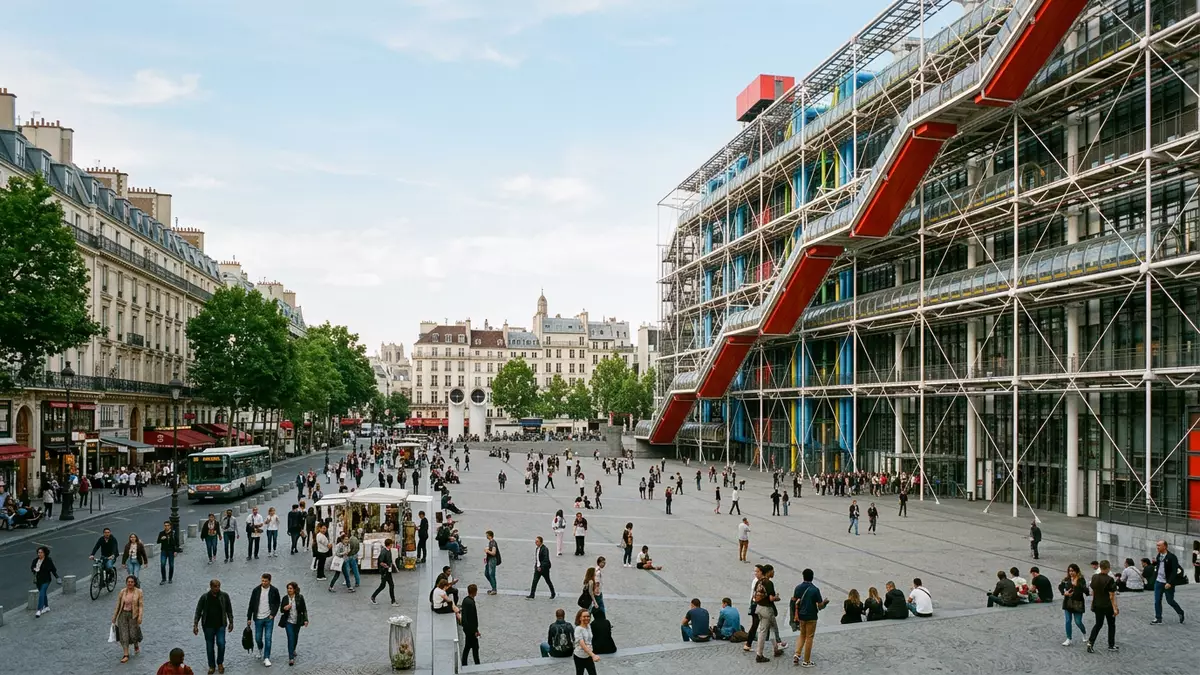
Centre Pompidou in Paris is a cultural complex that turns architecture inside out, exposing its colourful services and steel structure to the city while housing one of Europe’s major collections of modern and contemporary art. Opened on 31 January 1977 and named after French president Georges Pompidou, it anchors the Beaubourg district with a building that looks and works like a vast cultural machine.
An inside?out landmark in Beaubourg
Centre Pompidou stands in the Beaubourg area of the 4th arrondissement, its long glass and metal volume set among the dense streets of central Paris and facing a broad piazza that acts as an open forecourt. The main structure is a large rectangle of steel and glass raised above the ground on a visible framework, with reinforced concrete floors spanning between deep trusses.The building was completed between 1971 and 1977, following an international competition held in 1971.
The architects Renzo Piano, Richard Rogers and Gianfranco Franchini gave the building a visible exoskeleton, concentrating stairways, lifts and circulation along the street side in external escalators running within a glazed gallery.The structure extends across ten levels, with long floor plates that create open interiors for exhibitions, a library and performance spaces. Services are expressed on the exterior in bright primary colours, giving the façade its distinctive bands of ducts and pipes against the pale steel frame.
Architecture, layout and uses
Centre Pompidou functions as a combined museum, public library and performance venue, organised on stacked levels that share a common structural grid. The Musée National d’Art Moderne occupies large areas of the upper floors, presenting modern and contemporary art from the early twentieth century onward in spaces that can be reconfigured thanks to the clear spans of the structural system.The museum’s collection runs to well over one hundred thousand works, giving the institution a central role in documenting major artistic movements of the twentieth and twenty?first centuries.
Below the galleries sits the Bibliothèque publique d’information, a large public reading library occupying a significant part of the building’s floor area and drawing readers into its open plan spaces.Dedicated areas are set aside for temporary exhibitions, cinema halls, a performance theatre and conference rooms, all served by the same exposed structural and service framework. The complex also houses IRCAM, a centre for music and acoustic research that extends partly underground on the neighbouring site.
Modern art in the heart of Paris
Centre Pompidou’s museum holds major works that trace the story of modern and contemporary art from the early 1900s onward, including key examples of fauvism, German expressionism and Russian avant?garde painting.The visual arts collection begins around 1905 and extends through movements such as cubism, surrealism, abstract art and post?war experiments, making the museum a reference point for twentieth?century art history.
Alongside painting and sculpture, the Centre Pompidou collection encompasses photography, design, architecture and new media works, reflecting the breadth of creative practice over the last century.The institution also maintains partnerships and research programmes that highlight under?represented artists, integrating archival initiatives into the museum’s holdings. With its museum, research library and performance spaces under one roof, the complex offers visitors a dense cross?section of cultural activity framed by its steel structure and external escalators.
Visiting Centre Pompidou: what travellers from Western Europe should know
- Centre Pompidou stands in the Beaubourg district of the 4th arrondissement of Paris, close to landmarks such as the Hôtel de Ville and the historic streets of the Marais. It is reached by metro services to nearby stations including Rambuteau and Hôtel de Ville, and lies within walking distance of the Seine.
- The site is largely level at street height, with a broad paved piazza in front of the building. Access to the upper floors involves escalators and stairways inside the glazed external gallery, while interior routes between museum spaces follow long, open floor plates.
- Paris is in France, where the official language is French and the currency is the euro.
- Centre Pompidou sits among narrow streets and historic blocks, so approaching on foot gives a clear sense of how the exposed steel frame contrasts with the older masonry buildings around it.
Searching for Centre Pompidou on social platforms
These links open searches for Centre Pompidou on each platform.
Frequently asked questions about Centre Pompidou
Where is Centre Pompidou located in Paris?
Centre Pompidou stands in the Beaubourg area of the 4th arrondissement of Paris, near the Hôtel de Ville and within walking distance of the Seine.
What can visitors expect inside Centre Pompidou?
Visitors encounter a major modern and contemporary art museum, a large public library, cinemas, performance spaces and research facilities housed within an open?plan steel and glass structure.
What makes Centre Pompidou distinctive among Paris museums?
Its inside?out architecture, with exposed services and external escalators, combined with its extensive modern art collection and public library under one roof, gives it a distinctive presence.


