
Centro Historico de Cuenca, an Andean grid of rivers and plazas
Published on 09/07/2026 at 12:46 | Editorial responsibility: Rafael Müller, Editor-in-Chief AD HOC NEWS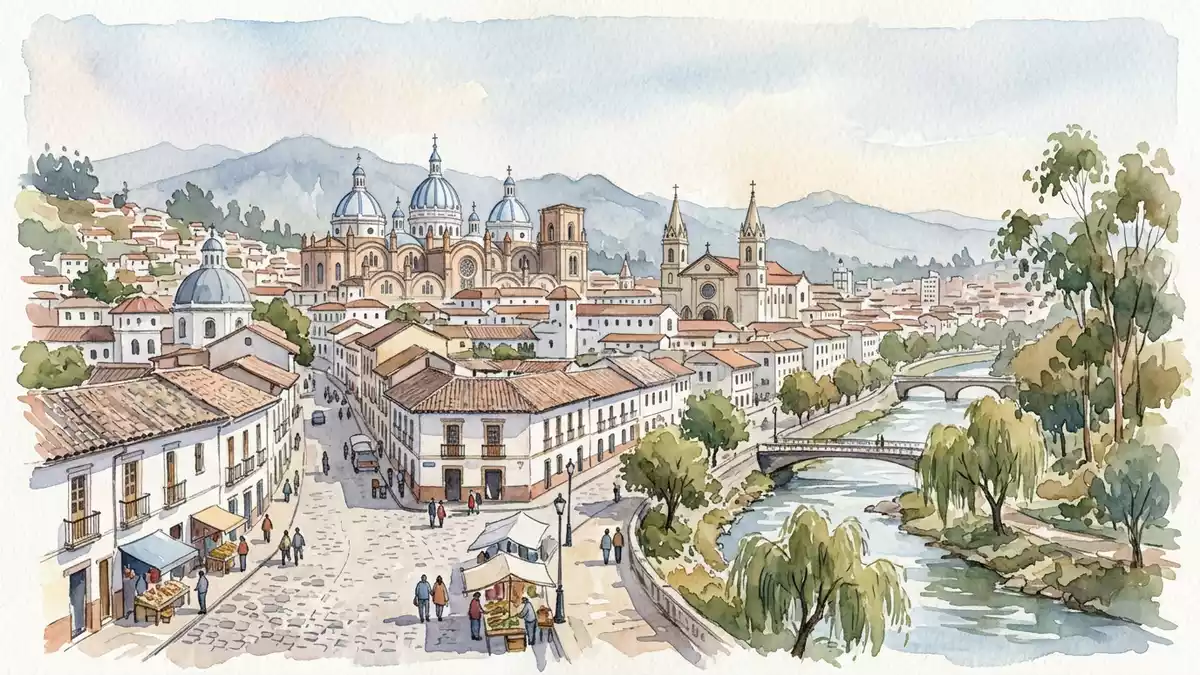
Centro Historico de Cuenca is the historic core of Santa Ana de los Ríos de Cuenca, a planned Andean city whose streets, churches and houses unfold across a highland plateau framed by several rivers. Set in Azuay province in southern Ecuador, this compact urban fabric reflects Spanish colonial town planning from the sixteenth century layered onto an older Andean landscape. Recognised as a cultural World Heritage site since 1999, it gathers centuries of architecture and everyday life into a walkable grid of plazas and low-rise facades.
An Andean plateau crossed by rivers
The historic centre of Cuenca lies on a plateau in the southern highlands of Ecuador, where the urban grid meets the edges of an Andean valley crossed by rivers such as the Río Tomebamba. The area recognised as the Historic Centre of Santa Ana de los Ríos de Cuenca covers more than 200 hectares, corresponding to the territory occupied by the town until the first half of the twentieth century.Historic Centre of Santa Ana de los Ríos de Cuenca Within this plateau, straight streets intersect to form regular blocks, descending gently towards the river terraces where masonry walls and gardens mark the transition from city to valley.
Along the southern edge of Centro Historico de Cuenca the ground falls towards the Río Tomebamba, creating a distinctive riverside strip known as El Barranco. Here, houses line the brink of the escarpment with rear terraces overlooking the water, while paths follow the riverbank below. The wider valley is irrigated by several rivers, including the Yanuncay, Tarqui and Machángara, which together frame the historic core.highland plateau crossed by rivers such as the Tomebamba
A planned colonial grid and layered heritage
Cuenca was founded as Santa Ana de los Ríos de Cuenca on 12 April 1557, when Spanish authorities established a new inland town in the highlands.Santa Ana de los Ríos de Cuenca founded on 12 April 1557 The historic centre preserves the Renaissance-inspired grid laid out at that time, with streets aligned to form rectangular blocks and central squares, a pattern that has remained largely intact since the sixteenth century.preservation of the original street grid since its foundation This planned layout reflects principles of Spanish colonial urban design applied in the Andes, where geometry and orientation shaped the town’s early growth.
The area now known as Centro Historico de Cuenca has long been recognised for its concentration of heritage buildings, archaeological remains and cultural practices. In March 1982, the historic centre and its historic areas were declared “Patrimonio Cultural del Ecuador”, acknowledging hundreds of patrimonial structures and their role in local identity.declared national cultural heritage of Ecuador in 1982 On 1 December 1999, UNESCO inscribed the Historic Centre of Santa Ana de los Ríos de Cuenca as a cultural World Heritage site for its well-preserved urban fabric and the fusion of Spanish, Cañari and Inca cultural elements within the city.UNESCO inscribed the Historic Centre on 1 December 1999
Streets, plazas and churches in the historic core
Centro Historico de Cuenca centres on Parque Calderón, the main square of the city, and extends across many blocks of streets lined with houses, shops and civic buildings. Within this area stand churches and religious complexes from different periods, their towers and domes rising above the otherwise low rooflines. The ensemble includes colonial and republican architecture, with masonry walls, timber balconies and internal courtyards forming a varied streetscape.more than 200 heritage buildings in diverse styles
The streets that define Centro Historico de Cuenca include axes such as Bolívar, Sucre and Hermano Miguel, among others that cross the grid and connect neighbourhood squares with markets and riverfront walks.streets that form the historic centre Many buildings present narrow frontages that open into deeper plots, where patios with galleries provide light and circulation. Civic structures, including municipal buildings and cultural institutions, occupy prominent corners and squares, underscoring the role of the centre as the administrative and ceremonial heart of Cuenca.
Visiting Centro Historico de Cuenca: what travellers from Western Europe should know
- Centro Historico de Cuenca lies in the city of Cuenca in Azuay province, southern Ecuador, on a highland plateau in the Andes that is reached by road connections and flights through regional airports.
- Walking the historic centre involves paved streets and pavements, with some gradients between the plateau and the river terraces and stairways linking El Barranco with the lower paths beside the Río Tomebamba.
- The official language is Spanish and the currency is the US dollar.
- Entry requirements depend on your nationality; UK travellers can check the FCDO travel advice at gov.uk/foreign-travel-advice, Irish travellers the Department of Foreign Affairs at ireland.ie.
Searching for Centro Historico de Cuenca on social platforms
These links open searches for Centro Historico de Cuenca on each platform.
Frequently asked questions about Centro Historico de Cuenca
Where is Centro Historico de Cuenca located?
Centro Historico de Cuenca is the historic centre of the city of Cuenca in Azuay province, southern Ecuador, on a highland plateau in the Andes crossed by several rivers.
What should visitors expect when walking through the historic centre?
Visitors encounter a planned grid of streets, plazas such as Parque Calderón, houses and civic buildings in colonial and republican styles, with views towards the Río Tomebamba and other rivers.
What makes Centro Historico de Cuenca distinctive among Andean cities?
Its preserved sixteenth-century street grid, recognition as national heritage in 1982 and UNESCO inscription in 1999 together highlight a dense concentration of patrimonial buildings and a layered fusion of Andean and Spanish colonial urban forms.


