
Centro Historico de Ouro Preto and its baroque hills
Published on 08/14/2026 at 14:41 | Editorial responsibility: Rafael Müller, Editor-in-Chief AD HOC NEWS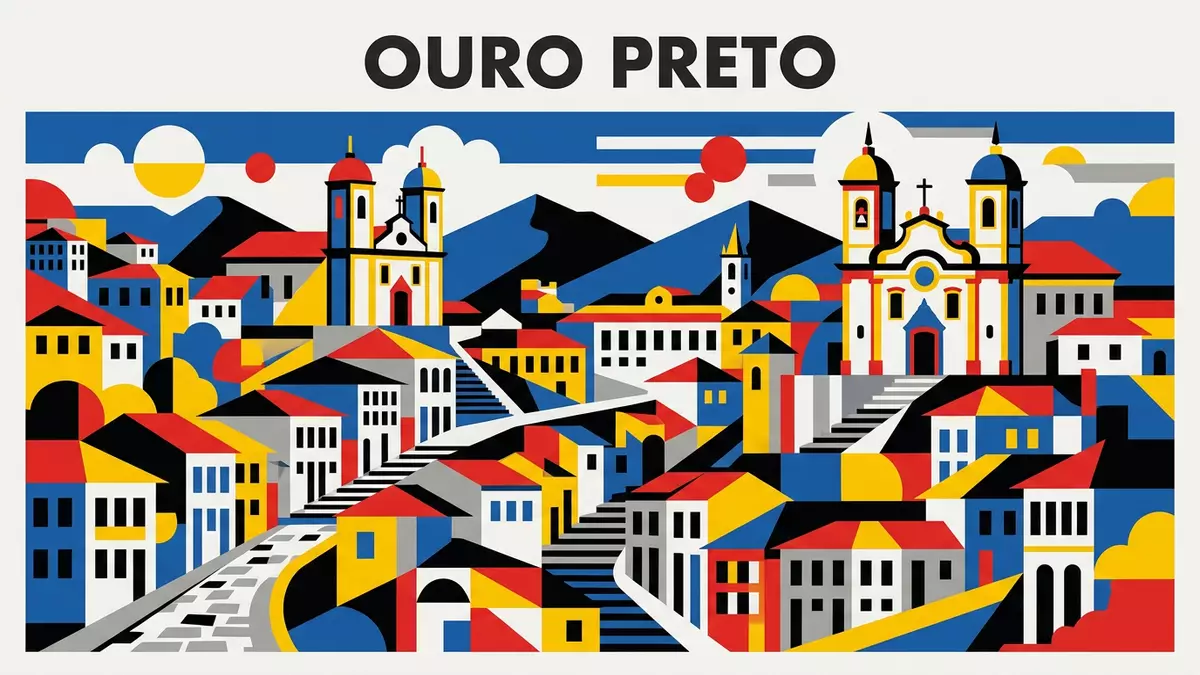
Centro Historico de Ouro Preto, the historic core of Ouro Preto in Brazil’s Minas Gerais, unfolds across steep hills where colonial streets climb past baroque churches and tiled houses. Founded in the early eighteenth century during the gold boom, the town’s historic centre preserves a dense ensemble of religious and civic buildings from the period of Portuguese rule.
Baroque hills shaped by the gold rush
Ouro Preto’s historic centre grew out of scattered mining settlements that were consolidated as a town in 1711, when the area emerged as a focus of Brazil’s gold rush under Portuguese colonial administration.the city’s historical origins The town occupies the slopes of a narrow valley in the Serra do Espinhaço, with streets that loop and bend along the contours rather than following a rigid grid.the steep slopes of the historic urban area Standing at one of the higher vantage points, the pattern of terracotta roofs stepping down to church towers and small squares gives Centro Historico de Ouro Preto a layered profile against the surrounding mountains.
In the eighteenth century Ouro Preto served as the capital of Minas Gerais, reflecting the importance of gold extraction in this inland state of south-eastern Brazil.its role as a provincial capital Public buildings from that era, including former governor’s residences and administrative structures, still line key squares in the centre, many with stone façades and classical details that contrast with the simpler whitewashed houses on the side streets.the ensemble of public buildings and houses
Baroque churches and colonial streets
The dominant architectural language in Centro Historico de Ouro Preto is Brazilian baroque, visible above all in the churches that punctuate the skyline and anchor neighbourhoods.baroque churches and colonial mansions Major religious buildings such as the Church of Nossa Senhora do Pilar and the Church of São Francisco de Assis display ornate façades, sculpted stonework and richly decorated interiors, forming focal points at the ends of cobbled streets.principal monuments of the historic centre Many of these churches are associated with the sculptor and architect Antônio Francisco Lisboa, known as Aleijadinho, whose work in stone and wood helped define the town’s baroque character.Aleijadinho’s contributions
Between the churches, narrow streets paved with irregular stones curve around hillside terraces, flanked by houses with white façades, wooden balconies and brightly painted doors. Courtyards and small gardens appear behind gates, while fountains and modest chapels mark corners and junctions. The historic centre’s layout, with its winding roads, squares and bridges, has been recognised as a coherent urban ensemble that illustrates the evolution of a gold-mining town during the eighteenth century.the integrated urban landscape
Heritage status and museums
Centro Historico de Ouro Preto holds a prominent place in Brazil’s heritage protection. Ouro Preto was declared a national monument in the 1930s, reflecting the value of its architectural and urban fabric, and in 1980 its historic town became the first Brazilian cultural property inscribed on the UNESCO World Heritage List.national monument status and UNESCO inscription UNESCO’s listing emphasises not only individual buildings but also the way streets, squares and structures together convey the scale and ambition of the eighteenth-century gold economy.criteria for the Historic Town of Ouro Preto
Several museums within Centro Historico de Ouro Preto deepen the picture of colonial life and Brazil’s path toward independence. The former colonial penitentiary houses the Museum of the Inconfidência, dedicated to movements in Minas Gerais that challenged Portuguese rule, while the old governor’s palace contains a mining school and collections of minerals drawn from the region.the Museum of the Inconfidência and mining school Elsewhere in the centre, a historic theatre dating from the nineteenth century stands among later houses, offering a rare example of a colonial-era performance space preserved within a small hill town.the colonial theatre
Visiting Centro Historico de Ouro Preto: what travellers from Western Europe should know
- Centro Historico de Ouro Preto lies in the city of Ouro Preto in the state of Minas Gerais, inland in south-eastern Brazil, and is reached by road from regional hubs such as Belo Horizonte.its location in Minas Gerais The historic centre itself is an urban district of streets and squares rather than a single enclosed site.
- The terrain in the centre is markedly steep, with cobbled streets, stairways and changes of level that can make walking demanding for some visitors.the town’s elevation and slopes Many routes between churches and viewpoints involve extended uphill or downhill sections.
- Several of the principal churches and museums sit at higher points within the town, so reaching them involves climbing streets or staircases from the main square areas. Streets are often narrow, and vehicle access through the historic centre can be constrained by the layout.
- The official language is Portuguese and the currency is the Brazilian real.
- Entry requirements depend on your nationality; UK travellers can check the FCDO travel advice at gov.uk/foreign-travel-advice, Irish travellers the Department of Foreign Affairs at ireland.ie.
Searching for Centro Historico de Ouro Preto on social platforms
These links open searches for Centro Historico de Ouro Preto on each platform.
Frequently asked questions about Centro Historico de Ouro Preto
Where is Centro Historico de Ouro Preto?
Centro Historico de Ouro Preto is the historic centre of the city of Ouro Preto in the state of Minas Gerais, in south-eastern Brazil, set among the Serra do Espinhaço mountains.
What should visitors expect on a visit?
Visitors encounter steep cobbled streets, baroque churches with elaborate façades, colonial houses and several museums in an urban landscape shaped during the eighteenth-century gold rush.
What makes Centro Historico de Ouro Preto distinctive?
The area combines Brazilian baroque religious architecture, a hillside town plan adapted to mining-era terrain and a long-standing heritage status as Brazil’s first cultural property inscribed on the UNESCO World Heritage List.


