
Centro Historico del Cusco and its layered Andean cityscape
Published on 08/24/2026 at 21:50 | Editorial responsibility: Rafael Müller, Editor-in-Chief AD HOC NEWS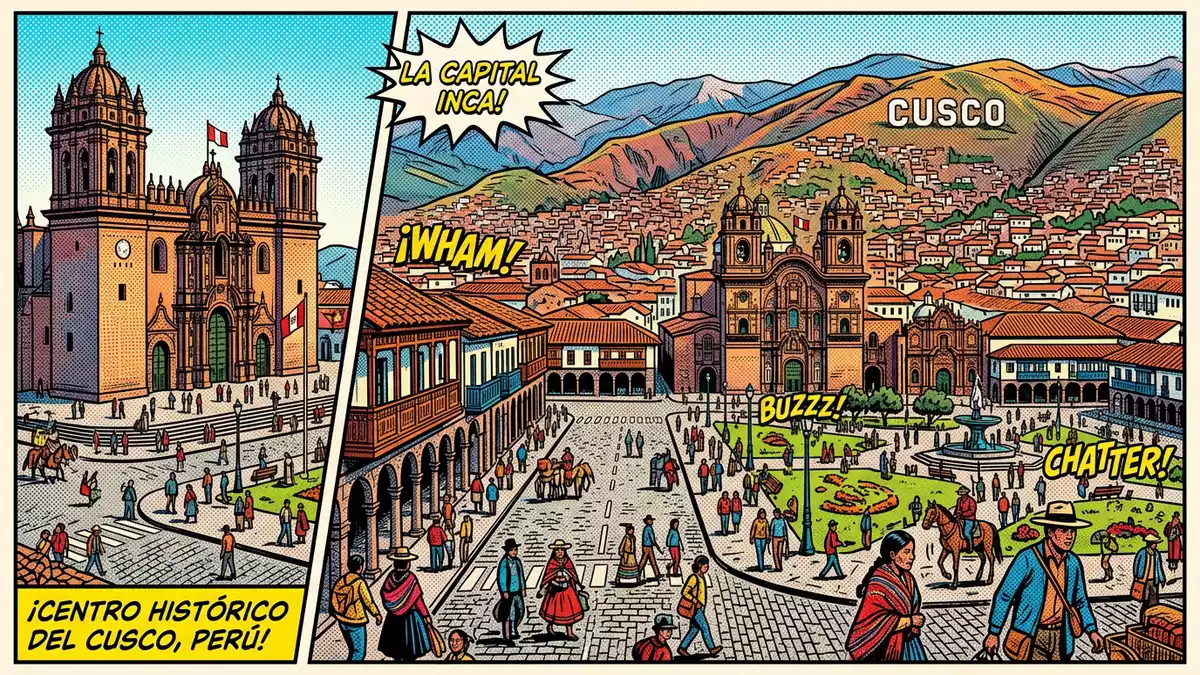
Centro Historico del Cusco is the historic centre of Cusco in the southern highlands of Peru, where finely worked Inca stone and Spanish colonial façades stand together around a dense network of plazas and streets. At more than 3,000 m (9,800 ft) above sea level in the Peruvian Andes, this compact district reflects the city’s long role as capital of the Inca Empire and later as a major colonial centre under Spain.
From Inca imperial capital to colonial city grid
The historic centre occupies the core of Cusco’s old urban basin and closely follows the layout established when the city was the political and ceremonial heart of the Inca Empire. The Historic Centre of Cusco is recognised as a World Heritage Site, reflecting the way Inca foundations and colonial structures share the same blocks and squares.Historic Centre of Cusco Inca rulers in the fifteenth century developed Cusco as a planned capital, with palaces aligned along principal streets and a great central square where processions and rituals took place.capital of the Inca Empire
After Spanish forces took Cusco in the sixteenth century, new rulers imposed a colonial urban order on the existing Inca city. They reused and adapted many Inca walls and platforms, raising churches and mansions on top of finely cut stone bases, and consolidated Cusco as an administrative and religious centre for the surrounding Andean region.churches and mansions on Inca bases The result is a layered cityscape where the lower courses of buildings often date from the Inca period while upper levels, balconies and façades belong to Spanish colonial architecture.
Plaza de Armas and the stone heart of Cusco
At the centre of Centro Historico del Cusco lies Plaza de Armas, the city’s main square and a space that has served as public heart since before the Spanish foundation in 1534.Plaza de Armas del Cusco In Inca times this area formed part of a much larger ceremonial square known as Huacaypata or Aucaypata, a gathering place for imperial rituals and celebrations associated with the Tahuantinsuyo road system radiating from the city.heart of the capital of the Inca Empire
Geological and historical studies describe how the original swampy ground crossed by the Saphy River was drained and shaped into an urban square before being transformed again under Spanish rule.swamp crossed by the Saphy River Around Plaza de Armas stand major religious and civic buildings, including the Cathedral Basilica of the Assumption of the Virgin, built from the mid-sixteenth century on the site of an Inca temple using stones taken from nearby Inca structures.Cathedral Basilica of the Assumption of the Virgin The square has also been a stage for dramatic historical events, including the execution of Tupac Amaru II in 1781, which gave it a lasting symbolic role in Peruvian history.execution of Tupac Amaru II in 1781
Streets, stonework and altitude in the historic centre
Beyond Plaza de Armas, Centro Historico del Cusco is characterised by narrow streets paved in stone, lined with buildings whose lower courses often consist of precise Inca masonry and whose upper storeys carry Spanish-era balconies in carved wood or plaster. Many lanes rise steeply towards surrounding slopes, reflecting the basin-like topography of the city and its Andean setting. The historic centre stands at an elevation of roughly 3,400 m (11,150 ft), giving its streets and squares an unmistakable high-altitude character.Centro Histórico de Cusco elevation
International recognition of the area’s architectural and historical value came in the twentieth century, when the historic centre was placed on the UNESCO World Heritage List, emphasising the coexistence of pre-Columbian and colonial elements within a living Andean city.historic center on the World Heritage List Stone façades, arcaded walkways and courtyards are interspersed with more recent urban fabric, but the presence of Inca stonework at street level remains one of the most distinctive features of Centro Historico del Cusco and shapes the visual impression of almost every block.
Visiting Centro Historico del Cusco: what travellers from Western Europe should know
- Centro Historico del Cusco occupies the central part of Cusco, a city in the southern Peruvian Andes, and is reached by road links from the wider urban area and from Alejandro Velasco Astete International Airport.
- The historic centre lies at around 3,400 m (11,150 ft) above sea level, and many streets climb steeply, with stone paving and stairways on the surrounding slopes.
- Plaza de Armas sits within Centro Historico del Cusco and forms a natural reference point, with major streets radiating from the square towards other parts of the city.
- Spanish and Quechua are official languages in Peru, and the national currency is the Peruvian sol.
- Entry requirements depend on your nationality; UK travellers can check the FCDO travel advice at gov.uk/foreign-travel-advice, Irish travellers the Department of Foreign Affairs at ireland.ie.
Searching for Centro Historico del Cusco on social platforms
These links open searches for Centro Historico del Cusco on each platform.
Frequently asked questions about Centro Historico del Cusco
Where is Centro Historico del Cusco located?
Centro Historico del Cusco occupies the historic centre of Cusco, a city in the southern Peruvian Andes, and forms the core of its urban basin.
What can visitors expect when walking through the historic centre?
Visitors encounter stone-paved streets, Inca masonry at ground level, Spanish colonial churches and mansions, and plazas such as Plaza de Armas that structure the neighbourhood.
What makes Centro Historico del Cusco distinctive among Andean cities?
The coexistence of Inca foundations, colonial architecture and high-altitude urban geography within a UNESCO-listed historic centre makes Centro Historico del Cusco distinctive.


