
Centrul Istoric Sibiu and its squares of layered history
Published on 09/23/2026 at 22:24 | Editorial responsibility: Rafael Müller, Editor-in-Chief AD HOC NEWS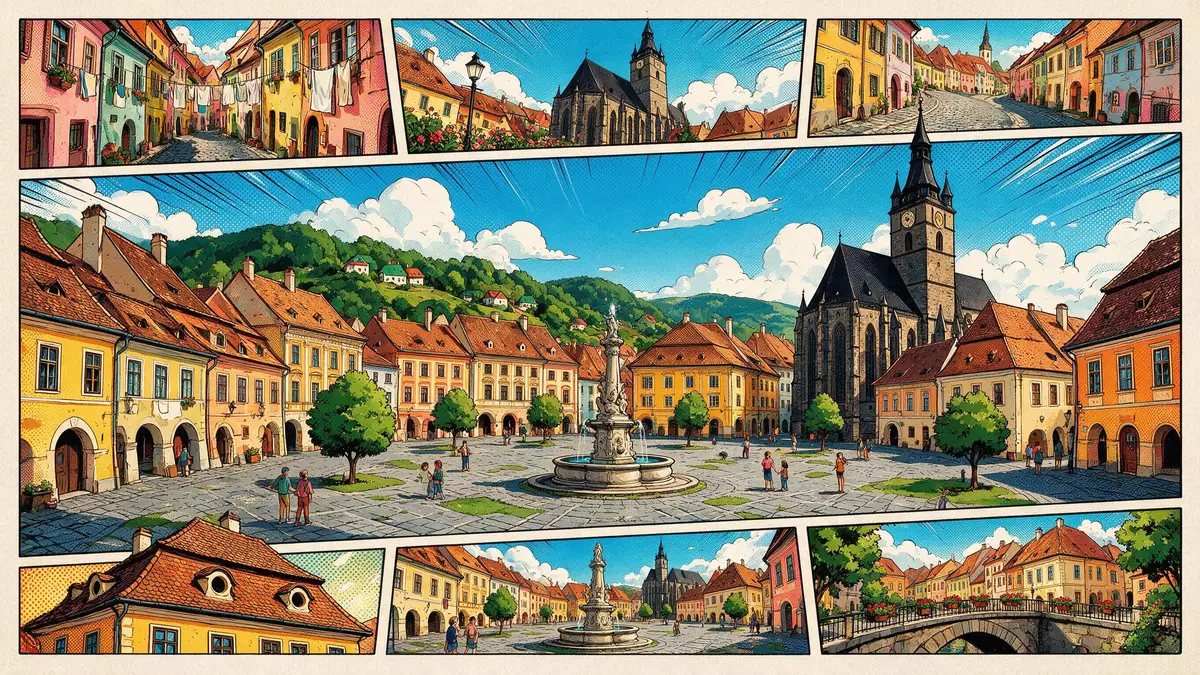
Centrul Istoric Sibiu brings three connected squares, steep streets and historic façades into a compact urban landscape. The district is shaped by the relationship between Pia?a Mare, Pia?a Mic? and Huet Square, with towers and passages linking their different scales. Sibiu’s historic core grew from a medieval Transylvanian town into a centre of civic, religious and cultural life.
Centrul Istoric Sibiu: three squares, one urban composition
Pia?a Mare is the broadest space in the historic centre. Its existence reaches back to 1366, when the city’s third fortification belt was completed, and documents mention it as a cereal market in 1411. The square became the principal civic space of the old town, bordered by buildings from several periods.
The Large Square history remains visible in its surrounding architecture. The Brukenthal Palace occupies a prominent side, while the Roman Catholic church, the Council Tower and former guild buildings mark other edges. Roof windows, portals, façades and heraldic details create a close visual relationship between the square and the houses around it.
From medieval market town to Baroque Sibiu
Sibiu developed from the settlement associated with Transylvanian Saxon communities during the medieval period. Its historic centre preserves the urban pattern of a fortified town, including defensive walls, towers, narrow streets and passages between the Upper Town and Lower Town.
The Council Tower occupies the link between Pia?a Mare and Pia?a Mic?. Its earliest history reaches into the thirteenth century, and the tower has served as a gate tower, lookout, jail, granary, museum and viewing point. The nearby Council Tower and city landmarks show how civic buildings and fortifications share the centre.
Pia?a Mic? has a more enclosed character, with arcaded buildings and routes leading towards the Bridge of Lies. The cast-iron bridge was made in 1859 and connects the upper and lower parts of the historic centre. Its name is linked to German wording and later translation, while the structure itself remains a clear nineteenth-century object within the medieval street pattern.
Churches, collections and historic façades
Huet Square is dominated by the Evangelical Cathedral, whose construction began in 1320 on the site of a Romanesque basilica. The Gothic church developed through several building stages, and its tower rises above the surrounding roofs as one of Sibiu’s most recognisable urban markers.
The square also contains the former parsonage, the school associated with the Transylvanian Saxon community and streets leading towards the fortification remains. The Evangelical Cathedral’s architecture adds a vertical counterpoint to the lower façades and enclosed passages elsewhere in Centrul Istoric Sibiu.
Baroque architecture appears prominently in the Brukenthal Palace. Samuel von Brukenthal, Governor of Transylvania from 1777 to 1787, had the palace built between 1778 and 1788. The building houses collections associated with the Brukenthal National Museum, whose history began with the opening of a museum in 1817.
Other layers include the Roman Catholic church in Pia?a Mare, the Orthodox cathedral on Strada Mitropoliei and the Grand Synagogue on Strada Constitu?iei. Together with guild houses, museums and residential buildings, they record the religious and civic variety of Sibiu’s historic centre.
Visiting Centrul Istoric Sibiu: what travellers from Western Europe should know
- Sibiu lies in central Romania, and Centrul Istoric Sibiu occupies the city centre. Sibiu International Airport is west of the city, while railway connections serve Sibiu station.
- The route between Lower Town and Upper Town includes steep streets, stairways and passages. The Bridge of Lies links Pia?a Mic? with the lower streets.
- The main historic spaces are Pia?a Mare, Pia?a Mic? and Huet Square. The Council Tower stands between the first two, while the Evangelical Cathedral faces Huet Square.
- The official language is Romanian and the currency is the Romanian leu.
Searching for Centrul Istoric Sibiu on social platforms
These links open searches for Centrul Istoric Sibiu on each platform.
Frequently asked questions about Centrul Istoric Sibiu
Where is Centrul Istoric Sibiu?
It occupies the historic centre of Sibiu in central Romania. The district includes the Upper Town, Lower Town, connected squares and surviving fortification elements.
What can visitors expect in the historic centre?
Visitors encounter squares, Gothic and Baroque buildings, steep streets, stairways, museums, churches and passages. Pia?a Mare, Pia?a Mic? and Huet Square provide the principal landmarks.
What makes Centrul Istoric Sibiu distinctive?
Its character comes from the close arrangement of three historic squares and the layers of medieval, Gothic, Renaissance, Baroque and nineteenth-century architecture. The Council Tower and Bridge of Lies connect these periods within the same urban setting.


