
Chan Chan and the adobe city of Trujillo
Published on 08/22/2026 at 21:27 | Editorial responsibility: Rafael Müller, Editor-in-Chief AD HOC NEWS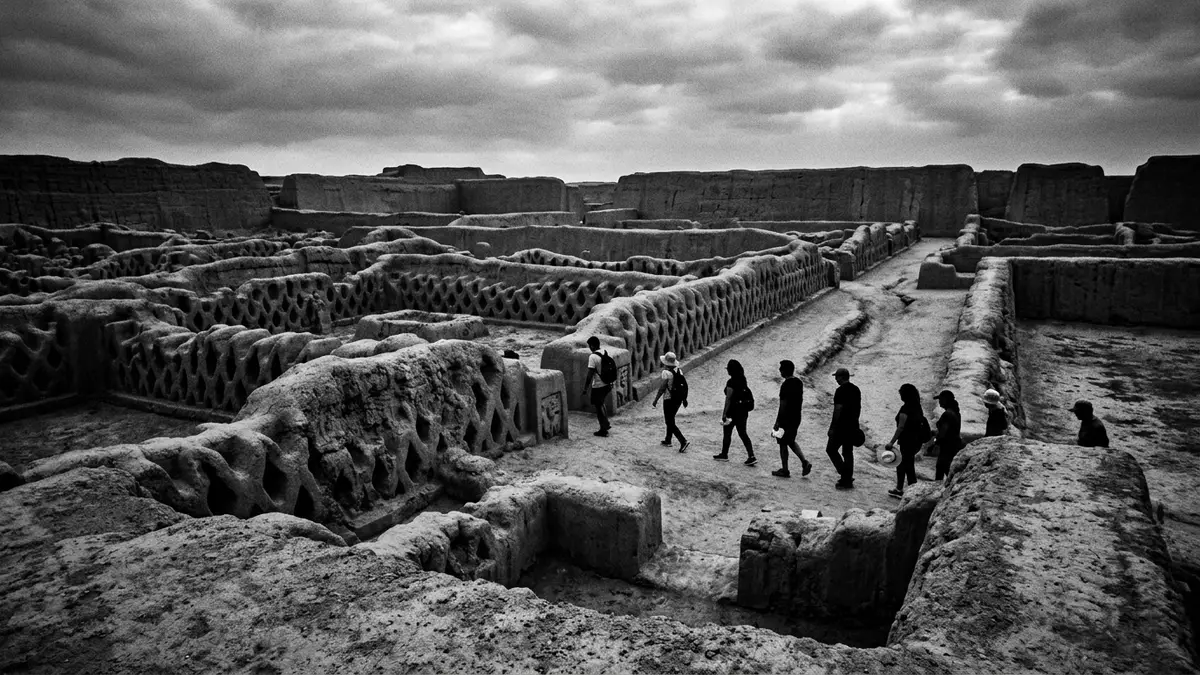
Chan Chan near Trujillo is an adobe city of walls, courtyards and enclosed compounds, set in the Moche valley on Peru’s northern coast. It was the capital of the Chimú kingdom and was inscribed as a World Heritage Site in 1986.
Chan Chan’s walled citadels
The clearest feature on site is its system of large enclosed compounds, laid out as separate units within the wider city. UNESCO describes nine such citadels or palaces, while Britannica notes the broader centre of the city as a cluster of walled quadrangles.nine citadels walled citadels
These compounds contain spaces for temples, storehouses, dwellings and burial platforms, all built in adobe brick and finished with mud. Their walls carry relief decoration with abstract, vegetal and animal motifs, which gives the ruins a strong visual character even in fragmentary form.funeral platforms
Chimú power in the fifteenth century
Chan Chan belonged to the Chimú world, and the Chimú Kingdom reached its apogee in the fifteenth century before falling to the Incas. Britannica places the capital of that kingdom in the Moche valley, between the Pacific Ocean and Trujillo, and describes the city as the largest in pre-Columbian America.fifteenth century Moche valley
The city’s scale is part of its appeal. UNESCO says the monumental zone at the centre covers around six square kilometres, within a once much larger urban area, and the remaining fabric still conveys the layout of a planned capital. The result is a landscape of long walls, rectilinear enclosures and open courts rather than a single monument.monumental zone
Adobe, decoration and surviving fabric
Chan Chan is valuable not only for its plan but also for its material. The city was made in earth, with adobe brick walls and mud surfaces, and much of what survives depends on that same fragile medium. Britannica notes that the surfaces were frequently decorated with patterned reliefs, and UNESCO records friezes with abstract, anthropomorphic and zoomorphic subjects.adobe brick abstract motifs
The surviving city also preserves traces of water management and productive activity. UNESCO mentions reservoirs, agricultural areas and a remnant irrigation system, while Britannica links the Chimú economy to irrigation in the dry coastal zone. That combination of urban form, decoration and infrastructure gives Chan Chan its particular historical depth.irrigation system
Visiting Chan Chan: what travellers from Western Europe should know
- The site lies between the Pacific Ocean and Trujillo, in Peru’s La Libertad region. Access is by road from the city; the wider setting is the Moche valley.between the Pacific Ocean
- The ruins are built of adobe and mud. That material gives the walls a raw, eroded surface and means much of the plan is read through outlines, enclosures and relief fragments.mud surfaces
- The core remains are organised into enclosed compounds with high earthen walls. This makes the city legible as a sequence of separable precincts rather than a single continuous block.high thick earthen walls
- English is not an official language in Peru, and the currency is the Peruvian sol.
Searching for Chan Chan on social platforms
These links open searches for Chan Chan on each platform.
Frequently asked questions about Chan Chan
Where is Chan Chan?
Chan Chan lies on Peru’s northern coast near Trujillo, in the Moche valley between the city and the Pacific Ocean. It forms part of the archaeological landscape of La Libertad.
What does a visit involve?
A visit means walking through adobe ruins, walled compounds and decorated surfaces spread across a broad archaeological zone. The plan is easiest to read by moving from wall to wall, rather than expecting a single intact monument.
What makes Chan Chan distinctive?
Its distinction lies in the combination of scale, adobe construction and planned enclosure. The surviving city is tied to the Chimú kingdom and preserves the form of a capital built in earth.


