
Chateau de Versailles and its axis of palace, gardens and power
Published on 09/22/2026 at 07:16 | Editorial responsibility: Rafael Müller, Editor-in-Chief AD HOC NEWS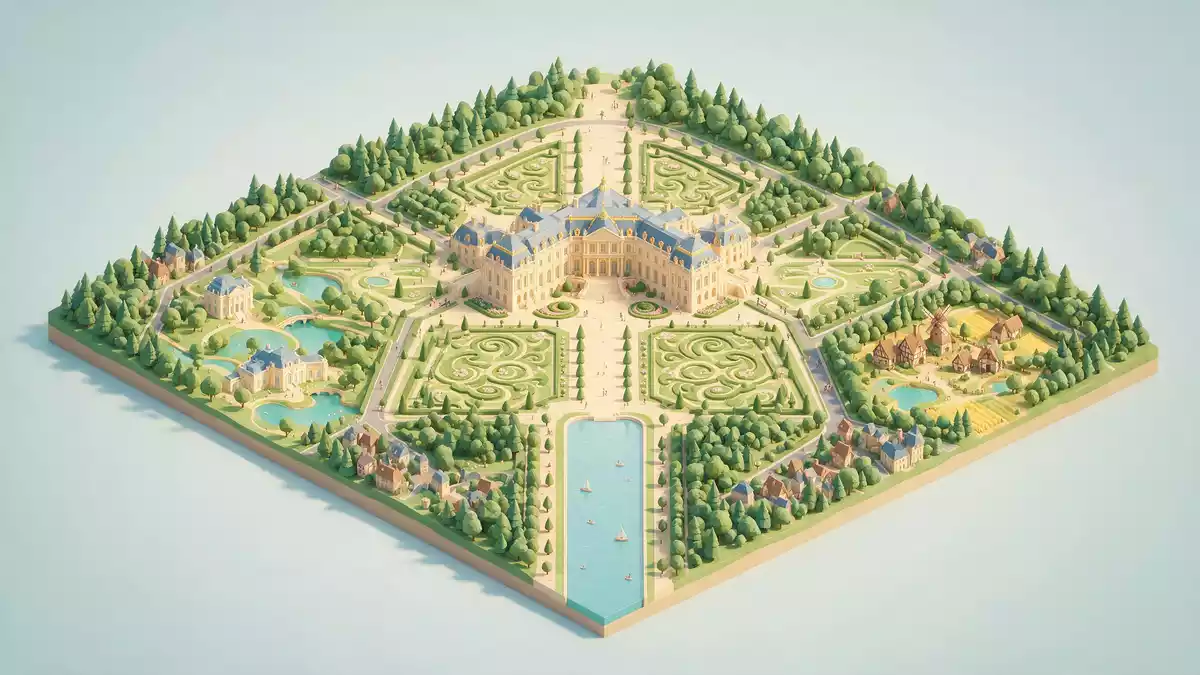
Chateau de Versailles extends from a palace of stone and decoration into formal gardens arranged along a long central axis. In Versailles, west of Paris, the buildings, parterres, groves and Grand Canal form a continuous royal composition. Louis XIV transformed his father’s hunting lodge into the principal residence of the French court, and the ensemble remains a place where architecture and landscape can be read together.
Louis XIV turns a hunting lodge into a royal residence
Louis XIII established the first small hunting lodge at Versailles in the early seventeenth century. Construction of a rebuilt château continued from 1631 to 1634, creating the basis for the palace associated with the Bourbon monarchy.
Louis XIV began major works in 1661. Louis Le Vau enlarged the building, while Jules Hardouin-Mansart directed later extensions, including the South Wing, North Wing and Royal Chapel. From 1682, Versailles became the main residence of the French court and government, linking royal apartments, administration and ceremonial rooms in one vast complex.
The palace served Louis XIV, Louis XV and Louis XVI. Its history includes court ceremony, diplomatic receptions and political events, including the departure of the royal family on 6 October 1789. After the Revolution, the royal residence lost its former function and became a museum in the nineteenth century.
The Hall of Mirrors and the language of French classicism
The Hall of Mirrors occupies the western side of the palace, facing the gardens. Mirrors line one side, while windows open towards the formal landscape on the other. The room belongs to the great decorative programme associated with Louis XIV and the artists working under Charles Le Brun.
The interior combines marble, gilded ornament, painted ceilings and repeated architectural divisions. The scale changes from intimate apartments to ceremonial galleries, the Royal Chapel and the Royal Opera House. UNESCO World Heritage ensemble includes the palace, the Trianon châteaux and the surrounding gardens and park.
Versailles is associated with French classicism, but its rooms also record changing styles. Louis XV introduced more private interiors, while the Petit Trianon belongs to the architecture of the Louis XV period. Marie-Antoinette’s domain at the Petit Trianon and the Hameau add smaller buildings and domestic settings to the formal palace complex.
André Le Nôtre’s gardens continue the palace outdoors
André Le Nôtre laid out the principal gardens during the reign of Louis XIV. Straight avenues, clipped hedges, ornamental parterres, fountains and groves extend westwards from the palace. The Grand Canal continues the principal perspective into the park.
The gardens use geometry as a visible organising language. Low planting keeps long views open, while groves create enclosed rooms within the larger plan. Water basins, sculptures and fountains mark the routes through the formal landscape. The history of Versailles reaches from Louis XIII’s lodge through Louis XIV’s building campaigns, the court of Louis XV and Louis XVI, revolutionary change and the museum created under Louis-Philippe.
The park covers hundreds of hectares, with formal gardens close to the palace and wider wooded areas beyond. The estate also contains the Grand Trianon, the Petit Trianon, the Orangerie and the Grand Canal. Together, these elements show how a royal residence could extend across buildings, planting, water and open ground.
Visiting Chateau de Versailles: what travellers from Western Europe should know
- Chateau de Versailles stands at Place d’Armes in Versailles, south-west of Paris. RER line C reaches Versailles Château–Rive Gauche station, followed by a walk towards the palace.
- The estate covers palace interiors, formal gardens, the park and the Trianon domain. A visit involves extensive outdoor ground, long avenues and large changes between enclosed rooms and open landscape.
- The official language is French and the currency is the euro.
- Versailles lies in the Île-de-France region. The nearby city contains the palace forecourt, the station and streets leading towards the estate.
Searching for Chateau de Versailles on social platforms
These links open searches for Chateau de Versailles on each platform.Frequently asked questions about Chateau de Versailles
Where is Chateau de Versailles?
Chateau de Versailles is in Versailles, in the Île-de-France region south-west of Paris. The palace address is Place d’Armes, near Versailles Château–Rive Gauche station.
What does a visit to Chateau de Versailles include?
The estate brings together palace rooms, the Hall of Mirrors, formal gardens, the park and the Trianon domain. The grounds include avenues, groves, fountains, sculptures and the Grand Canal.
What makes Chateau de Versailles distinctive?
The palace and gardens share a long central axis. Louis XIV’s architecture, Le Nôtre’s formal landscape and the later Trianon buildings form one connected royal estate.


