
Chichen Itza and the geometry of power on the Yucatán plain
Published on 08/20/2026 at 09:24 | Editorial responsibility: Rafael Müller, Editor-in-Chief AD HOC NEWS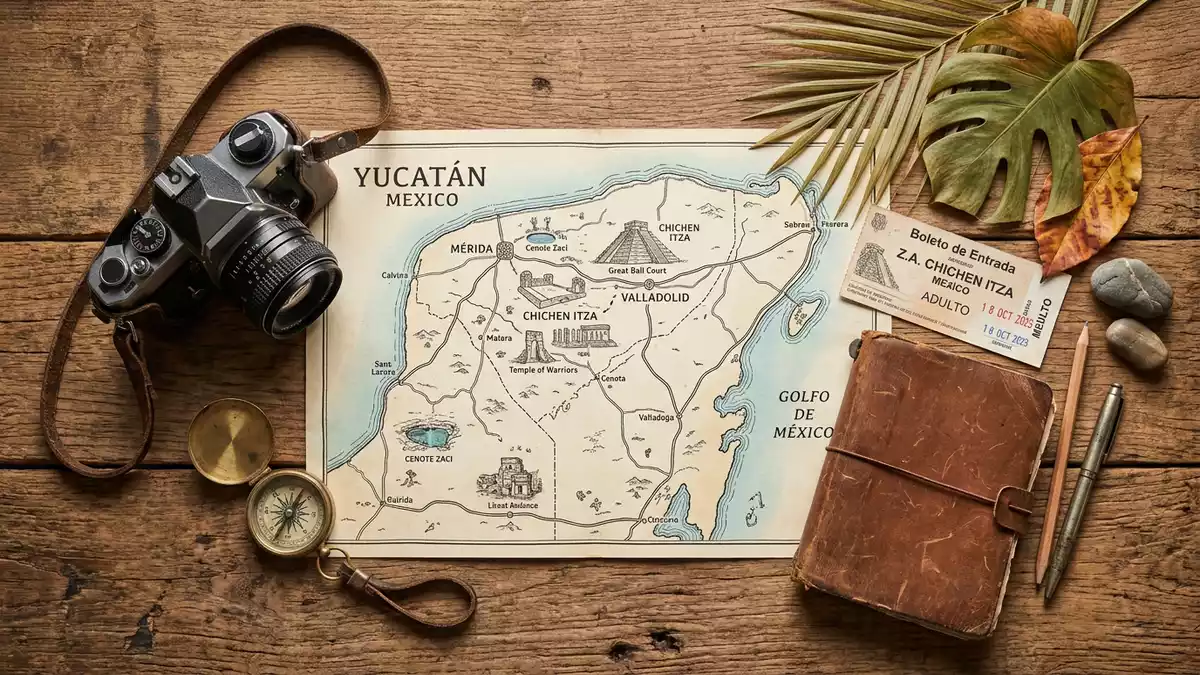
On the limestone plain north-east of Valladolid in Mexico, Chichen Itza presents a whole city of stone geometry, from pyramids and temples to observatories and cenotes. Built by Maya communities during the Late Classic and Postclassic periods, the site shows a long sequence of construction that extends across several centuries and culminates in monuments that combine Maya and Toltec forms in a single urban landscape.Maya city on the Yucatán Peninsula Chichen Itza is recognised by UNESCO as the “Pre-Hispanic City of Chichen-Itza”, a cultural World Heritage Site inscribed in 1988 for the quality of its architecture and its role in the Northern Maya Lowlands.UNESCO World Heritage inscription
El Castillo: a stepped calendar in stone
At the heart of Chichen Itza stands El Castillo, also known as the Temple of Kukulcán, a stepped pyramid that dominates the main plaza and has become the site’s defining image.El Castillo at the centre of the site Rising about 24 m (79 ft) from the plaza to the temple platform and about 30 m (98 ft) including the summit temple, the pyramid stacks limestone terraces into a symmetrical square plan with stairways on each side leading to the small temple above.pyramid height in metres and feet
Archaeologists date the visible structure to roughly the ninth to twelfth centuries AD, with an earlier inner pyramid encased within the larger shell.Terminal Classic and Postclassic dating The building is associated with Kukulcán, the feathered serpent deity whose cult shows strong links between Yucatán and central Mexico and reflects the Toltec-Maya blend that characterises the later phase of the city.fusion of Maya and Toltec styles
The Great Ball Court and the Sacred Cenote
North of El Castillo, the Great Ball Court stretches across the site as a long masonry enclosure with parallel walls used for the Mesoamerican ballgame.Great Ball Court in the Maya-Toltec city Measuring around 168 m along its playing alley, it is described as one of the largest and best-preserved ball courts in Mesoamerica, and the carved panels on its walls depict figures linked to ritual and warfare.ball court size and carvings
Beyond the formal plazas, the Sacred Cenote opens in the limestone as a broad sinkhole connected to the ceremonial centre by a raised causeway.Sacred Cenote as ritual focus Archaeological investigations have recovered offerings from its waters, including ceramics and metal objects associated with the rain god Chaac, underlining the cenote’s role in ritual practice and its place in the wider hydrological landscape of the site.
Observatories, warrior temples and urban layout
Chichen Itza’s architectural variety extends beyond the main pyramid and ball court to buildings such as El Caracol, a circular tower on a broad platform interpreted as an observatory used to track celestial movements, including those of Venus.El Caracol observatory description Nearby, the Temple of the Warriors rises above a forest of columns whose carved surfaces carry figures of warriors, eagles and jaguars, themes that recur across the site and speak to the militarised imagery of the Toltec-Maya phase.Temple of the Warriors as monumental complex
The monuments occupy an area of several square miles, with clusters of buildings laid out around plazas and linked by causeways that step across the slightly undulating terrain of the northern Yucatán peninsula.extent of the pre-Hispanic city Architectural styles such as Puuc masonry from earlier Maya phases sit alongside the later “Maya-Toltec” forms, giving the site a layered character in which different periods and influences are legible in stone.
Visiting Chichen Itza: what travellers from Western Europe should know
- Chichen Itza lies on the northern Yucatán Peninsula in Mexico, north-east of Valladolid, and is reached by road connections that link the site with regional towns and cities.
- The archaeological area is spread across gently sloping limestone ground, and visiting the plazas and outlying monuments involves walking on uneven stone and packed earth surfaces.
- The official language is Spanish and the currency is the Mexican peso.
- Entry requirements depend on your nationality; UK travellers can check the FCDO travel advice at gov.uk/foreign-travel-advice, Irish travellers the Department of Foreign Affairs at ireland.ie.
Searching for Chichen Itza on social platforms
These links open searches for Chichen Itza on each platform.
Frequently asked questions about Chichen Itza
Where is Chichen Itza and what kind of place is it?
Chichen Itza is a pre-Hispanic Maya city on the northern Yucatán Peninsula in Mexico, north-east of Valladolid, known today as an archaeological site with monumental architecture.
What should visitors expect on a visit?
A visit involves walking across large plazas and causeways to see pyramids, temples, the Great Ball Court, observatory structures and the Sacred Cenote spread across the limestone landscape.
What makes Chichen Itza distinctive among ancient cities?
The site is distinctive for El Castillo, the Great Ball Court and other monuments whose architecture records a blend of Maya and Toltec traditions, recognised by UNESCO as a World Heritage property.


