
Choeung Ek: a memorial landscape on Phnom Penh’s edge
Published on 09/14/2026 at 16:42 | Editorial responsibility: Rafael Müller, Editor-in-Chief AD HOC NEWS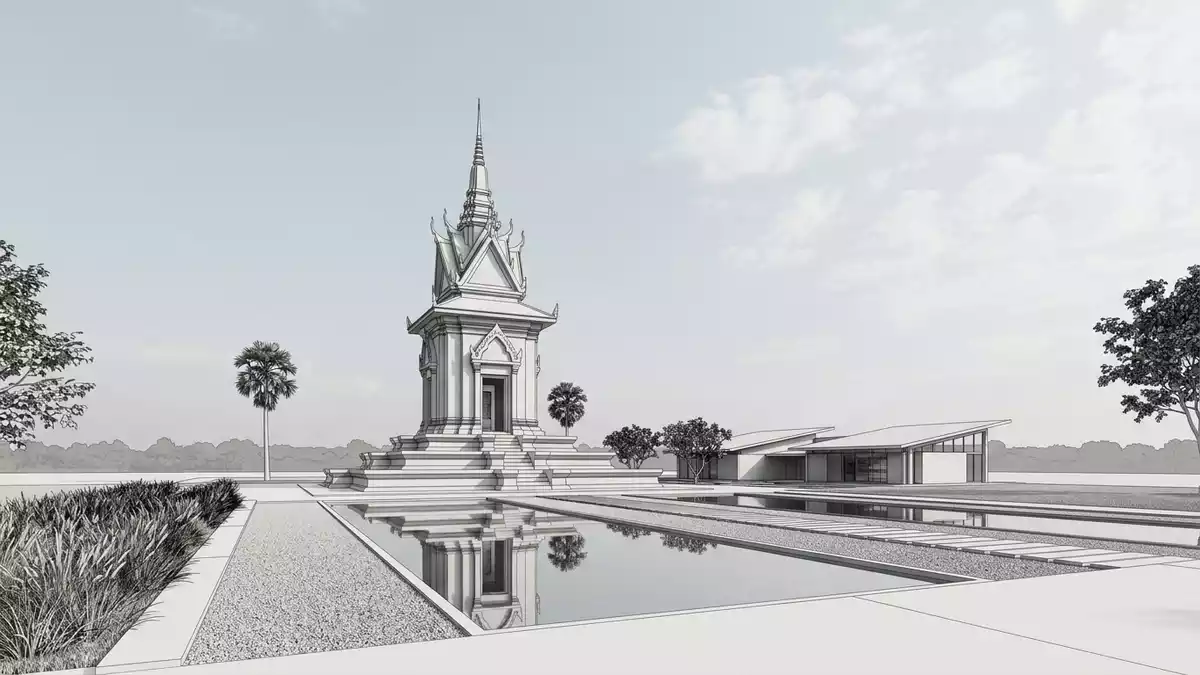
On the southern edge of Phnom Penh, Choeung Ek spreads across low ground that was once a cemetery and orchard, now reshaped into a memorial landscape to the Cambodian genocide of the Khmer Rouge period in the late 1970s. The site links directly to the former S-21 prison at Tuol Sleng, where detainees were held and tortured before being transported here for execution during the regime of Pol Pot between 1975 and 1979.
From rural edge to genocidal centre
Choeung Ek lies in Dangkao district, several kilometres south of Phnom Penh’s centre, in terrain that was comparatively quiet agricultural land when the Khmer Rouge seized power in 1975.The compound stood partly on a Chinese cemetery before the regime repurposed it as one of a nationwide network of killing sites linked to the security system of Democratic Kampuchea.UNESCO documentation describes the ground as falling under the municipal authority of Phnom Penh, though physically separated from the dense urban core.
The execution ground at Choeung Ek formed the end point of a lethal route that began at Tuol Sleng, the former school building in Phnom Penh converted into the S-21 interrogation centre under Pol Pot.Research on Tuol Sleng and Choeung Ek describes how prisoners classed as enemies of the regime were transported from the city to this rural location, where they were killed and buried in mass graves between 1977 and 1979. The gentle fields and ponds that visitors see now therefore stand on ground where thousands of men, women and children lost their lives during the Khmer Rouge purges.
Mass graves and the memorial stupa
After Vietnamese forces overthrew the Khmer Rouge in January 1979, investigations at Choeung Ek uncovered a landscape marked by pits and scattered human remains, revealing the scale of executions carried out there.Exhumations at the site brought to light thousands of bodies, with sources describing roughly 8,895 victims recovered from the ground in the early years after the regime’s fall.Accounts of the genocidal centre also refer to dozens of individual mass graves, some several metres deep, cut into the former orchard soil.
At the centre of the site stands a white, glazed memorial stupa that rises above the burial pits, housing shelves of human skulls and bones arranged behind transparent panels.An Australian War Memorial description notes that almost 9,000 victims’ remains, many showing clear trauma, were placed inside this stupa as part of a national effort to commemorate those killed at Choeung Ek and at Tuol Sleng between 1975 and 1979. Outside, the ground is dotted with mounds and depressions where graves were excavated, some marked by simple wooden signs describing the type of victims found there.
Walking the grounds of remembrance
For visitors, Choeung Ek is laid out as an open-air memorial landscape, combining traces of the former rural use with structures that focus attention on the Khmer Rouge period. The site retains low mounds, shallow ponds and areas of grass that recall its earlier life as a longan orchard and burial ground, while pathways guide walkers past grave sites, the stupa and smaller commemorative elements such as simple Buddhist shrines and information boards.A detailed feature on Choeung Ek describes fragments of clothing and personal items that remain embedded in the soil, occasionally emerging with erosion, underlining the direct connection between the landscape and the people killed here.
Choeung Ek also forms part of a broader effort to document the Khmer Rouge period across Cambodia, linked conceptually and historically to Tuol Sleng Genocide Museum in Phnom Penh and other former prisons and killing fields.The UNESCO tentative list entry groups Choeung Ek with these sites in a nomination that emphasises their joint role in remembering the victims of Democratic Kampuchea. For travellers from Western Europe, a walk through Choeung Ek therefore often sits alongside a visit to Tuol Sleng, tracing the route that so many prisoners were forced to follow.
Visiting Choeung Ek: what travellers from Western Europe should know
- Choeung Ek lies south of central Phnom Penh in Dangkao district and is usually reached by road, with local taxis and hired drivers following the main routes towards the rural outskirts.
- The memorial landscape is largely level, with footpaths crossing grassy ground and areas of bare soil; visitors should expect uneven surfaces around the excavated pits and ponds.
- The site stands near small lakes and agricultural land outside the dense urban grid of Phnom Penh, so the surroundings include open fields and scattered village development.
- The official language is Khmer and the currency is the Cambodian riel.
- Entry requirements depend on your nationality; UK travellers can check the FCDO travel advice at gov.uk/foreign-travel-advice, Irish travellers the Department of Foreign Affairs at ireland.ie.
Searching for Choeung Ek on social platforms
These links open searches for Choeung Ek on each platform.
Frequently asked questions about Choeung Ek
Where is Choeung Ek located in relation to Phnom Penh?
Choeung Ek lies in Dangkao district, to the south of Phnom Penh’s centre, on ground that was formerly agricultural land and a cemetery.
What should visitors expect when walking around Choeung Ek?
The site is an open-air memorial with footpaths, ponds, grave mounds and the central stupa, combining traces of rural landscape with structures commemorating Khmer Rouge victims.
What makes Choeung Ek distinctive among Cambodia’s genocide memorials?
Choeung Ek is closely linked to Tuol Sleng, with mass graves, visible burial pits and a stupa housing thousands of victims’ remains, giving it a direct connection to the killing process.


