
Chua Tran Quoc on Hanoi’s West Lake
Published on 08/16/2026 at 13:48 | Editorial responsibility: Rafael Müller, Editor-in-Chief AD HOC NEWS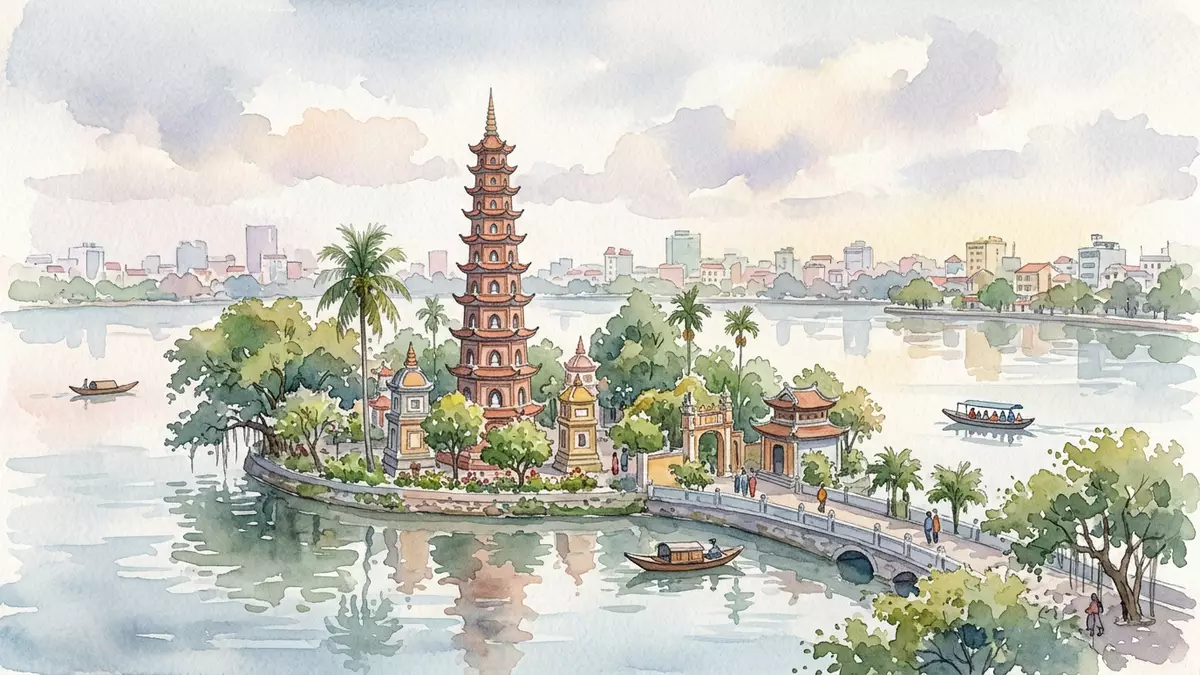
Chua Tran Quoc, known in English as Tran Quoc Pagoda, rises from a small island on Hanoi’s West Lake as one of the city’s most recognisable Buddhist sites. Rooted in the sixth century under Emperor Ly Nam De, it carries more than 1,400 years of religious life within its courtyards and towers, making it widely regarded as the oldest surviving Buddhist pagoda in the Vietnamese capital.
An ancient pagoda on a lake island
Tran Quoc Pagoda stands on Kim Ngu islet off the eastern shore of West Lake, linked to the mainland by a short causeway along Thanh Nien Road in Tay Ho District. The temple complex occupies much of the island, so the lake forms a natural boundary on almost every side and gives the pagoda its characteristic reflections in the water.
The origins of Chua Tran Quoc go back to the reign of Emperor Ly Nam De in the mid-sixth century, when a Buddhist temple named Khai Quoc was founded near the Red River.constructed in the sixth century Over the centuries the riverbank site became vulnerable to erosion, and the temple complex was transferred to Kim Ngu islet on West Lake in the early seventeenth century.relocated to West Lake in 1615 The move fixed the temple’s relationship with the lake and established the island setting that visitors encounter.
Names, dynasties and Buddhist heritage
The pagoda has carried several names that reflect different periods of Vietnamese history. The original name Khai Quoc, often rendered “National Founding”, dates to the sixth century when the temple was associated with the short-lived Van Xuan kingdom.named Khai Quoc in the sixth century In the fifteenth century, during the reign of Le Thai Tong, it became known as An Quoc, a name linked to ideas of a secure or peaceful realm.renamed An Quoc under Le Thai Tong
The modern name Tran Quoc, which can be translated as “protecting the nation”, dates to the late seventeenth century reign of Le Hy Tong and has endured since his era.name adopted in the reign of Le Hy Tong Through the Ly and Tran dynasties the temple served as a centre of Buddhist activity for Thang Long, the historical name for Hanoi, and its long continuity is reflected in the statues, stelae and architectural elements that span many centuries.Buddhist centre of Thang Long
Towers, shrines and temple layout
From the causeway, visitors first notice the tall, brick-built stupa rising above the trees, composed of stacked storeys with small niches for Buddha images on each level.multi-storey stupa tower Around it stand subsidiary stupas and memorial towers, contributing to the vertical profile that has become associated with Tran Quoc Pagoda. The main sanctuary, rebuilt in the early nineteenth century, sits deeper inside the island and houses wooden statues of Buddhas and bodhisattvas on stepped altars.major repairs in 1815
The complex also includes a reception hall and various side shrines dedicated to different figures of Vietnamese and Buddhist tradition. Courtyards paved with stone and lined with potted plants connect these buildings, while trees and small gardens soften the transition between architecture and lake. The compact scale means that religious structures, statues and water are all within sight at most points on the island.
Visiting Chua Tran Quoc: what travellers from Western Europe should know
- Chua Tran Quoc stands on Kim Ngu islet off the eastern shore of West Lake in Tay Ho District, Hanoi, linked to Thanh Nien Road by a short causeway.
- The approach from the road crosses the lake and leads into a temple yard with stone paving, shrines, towers and steps between different courtyard levels.
- The official language is Vietnamese and the currency is the Vietnamese dong.
- Entry requirements depend on your nationality; UK travellers can check the FCDO travel advice at gov.uk/foreign-travel-advice, Irish travellers the Department of Foreign Affairs at ireland.ie.
Searching for Chua Tran Quoc on social platforms
These links open searches for Chua Tran Quoc on each platform.
Frequently asked questions about Chua Tran Quoc
Where is Chua Tran Quoc located in Hanoi?
Chua Tran Quoc stands on Kim Ngu islet in West Lake, reached from Thanh Nien Road in Tay Ho District.
What can visitors expect during a visit?
Visitors encounter a compact Buddhist temple complex with a tall stupa, shrine halls, Buddha statues and stone courtyards surrounded by lake views.
What makes Chua Tran Quoc distinctive among Hanoi’s temples?
Its combination of great age, continuous Buddhist use since the sixth century and a pagoda layout set entirely on a small lake island gives it a particular character.


