
Cinque Terre’s cliffside villages between terraces and sea
Published on 08/16/2026 at 14:07 | Editorial responsibility: Rafael Müller, Editor-in-Chief AD HOC NEWS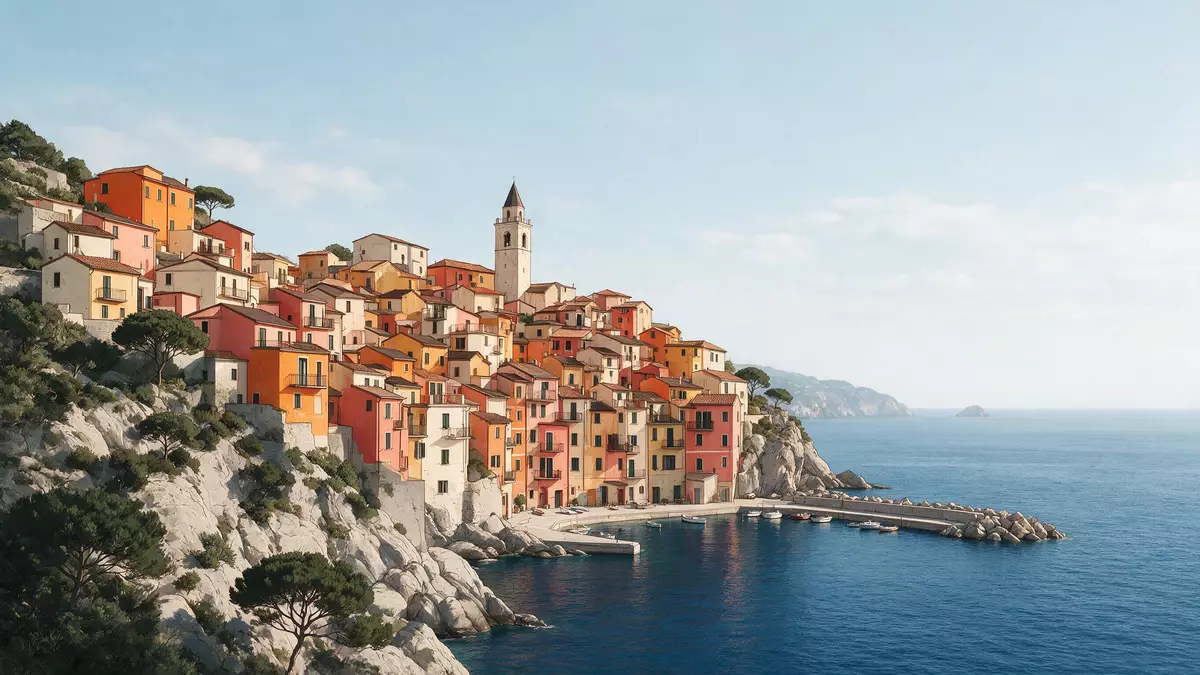
Cinque Terre on the Ligurian coast near La Spezia is a compact stretch of cliffs where five small villages cling to the rock between terraced hillsides and the sea. The area forms part of a UNESCO-listed cultural landscape that links traditional hillside agriculture with dense coastal settlement from the Punta Mesco headland towards La Spezia.
Five “lands” strung along the Ligurian cliffs
Cinque Terre, literally “Five Lands”, refers to the coastal area west of La Spezia where the villages of Monterosso al Mare, Vernazza, Corniglia, Manarola and Riomaggiore occupy short inlets and ledges along a broken line of cliffs.the villages of Monterosso al Mare, Vernazza, Corniglia, Manarola and Riomaggiore Each settlement has its own geometry, but all sit between steep slopes and the Ligurian Sea.
Monterosso al Mare at the western end spreads out more widely than the other villages and includes long shorefront stretches backed by houses and promenade walls.Monterosso al Mare Vernazza clusters around a small harbour ringed by tall, narrow houses and a compact waterside square. Corniglia sits higher, on a rocky spur above the sea, with its streets gathered around a central spine rather than around a harbour basin. Manarola and Riomaggiore occupy tight ravines where houses rise in layers on either side of short inlets, their facades facing towards jetties and boat ramps.
A terraced cultural landscape recognised by UNESCO
Beyond the houses and lanes, Cinque Terre is defined by terraces cut into slopes that would otherwise fall sharply to the sea. For centuries, stone walls have supported narrow strips of soil used for vines and olive trees along the coastal band between Levanto and La Spezia.stone walled terraces for the growing of vines and olive trees The terraces follow the contours of the hillsides, creating horizontal lines that contrast with the vertical rise of the cliffs.
This combination of terraced agriculture, compact coastal villages and the surrounding natural slopes forms part of the UNESCO World Heritage property “Portovenere, Cinque Terre, and the Islands (Palmaria, Tino and Tinetto)”.Portovenere, Cinque Terre, and the Islands (Palmaria, Tino and Tinetto) The inscription was made in 1997 as a cultural landscape in the region of Liguria, reflecting long-standing settlement and agricultural patterns along about 15 km of coast between the Punta Mesco in the west and the Punta Persico in the east.inscribed into the list of UNESCO’s World Heritage sites in 1997
Paths, rail tracks and sea routes along the coast
The physical character of Cinque Terre means that movement along the coast has long followed narrow paths and rail corridors rather than wide roads. The five settlements lie within Cinque Terre National Park, created in 1999 as an Italian national park and covering the towns, their slopes and parts of the adjoining communes of Levanto and La Spezia.Cinque Terre National Park The park boundary marks out a protected area where built structures and cultivated terraces sit within a frame of scrub, woodland and cliffs.
Between the villages, a network of footpaths follows shelves, terrace edges and wooded slopes. These routes link Monterosso, Vernazza, Corniglia, Manarola and Riomaggiore and extend towards Levanto and Portovenere, making it possible to cross sections of the coast on foot at varying levels above the sea.stretch of coast of Liguria, about 10 km long between Genoa and La Spezia Parallel to the paths, a railway line runs through tunnels and short open cuts to reach the stations serving the villages; this line, together with boat services along the coast, ties Cinque Terre to La Spezia and to the wider Ligurian Riviera.
Visiting Cinque Terre: what travellers from Western Europe should know
- Cinque Terre lies on the Ligurian coast west of La Spezia in northern Italy and is reached by regional trains running along the Riviera line, with stations serving all five villages.
- The terrain consists of steep coastal slopes cut by ravines; many lanes rise on stairways, and paths between villages include sections on narrow terraces above drops to the sea.
- In summer, vegetation on the terraces and hillsides is in full leaf, while in winter the exposed rock and the shape of the terraces are more evident along the coastal slopes.
- Nearby, the town of La Spezia serves as a wider transport hub, and Portovenere lies to the south-east along the same UNESCO-listed coastal landscape.
- The official language is Italian and the currency is the euro.
Searching for Cinque Terre on social platforms
These links open searches for Cinque Terre on each platform.
Frequently asked questions about Cinque Terre
Where is Cinque Terre located?
Cinque Terre lies along the Ligurian coast in the province of La Spezia in northern Italy, between the Punta Mesco and areas near La Spezia.
What should travellers expect on a visit?
Travellers encounter steep lanes, stairways, cliffside paths, compact harbours and terraced hillsides, with rail and boat links between the villages and to La Spezia.
What makes Cinque Terre distinctive?
Cinque Terre stands out for its combination of five dense coastal villages, extensive dry-stone terraces for vines and olives, and its recognition as a UNESCO cultural landscape.


