
Ciudad Colonial, Santo Domingo’s stone grid of the New World
Published on 08/19/2026 at 21:14 | Editorial responsibility: Rafael Müller, Editor-in-Chief AD HOC NEWS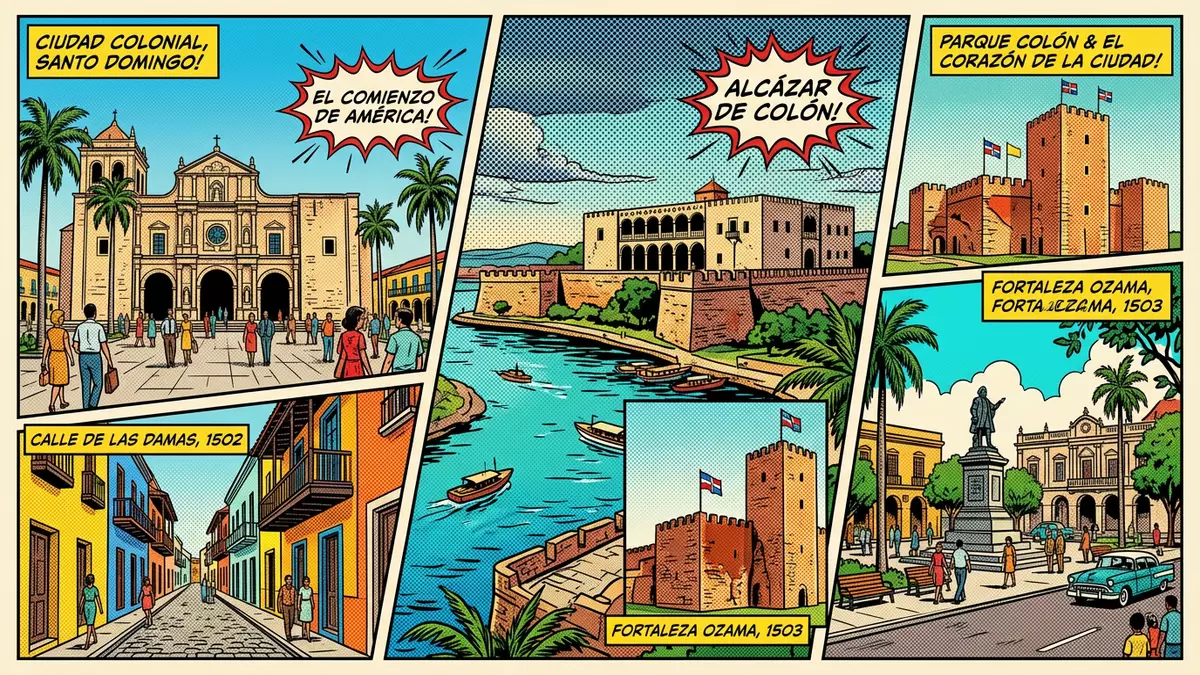
Ciudad Colonial in Santo Domingo is the historic core of the Dominican Republic’s capital, a compact district where early Spanish stone streets, churches and fortifications still define the urban fabric. Founded at the turn of the sixteenth century on the west bank of the Ozama River, it retains a planned grid of blocks that became a model for colonial towns across the Americas.
A planned stone city on the Ozama River
Ciudad Colonial occupies a defined area on the western bank of the Ozama, close to where the river meets the Caribbean Sea, enclosed by sections of surviving defensive walls. Within this area, the historic streets and buildings form an ordered grid, one of the earliest examples of a European-style town plan in the Americas, with straight streets intersecting at right angles to organise the urban blocks.Colonial City of Santo Domingo The layout reflects the role of Santo Domingo as an administrative centre for Spain’s Caribbean territories, with religious, military and civic buildings grouped near key plazas.
The city on this site developed under Spanish rule from the late fifteenth century, with Bartolomé Columbus and other colonial officials involved in establishing the settlement as a base for expeditions into the continent.Founded by Bartolomé Columbus Santo Domingo became a seat of colonial government, and the streets of Ciudad Colonial once carried the traffic of viceregal administrators, merchants and clergy moving between the cathedral, the fortress and the port on the river.
Early “firsts” in the Americas: cathedral, fortress and palace
Walking through Ciudad Colonial brings visitors face to face with structures linked to some of the earliest European institutions in the Americas. The district contains the Catedral Primada de América, regarded as the first cathedral built on the continent, whose stone mass rises near the central plaza.first cathedral in the Americas Nearby, the Fortaleza Ozama stands as one of the oldest surviving forts in the region, positioned to oversee the entrance to the Ozama River and the sea approach to the city.
On one of the inner plazas rises the Alcázar de Colón, a stone palace associated with Diego Columbus, son of Christopher Columbus, who lived here during his tenure as Viceroy of the Indies.Alcázar de Colón palace Together with early institutional buildings such as the first hospital and university of the New World, these monuments give Ciudad Colonial a dense concentration of early colonial architecture, all within a relatively small urban area lined with stone and stucco façades.
UNESCO status and streets that carry the past
Ciudad Colonial has been recognised by UNESCO as the “Colonial City of Santo Domingo” and inscribed on the World Heritage List as a cultural site since 1990, with an area of around 106 hectares covered by the designation.UNESCO World Heritage inscription The listing cites criteria that include the interchange of human values, the urban layout and the association with events and traditions of the so-called New World.
Several streets in Ciudad Colonial carry names linked to early colonial life. Calle de las Damas, for example, is known as one of the earliest formal streets in the Americas, lined with stone houses and public buildings along its straight course.grid of streets in Ciudad Colonial Elsewhere, thoroughfares such as Calle El Conde and Calle Las Mercedes run between low-rise façades, plazas and churches, giving the district a rhythm of shaded spaces and open squares framed by colonial architecture.
Visiting Ciudad Colonial: what travellers from Western Europe should know
- Ciudad Colonial lies on the west side of the Ozama River in Santo Domingo, with its streets extending inland from the Caribbean shoreline and bounded in part by historic walls.
- The district’s streets are largely level and paved, but some approaches to fortifications and towers involve staircases inside stone structures.
- Nearby features include the Ozama River itself, the seafront along Avenida George Washington and modern commercial areas of Santo Domingo beyond the old town’s perimeter.
- The official language is Spanish and the currency is the Dominican peso.
- Entry requirements depend on your nationality; UK travellers can check the FCDO travel advice at gov.uk/foreign-travel-advice, Irish travellers the Department of Foreign Affairs at ireland.ie.
Searching for Ciudad Colonial on social platforms
These links open searches for Ciudad Colonial on each platform.
Frequently asked questions about Ciudad Colonial
Where is Ciudad Colonial located within Santo Domingo?
Ciudad Colonial occupies the historic centre of Santo Domingo on the west bank of the Ozama River, close to the city’s Caribbean shoreline.
What can visitors expect when exploring Ciudad Colonial?
Visitors encounter straight stone streets, plazas, churches, fortifications and a dense collection of early colonial buildings arranged in a planned grid.
What makes Ciudad Colonial distinctive among old towns in the Americas?
The district combines an early European-style street plan with monuments linked to the first cathedral, fortress, palace and other institutions established in the New World.


