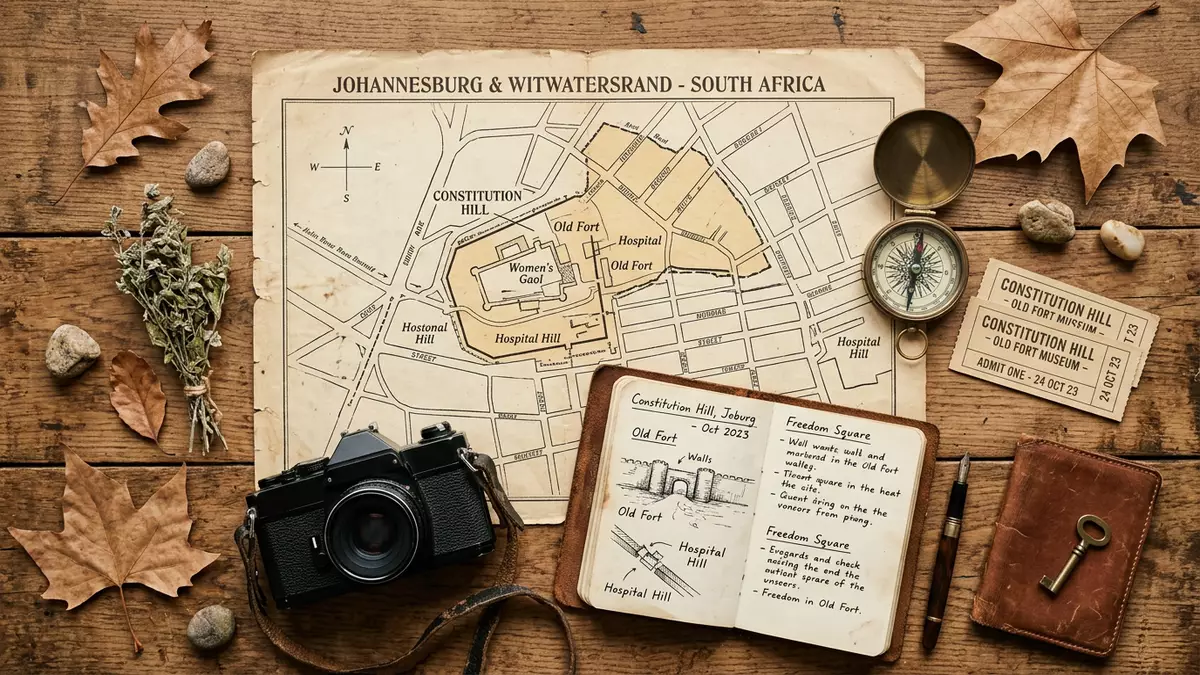
Constitution Hill and the story of South Africa’s democracy
Published on 08/10/2026 at 15:09 | Editorial responsibility: Rafael Müller, Editor-in-Chief AD HOC NEWS
Constitution Hill in Johannesburg is one of South Africa’s clearest architectural reflections of its journey from repression to constitutional democracy. The hilltop complex brings together the country’s Constitutional Court, opened in 2004, with preserved sections of the Old Fort prison where political prisoners such as Mahatma Gandhi and Nelson Mandela were held during the twentieth century. Walking across the site, visitors move between raw brick cells and a light-filled court building that houses South Africa’s highest court on constitutional matters.
A hill of prisons and a court of rights
The ridge on which Constitution Hill stands overlooks central Johannesburg, with the city’s commercial core spread out below and the residential suburbs stretching into the distance. The complex incorporates several layers of prison history, including the Old Fort built in the late nineteenth century under the South African Republic and later used by the Union of South Africa, as well as the so?called Number Four men’s prison and the women’s jail that operated through much of the twentieth century. These sections held a broad range of inmates, from common-law prisoners to anti-apartheid activists.
In the Old Fort area, visitors encounter thick stone and brick walls, enclosed yards and narrow corridors leading to small prison cells. The ramparts, guard towers and internal passages reflect the site’s initial military and defensive role under President Paul Kruger before its adaptation into a prison complex. The Number Four section, known for harsh treatment of black male prisoners, is preserved with communal cells, isolation cells and washing areas that illustrate the conditions under segregation-era punishment. Nearby, the women’s jail records the experiences of women imprisoned for political activity or pass law offences, with exhibits about figures such as Winnie Madikizela-Mandela and other activists.
The Constitutional Court building and its symbolic fabric
The Constitutional Court of South Africa occupies a modern building inserted into the historic hill, designed by an architectural team that included Janina Masojada, Andrew Makin and Paul Wygers and inaugurated in 2004. The court is the highest authority on constitutional matters under the country’s 1996 Constitution, and its building is shaped around an internal public atrium, known as the court foyer, with tall columns and extensive glazing. Much of the brick used in the new structure incorporates material reclaimed from demolished prison structures on the hill, giving the walls a varied texture that carries traces of the earlier buildings.
The main courtroom is arranged with a curved bench for the justices, facing a public seating area where visitors can observe proceedings when the court is in session. Behind the bench, the wall incorporates coloured panels and artworks that reference South African stories and landscapes, while the court’s doors feature carved images of the rights enumerated in the Bill of Rights. Art is woven through the building, with works by South African artists displayed in corridors and public spaces. The building’s exterior sets concrete, brick and glass alongside the rougher surfaces of neighbouring prison structures, creating a visible contrast between the contemporary court and the older detention blocks.
Museums, memory and daily life on Constitution Hill
Today Constitution Hill functions as a combined judicial, memorial and cultural precinct. Museum spaces inside the Old Fort, Number Four and the women’s jail present exhibitions on prison life, the apartheid legal system and the broader struggle for human rights in South Africa. Objects such as uniforms, bedding, food containers and hand-written letters sit alongside photographs, court documents and oral histories, helping visitors form a sense of daily routines and restrictions inside the cells. The ramp that once served the prison complex now leads visitors across the site, linking the heritage buildings with the court.
Open courtyards and lawns between the buildings host public events, gatherings and occasional performances, and the site’s terraces offer views towards the Johannesburg skyline. The precinct includes spaces adapted for conferences, art installations and educational programmes, bringing school groups and international visitors into direct contact with the country’s constitutional framework. Street art and sculptures appear on some walls and open areas, echoing themes of justice, equality and remembrance. The combination of working court, museum and urban park means a visit often includes the ordinary routines of court staff alongside reflective encounters with the preserved prison spaces.
Visiting Constitution Hill: what travellers from Western Europe should know
- Constitution Hill lies on a ridge above central Johannesburg and is reached by road or taxi from the city, with public transport options serving the surrounding area.
- Admission arrangements and opening hours are set by the site’s operator and change with the season; the official website is the only binding source.
- Johannesburg has a dry, cooler winter and a warmer, wetter summer; many visitors appreciate the clarity of winter light or the softer temperatures of spring and autumn.
- The hill involves walking between several buildings on paved paths and ramps, with staircases and some uneven surfaces inside heritage structures; comfortable shoes are advisable and restrictions may apply on site.
- English is widely used in Johannesburg alongside other South African languages; card payments are common in the city and respectful, straightforward behaviour is welcomed in both the court and museum areas.
- Entry requirements depend on your nationality. UK travellers should check the FCDO travel advice at gov.uk/foreign-travel-advice; Irish travellers the Department of Foreign Affairs at ireland.ie; EU and EEA citizens their own national foreign ministry.
Searching for Constitution Hill on social platforms
These links open searches for Constitution Hill on each platform.Frequently asked questions about Constitution Hill
Where is Constitution Hill and what kind of place is it?
Constitution Hill is a hilltop complex in Johannesburg, South Africa, combining the country’s Constitutional Court with preserved prison buildings from the Old Fort, Number Four and the women’s jail.
What can visitors expect during a visit?
Visitors usually walk between museum spaces in the former prisons and public areas of the court building, encountering exhibitions, artworks, open courtyards and views across central Johannesburg.
What makes Constitution Hill distinctive among South African landmarks?
The combination of a functioning Constitutional Court, prison museums linked to figures such as Nelson Mandela and Mahatma Gandhi, and reclaimed materials embedded in the court’s architecture gives Constitution Hill a rare blend of legal, historical and architectural significance.