
Constitution Hill, Johannesburg’s hilltop court and prison complex
Published on 08/18/2026 at 14:35 | Editorial responsibility: Rafael Müller, Editor-in-Chief AD HOC NEWS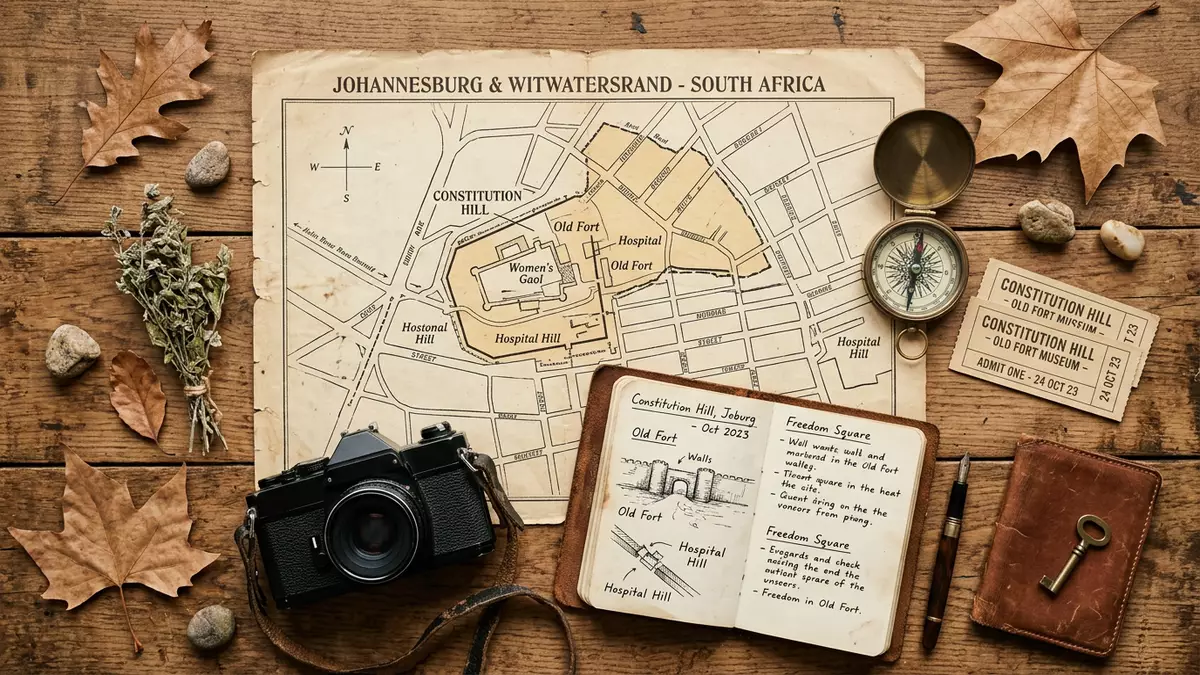
On a rise above central Johannesburg, Constitution Hill ties South Africa’s Constitutional Court directly to the former prison and fort that once dominated the skyline here. The precinct draws a line between a site dating to the 1890s and the democratic era that followed 1994, keeping historic cellblocks alongside one of the country’s key judicial institutions.
A hill of fortifications, prisons and a court
Constitution Hill stands in Braamfontein, on the western edge of the Hillbrow ridge, looking across central Johannesburg’s streets and towers. The ground was first occupied in the nineteenth century by the Old Fort, constructed under President Paul Kruger of the South African Republic in the 1890s to control the fast-growing goldfields town and to guard against British attack, only later turning fully into a prison complex.The Old Fort under Paul Kruger became the core of Johannesburg’s jail for white men, with defensive walls and watchpoints wrapped around the cellblocks.
In the early twentieth century, the site expanded into a dense complex of specialised prisons, each with its own blocks and yards. A section for black male prisoners gained the label Number Four, a Women’s Jail rose nearby, and an Awaiting Trial Block held those not yet sentenced, creating a network of different regimes within one precinct.Number Four, the Women’s Jail and the Awaiting Trial Block all stood inside the same perimeter, linked by passages and courtyards that are still legible in the preserved fabric.
From incarceration to a living museum of democracy
For roughly a century the hill operated as Johannesburg’s central prison, holding a wide range of inmates from common-law offenders to political activists. Under colonial rule and apartheid, the cells took in men, women and children accused of crimes as varied as violating pass laws, taking part in strikes or resisting segregation, alongside those convicted of serious offences.The history of Constitution Hill as a prison records that figures such as Nelson Mandela, Winnie Madikizela-Mandela, Albertina Sisulu, Mahatma Gandhi and many others spent time behind its doors at different moments of the twentieth century.
The prison use ended in the 1980s, but the site did not disappear into dereliction. After South Africa became a democracy in 1994, a decision in 1995 placed the country’s new Constitutional Court directly on this former jail terrain.The factsheet on Constitution Hill describes how the precinct was renamed Constitution Hill and reshaped as a National Heritage Site, proclaimed on 10 March 2017, turning the old fort and prisons into a living museum that tells the story of South Africa’s journey to democracy.
Architecture, exhibitions and the experience of the site
Walking through Constitution Hill today means moving between preserved prison structures and contemporary civic architecture. Heavy masonry walls, barred doorways and narrow exercise yards remain from the Old Fort, Number Four and the Women’s Jail, while the Constitutional Court introduces lighter materials and open interior volumes to the ridge. The court building rises where parts of the Awaiting Trial Block once stood, incorporating elements of the former prison into its fabric and marking the shift from confinement to rights-based law.The description of Constitution Hill as a living museum emphasises that the precinct now accommodates both heritage exhibitions and an active court chamber.
The museum installations concentrate on the daily realities of incarceration and the broader legal and political systems that produced them. In the spaces of Number Four and the Women’s Jail, displays use original cell interiors, inscriptions and reconstructed fixtures to convey how people were held and classified, while interpretive panels and artworks connect those conditions to South Africa’s transition from colonial rule and apartheid to democracy.The “Explore” section on Constitution Hill’s museum describes how exhibitions challenge visitors to consider the treatment of black people as criminals and to follow a narrative arc from repression to constitutional protection.
Visiting Constitution Hill: what travellers from Western Europe should know
- Constitution Hill stands in Braamfontein, just north of central Johannesburg, close to the junction of Joubert Street and Kotze Street and within walking distance of inner-city transport hubs.
- The historic prison buildings incorporate staircases, uneven surfaces and enclosed yards, while the hilltop setting exposes visitors to changes in weather and Johannesburg’s elevation.
- The official language is English alongside other South African languages, and the currency is the South African rand.
- Entry requirements depend on your nationality; UK travellers can check the FCDO travel advice at gov.uk/foreign-travel-advice, Irish travellers the Department of Foreign Affairs at ireland.ie.
Searching for Constitution Hill on social platforms
These links open searches for Constitution Hill on each platform.
Frequently asked questions about Constitution Hill
Where is Constitution Hill in Johannesburg?
Constitution Hill is on a hilltop in Braamfontein, just north of Johannesburg’s traditional city centre and close to the Hillbrow ridge.
What can visitors expect on a visit to Constitution Hill?
Visitors encounter preserved prison buildings, museum exhibitions about South Africa’s democratic journey and the contemporary Constitutional Court housed within the same precinct.
What makes Constitution Hill distinctive among heritage sites?
The combination of a former fort and prison complex with a functioning Constitutional Court on one historic ridge sets Constitution Hill apart within Johannesburg’s landscape.


