
Copan’s stone acropolis and hieroglyphic stairway
Published on 08/18/2026 at 14:08 | Editorial responsibility: Rafael Müller, Editor-in-Chief AD HOC NEWS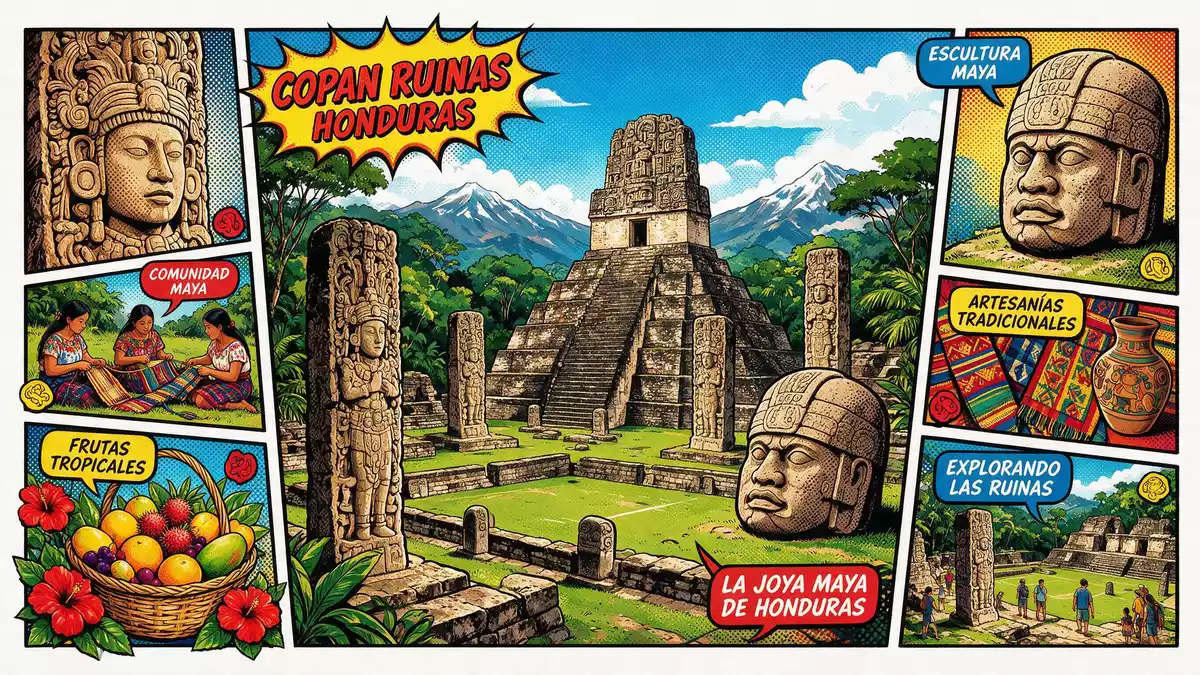
Copan in Copan Ruinas, Honduras, is a Maya archaeological site shaped by stone terraces, plazas and carved monuments. Its acropolis and hieroglyphic stairway give the place its most striking profile.
Copan’s carved core
The centre of Copan gathers architecture, sculpture and text into a compact ceremonial landscape. The site is linked above all with Diego García de Palacio, who described it in 1570, and with the Classic Maya period, when the city reached its peak.
Copan was the capital of a dynastic kingdom under K'inich Yax K'uk' Mo' from AD 426, and the ruins preserve that long political story in stone. The UNESCO-listed core shows successive building phases, and the carved monuments remain part of the main visual identity of the place.
Stelae, stairways and royal memory
The best-known monuments at Copan are the stelae and the long stairway packed with glyphs. The Hieroglyphic Stairway is one of the site’s defining features, and the royal monument Altar Q records the sequence of rulers.
These monuments make Copan more than a ruin field. They turn the site into a carved historical record, where sculpture, inscription and architecture sit side by side across the acropolis and the great plaza.
A Maya city in western Honduras
Copan lies in western Honduras, close to the border with Guatemala, and within the municipality of Copán Ruinas. The setting is a fertile valley, and the site belongs to the broader world of Classic Maya settlement and authority.
The ruins are associated with the early 5th century AD foundation under K'inich Yax K'uk' Mo', the reign of Uaxaclajuun Ub'aah K'awiil in the early 8th century, and abandonment in the early 10th century. That sequence gives the site an unusually clear historical arc.
Visiting Copan: what travellers from Western Europe should know
- Copan stands in Copán Ruinas, in western Honduras, near the Guatemalan frontier. It is reached through the town and by road from the valley settlements.
- The main archaeological group includes stepped masonry, plazas and stone monuments. The acropolis rises above the surrounding ground, and the Hieroglyphic Stairway is a major climb within the core.
- The site includes carved stelae, altars and temple platforms. Copan also preserves a sequence of rebuilding phases, visible in the layered architecture of the acropolis.
- The official language is Spanish and the currency is the Honduran lempira.
- Entry requirements depend on your nationality; UK travellers can check the FCDO travel advice at gov.uk/foreign-travel-advice, Irish travellers the Department of Foreign Affairs at ireland.ie.
Searching for Copan on social platforms
These links open searches for Copan on each platform.
Frequently asked questions about Copan
Where is Copan?
Copan is in western Honduras, in Copán Ruinas near the border with Guatemala. It belongs to the archaeological landscape of the Copán Valley.
What does a visit involve?
The site is a spread of plazas, platforms, stairways and carved monuments. The acropolis and the main plaza form the clearest architectural core.
What makes Copan distinctive?
Copan is known for the combination of architecture and inscription, especially the Hieroglyphic Stairway and the royal monuments. Its Classic Maya phases remain visible in the layered fabric of the ruins.


