
Cradle Mountain’s jagged skyline over Tasmania’s high country
Published on 08/16/2026 at 14:29 | Editorial responsibility: Rafael Müller, Editor-in-Chief AD HOC NEWS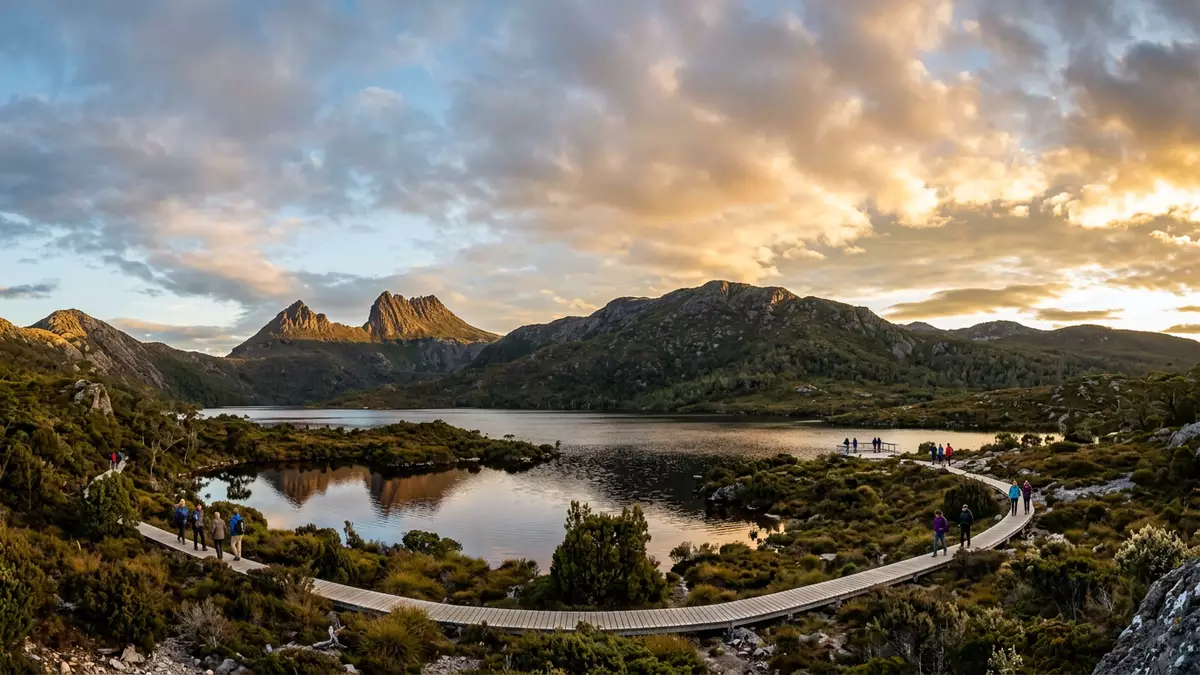
Cradle Mountain in Tasmania’s Central Highlands is a jagged dolerite peak rising to 1,545 m (5,069 ft) above sea level, a focal point of Cradle Mountain–Lake St Clair National Park and the wider Tasmanian Wilderness World Heritage Area.Cradle Mountain The mountain’s distinctive skyline, mirrored in nearby lakes and framed by subalpine heath and forest, gives this corner of Australia a compact but striking high-country character.
Cradle Mountain and its alpine setting
Cradle Mountain stands at the northern boundary of Cradle Mountain–Lake St Clair National Park, on Tasmania’s central plateau in the island’s north-west.northern boundary The peak forms part of a chain of mountains that also includes Barn Bluff and Mount Ossa, rising above a landscape of glacial lakes and valleys.major features The area lies within a national park of more than 1,600 square kilometres (around 620 square miles), giving the mountain an expansive wilderness backdrop.area of approximately 1,616 square kilometres
The summit ridge of Cradle Mountain is an arête, a narrow glacially carved spine of rock that resembles a cradle when seen from certain angles.arête that resembles a cradle Its cliffs and terraces are formed from dolerite, a hard igneous rock common in Tasmania’s high country, which weathers into sheer faces and blocky columns.sub-volcanic rock Below the rock walls, slopes fall towards alpine lakes and tarns, including Dove Lake near the mountain’s northern approaches, where the water reflects the peak and the surrounding heath.
Tasmanian Wilderness and the Overland Track
Cradle Mountain–Lake St Clair National Park forms part of the Tasmanian Wilderness World Heritage Area, a cluster of protected landscapes recognised for their geology, ecosystems and relatively intact wild character.Tasmanian Wilderness UNESCO World Heritage site Within the park, habitats range from temperate rainforest along riverbanks to alpine heath and buttongrass moorland on exposed plateaus, with Cradle Mountain rising above them as a landmark.
The park is also the setting for the Overland Track, a multi-day walking route that links the Cradle Mountain area with Lake St Clair in the south.Overland Track The route passes through valleys and saddles framed by peaks such as Mount Pelion East, Mount Pelion West and Mount Ossa, with side paths leading towards viewpoints and high summits.Mount Pelion East, Mount Pelion West, Mount Ossa Shorter walking tracks near Cradle Mountain itself take in glacially carved features, forest edges and open moorland within sight of the ridge.
Access, locality and human history
The locality of Cradle Mountain lies within the Meander Valley, Kentish and West Coast local government areas in northern and western Tasmania, forming a small settlement and visitor focus beside the national park’s northern edge.locality in the local government areas Roads approach the Cradle Valley from towns such as Sheffield and Mole Creek, linking to the Cradle Link Road towards the visitor centre and the park entrance.Cradle Valley access
European exploration of the area dates back to the early nineteenth century, with surveyor Henry Hellyer recorded as one of the first to scale Cradle Mountain in 1831.Henry Hellyer in 1831 The national park itself was established in 1922, and it has since become a cornerstone of Tasmania’s protected landscapes.established in 1922 Within this framework, Cradle Mountain functions both as a geographic landmark and as a starting point for journeys deeper into the Tasmanian high country.
Visiting Cradle Mountain: what travellers from Western Europe should know
- Cradle Mountain is in Tasmania’s Central Highlands, with road access to the Cradle Valley from towns such as Sheffield, Wilmot and Mole Creek in northern Tasmania.
- Paths near the mountain include boardwalks and formed tracks across moorland and forest, along with steeper, rocky sections on higher routes where footing can be uneven.
- The wider national park contains glacial lakes, including Lake St Clair at the southern end, and spans elevations that can bring rapid changes in temperature and weather.
- The official language is English and the currency is the Australian dollar.
- Entry requirements depend on your nationality; UK travellers can check the FCDO travel advice at gov.uk/foreign-travel-advice, Irish travellers the Department of Foreign Affairs at ireland.ie.
Searching for Cradle Mountain on social platforms
These links open searches for Cradle Mountain on each platform.Frequently asked questions about Cradle Mountain
Where is Cradle Mountain?
Cradle Mountain is in the Central Highlands of Tasmania in southern Australia, forming the northern gateway to Cradle Mountain–Lake St Clair National Park.
What should visitors expect on a trip to Cradle Mountain?
Visitors encounter alpine lakes, heathlands and forest tracks beneath a dolerite summit ridge, with walking routes that range from short boardwalk circuits to longer mountain days.
What makes Cradle Mountain distinctive compared with other Tasmanian peaks?
Its cradle-like arête and prominent position above Dove Lake, combined with its role as a landmark in a World Heritage-listed wilderness, give it a particularly recognisable profile.


