
Cristo Rei in Almada and its concrete embrace of Lisbon
Published on 08/22/2026 at 13:15 | Editorial responsibility: Rafael Müller, Editor-in-Chief AD HOC NEWS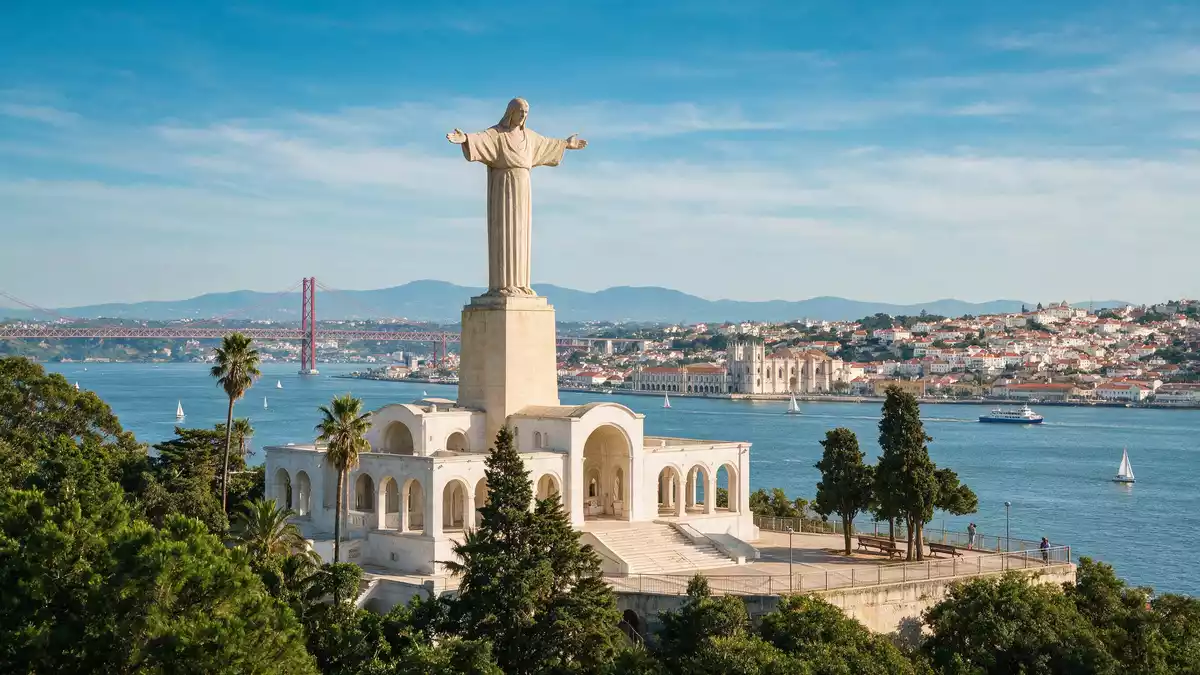
Cristo Rei in Almada is a monumental concrete figure of Christ raised on a towering pedestal above the River Tagus, facing Lisbon across the water. Completed in 1959 and dedicated as the National Sanctuary of Christ the King, it combines a Catholic shrine with a vast viewing platform over the estuary and the city’s skyline.
A riverbank sanctuary above the Tagus
The sanctuary stands on the south bank of the Tagus at Alto do Pragal in Almada, on a high plateau that drops away towards the broad river mouth. From this height, the monument looks across to Lisbon and the red span of the 25 de Abril Bridge, with the estuary’s channels and docks spread out below.Alto do Pragal in Almada The full Portuguese name, Santuário Nacional de Cristo Rei, signals its status as a national Catholic sanctuary rather than only a viewpoint.
The complex is arranged around a landscaped park with paths, lawns and simple plazas that frame the approach to the pedestal. At the heart of the sanctuary, a chapel and devotional spaces sit within the base, while the statue of Christ rises above on a cross-shaped support, arms open towards Lisbon. The composition makes Cristo Rei visible from wide stretches of the metropolitan area, both as a religious symbol and as a marker of the south bank.
Concrete, height and a cross-shaped pedestal
Cristo Rei is built in reinforced concrete, a material that gives the pedestal its straight planes and sharp vertical lines while supporting the weight of the figure above. The overall height is widely given as around 110 m (361 ft) from base to the top of the statue, placing the monument among the taller structures on the south bank skyline.Christ the King monument height The pedestal itself forms a simplified cross, with a central vertical tower and projecting arms that frame an opening beneath the statue.
Within the pedestal, lifts and stairways rise to an observation platform at the level of the statue’s feet, enclosed by parapets and open to the air. From here, visitors look along the Tagus towards the Atlantic and across to Lisbon’s hills, with the bridge deck almost level with the viewing terrace. The statue above, sculpted by Francisco Franco de Sousa, depicts Christ in long robes with outstretched arms, following the broad pose familiar from Rio de Janeiro’s Cristo Redentor while adapting it to the cross-shaped Portuguese pedestal.Francisco Franco de Sousa statue
A twentieth-century monument of gratitude
The idea of building Cristo Rei emerged in the twentieth century, linked to expressions of gratitude for Portugal’s peace during the years of the Second World War. The monument was inaugurated on 17 May 1959, placing it within the post-war decades when large religious structures were raised in several Catholic countries.inaugurated in May 1959 Its dedication to the Sacred Heart of Jesus reflects devotional currents of that period, which also informed the sanctuary’s interior chapels.
The statue’s general form was inspired by Brazil’s Christ the Redeemer in Rio de Janeiro, echoing its open-armed figure on a high promontory above a major city. In Almada, the Portuguese monument translates that idea to the broad valley of the Tagus and the urban fabric of Lisbon and the Setúbal District, giving the metropolitan area its own Christ figure on a riverbank height.inspired by Christ the Redeemer Since the mid-twentieth century, Cristo Rei has become a familiar outline on the horizon for travellers crossing the bridge or arriving by ship.
Visiting Cristo Rei: what travellers from Western Europe should know
- Cristo Rei stands on the south bank of the Tagus at Alto do Pragal in Almada, reached from Lisbon by crossing the river, including via ferry routes to Cacilhas and onward local transport.
- The sanctuary occupies a high plateau with outdoor paths and lawns, and access to the main terrace and the observation platform involves lifts and stairs inside the concrete pedestal.
- The monument is in Portugal, where the official language is Portuguese and the currency is the euro.
Searching for Cristo Rei on social platforms
These links open searches for Cristo Rei on each platform.
Frequently asked questions about Cristo Rei
Where is Cristo Rei located?
Cristo Rei is located at Alto do Pragal in Almada, on the south bank of the River Tagus opposite Lisbon in Portugal.
What can visitors expect during a visit?
Visitors find a landscaped sanctuary with a concrete pedestal housing chapels and lifts, leading to terraces and an observation platform with wide views over the Tagus and Lisbon.
What makes Cristo Rei distinctive among riverbank landmarks?
The combination of a twentieth-century Catholic shrine, a tall concrete cross-shaped pedestal, and a Christ statue facing Lisbon across the Tagus gives Cristo Rei a distinctive profile on the metropolitan skyline.


