
Cueva de las Manos and the painted canyon of Patagonia
Published on 08/18/2026 at 13:20 | Editorial responsibility: Rafael Müller, Editor-in-Chief AD HOC NEWS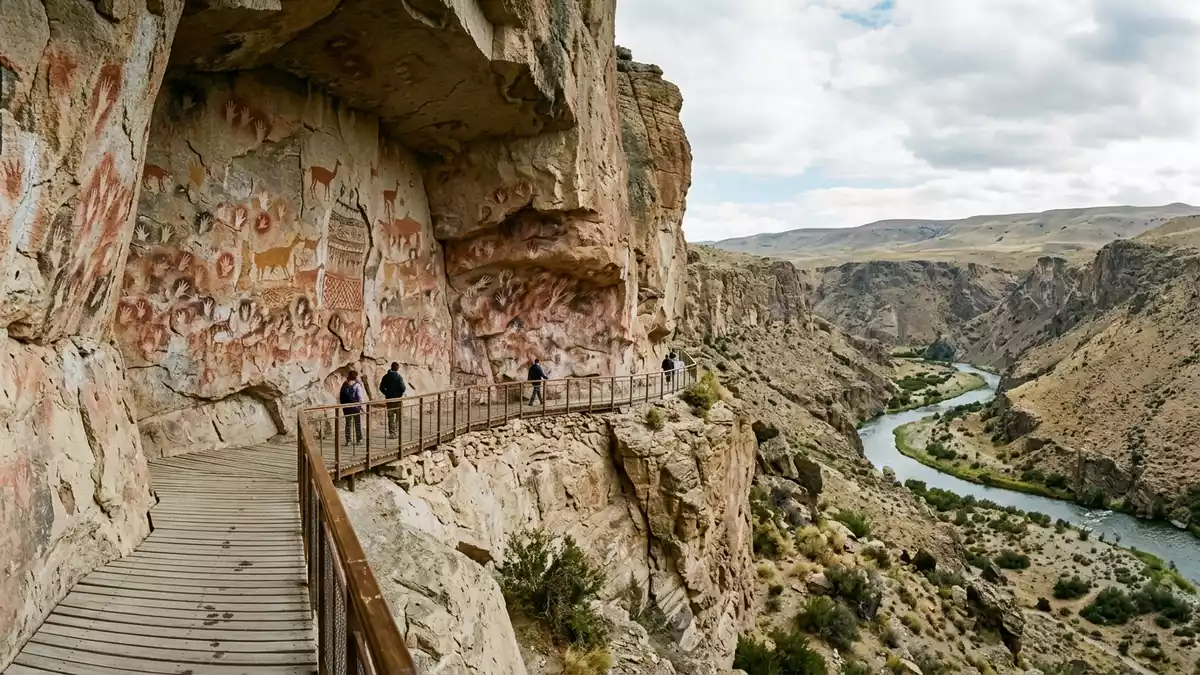
Cueva de las Manos in the Patagonian province of Santa Cruz is an archaeological site where ancient rock paintings cover a cliff face above the Pinturas River canyon. The cave and surrounding shelters lie between the towns of Perito Moreno and Bajo Caracoles in southern Argentina, and the paintings are dated to the early Holocene, with some panels executed more than 9,000 years ago.
A cliffside gallery above the Pinturas River
The site occupies a stepped cliff high above the Pinturas River, in the upper basin of the Deseado River, in an arid part of Patagonia where the landscape opens into a deep canyon and broad plateaus. The cave itself sits in this canyon wall at a substantial height above the riverbed, forming a natural shelter that was later enhanced by human occupation and painting.The site in the Alto Río Pinturas area is reached from the long north–south corridor of Ruta Nacional 40, with a branch road leading into the provincial park lands.
The rocky surroundings are composed of cliffs, ledges and protected overhangs that hold panels of art beyond the main cave, extending the experience into a wider landscape of painted rock shelters. The terrain is dry, with sparse vegetation and wide views across the plateau, and the cliff line itself forms a striking backdrop to the narrow course of the river below.A path along the canyon links the access point with the cave and neighbouring rock walls.
Handprints, hunting scenes and abstract figures
Cueva de las Manos takes its name from the dense band of stencilled handprints that runs along part of the cave wall, where hundreds of hands appear in black, white, red, yellow and other colours, creating a continuous frieze of overlapping silhouettes.More than 2,000 handprints are recorded at the site, many of them made by spraying pigment around hands pressed against the rock. Alongside the hands are depictions of guanacos and hunting scenes, where animal figures and human forms suggest movement across the rock surface.
The paintings cover several millennia of occupation, with stylistic phases identified by archaeologists: realistic hunting scenes associated with early occupation, bands of negative handprints, and later abstract motifs and geometric designs.Rock art executed between roughly 13,000 and 9,500 years ago forms part of this sequence, and further research has linked particular pigment compositions with dated occupation layers. The range of motifs and techniques turns the cliff wall into a layered record of hunter?gatherer communities across thousands of years.
Protection, research and visiting experience
Cueva de las Manos was declared a National Historic Monument in Argentina in 1993 and was inscribed on the UNESCO World Heritage List in 1999, recognising both the age and preservation of its paintings.The World Heritage inscription describes the ensemble as an exceptional example of early rock art, with hunting scenes and hand stencils in notably good condition. The site forms part of Parque Provincial Cueva de las Manos and is also linked with Perito Moreno National Park, placing it within a broader protected landscape.
Visitors encounter the paintings through a managed path system, with a route that approaches the cave along the canyon and passes a series of overhangs and vertical rock faces bearing panels of art.An interpretation centre at the access point presents the archaeological context, and guided routes focus on the main concentrations of handprints and hunting scenes. The combination of scientific study, legal protection and controlled access has helped maintain the condition of the paintings while making the site accessible to travellers interested in pre?Columbian art.
Visiting Cueva de las Manos: what travellers from Western Europe should know
- Cueva de las Manos lies in the canyon of the Pinturas River in Santa Cruz Province, reached by road from the town of Perito Moreno via Ruta Nacional 40 and a signed access route into the provincial park.
- The approach from the car park to the cave involves walking along a footpath on uneven ground, with sections close to the canyon edge and a noticeable gradient.
- The surrounding area forms part of a Patagonian plateau landscape, where weather can be variable and shade along the path is limited.
- The official language is Spanish and the currency is the Argentine peso.
- Entry requirements depend on your nationality; UK travellers can check the FCDO travel advice at gov.uk/foreign-travel-advice, Irish travellers the Department of Foreign Affairs at ireland.ie.
Searching for Cueva de las Manos on social platforms
These links open searches for Cueva de las Manos on each platform.
Frequently asked questions about Cueva de las Manos
Where is Cueva de las Manos located?
Cueva de las Manos is in Santa Cruz Province in southern Argentina, in the canyon of the Pinturas River between Perito Moreno and Bajo Caracoles, within a protected provincial park.
What can visitors expect on a visit?
Visitors follow a managed path along the canyon to reach a cave and nearby rock shelters where extensive panels of hand stencils, hunting scenes and other rock paintings are visible on the cliff walls.
What makes Cueva de las Manos distinctive?
The site combines thousands of early Holocene handprints and hunting scenes with a dramatic cliffside setting, and its paintings are among the best preserved and longest dated rock art sequences in Patagonia.


