
Culture ministry starts works at Ancient Olympia on 25 September
Published on 09/27/2026 at 10:46 | Editorial responsibility: Rafael Müller, Editor-in-Chief AD HOC NEWS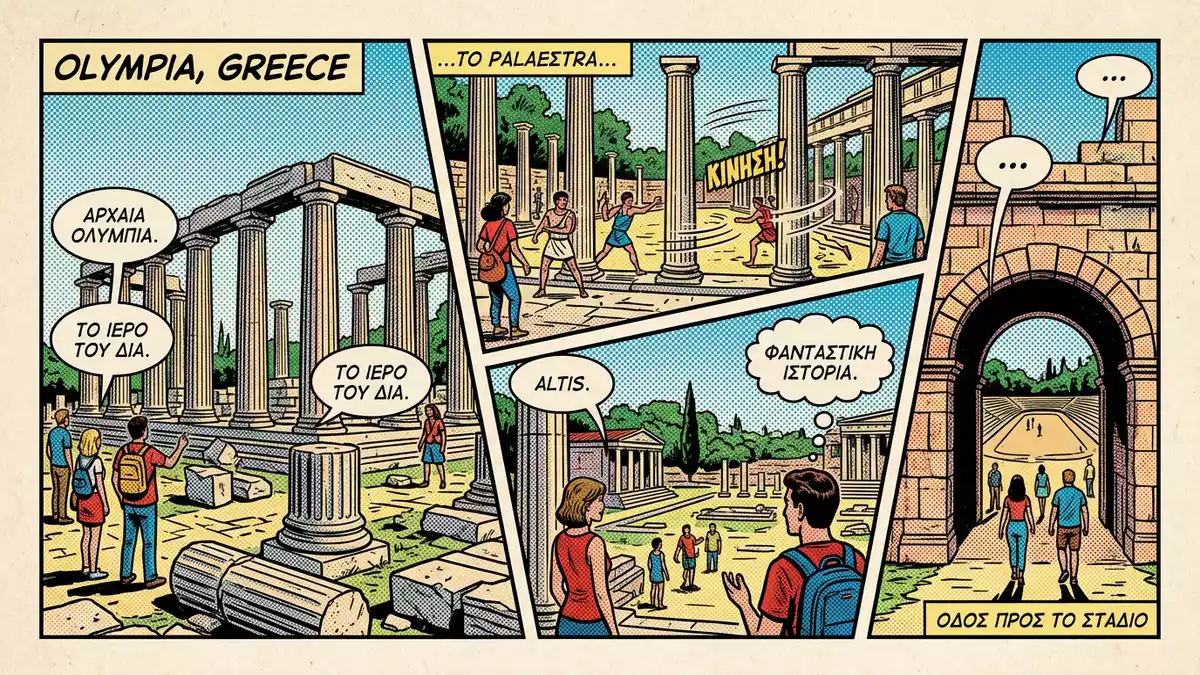
The Culture Ministry announced new restoration works at Ancient Olympia on 25 September 2026, placing the archaeological site in a fresh phase of protection and visitor improvements. The projects concern the Roman Octagon, the Gymnasium and the retaining wall of the Treasuries of Mount Kronion in Olympia, Greece.
The works were announced for the archaeological site of Ancient Olympia, where the ministry says the projects are already under way. The announcement follows the completion and public opening in April 2026 of three restored monuments: the Early Christian basilica or Workshop of Pheidias, the complex of the Southern Baths and the Baths of the Leonidaion.
Restoration works begin across three parts of Ancient Olympia
The new programme includes the restoration and presentation of the Roman Octagon, also called the House of Nero, the third phase of excavation and presentation at the Gymnasium, and protection for the retaining wall of the Treasuries of Mount Kronion. The Culture Ministry puts the combined budget at approximately EUR 4 million. Details of the three projects were reported on 25 September 2026.
At the Roman complex, planned work includes partial reconstruction of sections of masonry and vaulting, restoration of openings and the repositioning of fallen architectural members. The project also includes uncovering and protecting a mosaic floor with a new shelter, creating a visitor route and landscaping the surrounding area.
House of Nero links new work to Ancient Olympia history
The House of Nero forms part of the Southeast Baths, a complex with several building phases. The site began in the fifth century BC as a sanctuary of Hestia, while a stoa and additional areas were added in the third century BC. Between AD 65 and 67, a villa was built there for Emperor Nero during his visit to Olympia and later served as an official guesthouse.
In the early third century AD, the complex was remodelled as public baths. The Octagon became a monumental vaulted hall and the heated centre of the baths. Its surviving architectural elements, marble slabs, stone basin and ceramic features connect the current conservation work with the changing functions of this part of the sanctuary. UNESCO describes Olympia as a sanctuary in the western Peloponnese with temples, athletic buildings and remains associated with the Olympic Games.
The relationship between the new route and the ancient remains is direct: the planned access is intended to make the Octagon easier to understand while avoiding pressure on original floors and mosaics. The wider programme also aims to expand the area available for visitors, although the announcement does not specify a completion date or a temporary closure.
Visiting Ancient Olympia: what travellers from Western Europe should know
- The restoration phase was announced on 25 September 2026 and covers the Roman Octagon or House of Nero, the Gymnasium and the Treasuries of Mount Kronion.
- The announcement describes planned visitor routes and safe access at the Octagon, but does not state that the archaeological site is closed or provide a revised entrance arrangement.
- Ancient Olympia is in the western Peloponnese, in the valley formed by the Alpheios and Kladeos rivers. The site can be reached by bus, private vehicle or by train connections from Katakolon and Pyrgos.
- The archaeological area includes the Altis sanctuary, the Temple of Zeus, the Temple of Hera, the Stadium, the Gymnasium, the Palaestra and the Treasuries. Visitors should expect an open historic landscape with uneven archaeological remains and walking routes.
- Ancient Olympia has been on the UNESCO World Heritage List since 1989. The Ephorate of Antiquities of Elis, under Greece’s Culture Ministry, supervises the property.
Searching for Ancient Olympia on social platforms
These links open searches for Ancient Olympia on each platform.
Frequently asked questions about Ancient Olympia
What changed at Ancient Olympia on 25 September 2026?
The Culture Ministry announced three restoration and presentation projects at the archaeological site. They cover the Roman Octagon or House of Nero, the Gymnasium and the Treasuries of Mount Kronion.
What is being restored at Ancient Olympia?
The Roman Octagon project includes work on masonry, vaulting, openings, fallen architectural pieces and a mosaic floor. A visitor route and a protective shelter are also planned.
Where is Ancient Olympia and how do you get there?
Ancient Olympia is in the western Peloponnese, in the valley of the Alpheios and Kladeos rivers. The site can be reached by bus, private vehicle or train connections from Katakolon and Pyrgos.


