
Dai Noi Hue and the imperial heart of Vietnam’s former capital
Published on 08/18/2026 at 14:40 | Editorial responsibility: Rafael Müller, Editor-in-Chief AD HOC NEWS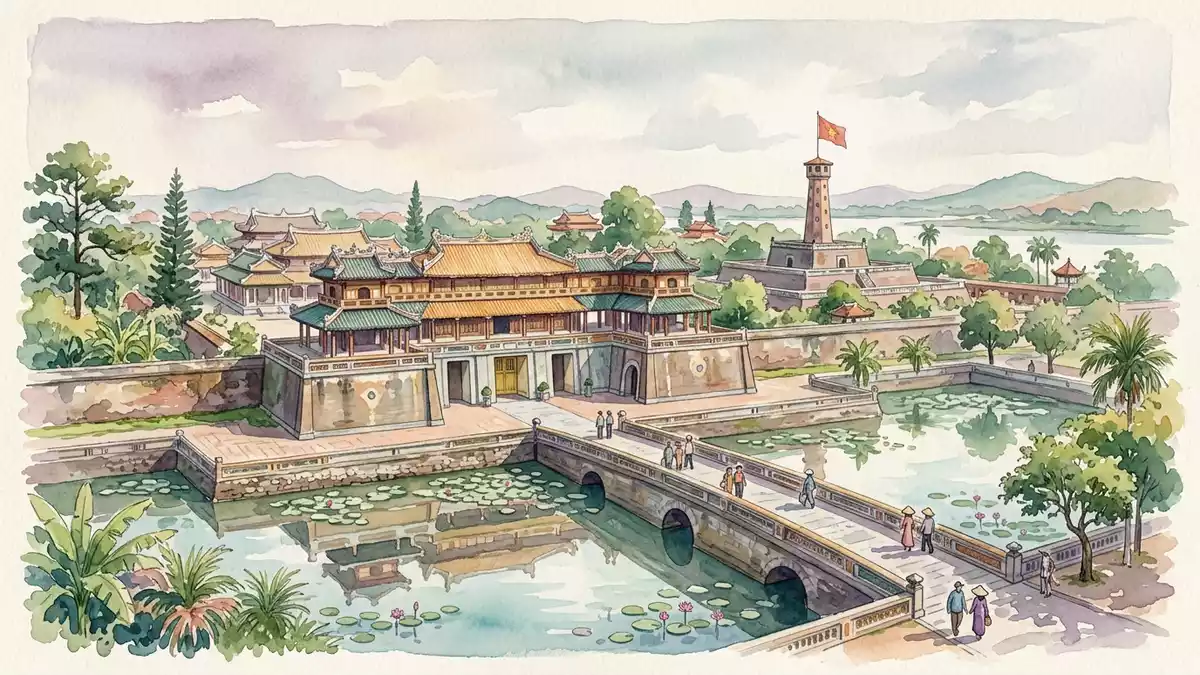
Dai Noi Hue, the Imperial City within Hue’s old citadel, is a walled royal enclosure on the north bank of the Perfume River in central Vietnam. Built in the early nineteenth century under the Nguyen dynasty, it formed the ceremonial and administrative heart of the imperial capital and still dominates the historic side of Hue.
Walled royal city on the Perfume River
The Imperial City known as Dai Noi occupies the inner section of Hue’s fortified Kinh Thanh, or walled city, laid out as the capital of the Nguyen dynasty in the nineteenth century.royal enclosure within the walled city It stands on the river’s north bank, facing Hue’s later commercial districts across the broad, slow course of the Perfume River.imperial citadel on the river’s left bank
The fortified perimeter of Hue’s citadel stretches for around 11 km (6.8 mi), forming a large rectangle edged by ramparts and a surrounding moat, with Dai Noi set inside as the royal precinct.7-mile walled circumference enclosed artifacts Within this enclosure, palace compounds, courtyards and ceremonial spaces created a self-contained inner city whose regular grid and axial layout still give Hue a distinctive historic structure.historical architectural complex in the heart of Hue
Nguyen dynasty power centre and palace world
Construction of the imperial enclosure began in 1804 under Emperor Gia Long, founding ruler of the Nguyen dynasty, as part of the project to establish Hue as Vietnam’s imperial capital.construction began in 1804 under Emperor Gia Long Within the outer citadel, Dai Noi formed the second ring of walls and gates protecting the most important palaces of state and the ancestral temples of the Nguyen rulers.second ring protecting palaces and temples
For much of the nineteenth and early twentieth centuries the Nguyen emperors and their courts lived and worked inside Dai Noi, which combined spaces for ritual, administration and daily royal life in one enclosed city.administrative and political centre and royal residence The compound contained audience halls, residential palaces, guardian gates, shrines and the innermost Forbidden Purple City reserved for the emperor and his household, all set within layered courtyards and gardens.
Architecture, restoration and UNESCO status
The architecture of Dai Noi blends Vietnamese planning traditions with influences from Chinese court design, expressed in axial symmetry, enclosed courtyards and timber halls with decorated roofs and lacquered interiors.Chinese-style Vietnamese imperial citadel Surviving gates, pavilions and palace structures show carved and painted ornament, glazed ceramic details and formal garden layouts that reflect the aesthetic of the Nguyen imperial court.palaces, gates, pavilions, temples and remains
Dai Noi forms part of the Complex of Hue Monuments, a cultural ensemble inscribed as a UNESCO World Heritage Site in 1993, recognising the outstanding testimony it offers to Vietnam’s last royal dynasty and its capital city.designation as a UNESCO World Cultural Heritage site Many palace buildings suffered damage in the twentieth century, yet restoration and conservation work has brought back key halls, gateways and ornamental features, leaving visitors able to walk through a substantial historic landscape of walls, moats and palace zones.
Visiting Dai Noi Hue: what travellers from Western Europe should know
- Dai Noi Hue lies in Hue in central Vietnam, within the historic citadel on the north bank of the Perfume River, opposite the city’s later commercial districts.
- The enclosure is surrounded by ramparts and a broad moat, and exploring the palace compounds involves walking through large courtyards, broad stone surfaces and long axial approaches.
- Hue’s main railway station and central hotel districts are on the south bank of the Perfume River, from where bridges and riverside roads lead towards the citadel gates giving access to Dai Noi Hue.
- The official language is Vietnamese and the currency is the Vietnamese dong.
- Entry requirements depend on your nationality; UK travellers can check the FCDO travel advice at gov.uk/foreign-travel-advice, Irish travellers the Department of Foreign Affairs at ireland.ie.
Searching for Dai Noi Hue on social platforms
These links open searches for Dai Noi Hue on each platform.
Frequently asked questions about Dai Noi Hue
Where is Dai Noi Hue located?
Dai Noi Hue stands within Hue’s historic citadel on the north bank of the Perfume River in central Vietnam, opposite the city’s later commercial areas.
What can visitors expect when exploring Dai Noi Hue?
Visitors encounter a large walled imperial enclosure with moats, gates, palace compounds and gardens, walking through expansive courtyards and restored royal architecture.
What makes Dai Noi Hue distinctive among historic sites?
Dai Noi Hue combines its role as the Nguyen dynasty’s imperial centre, its axial palace layout and its status within the UNESCO-listed Complex of Hue Monuments.


