
Dalt Vila, Ibiza’s hilltop walled old town
Published on 08/24/2026 at 06:28 | Editorial responsibility: Rafael Müller, Editor-in-Chief AD HOC NEWS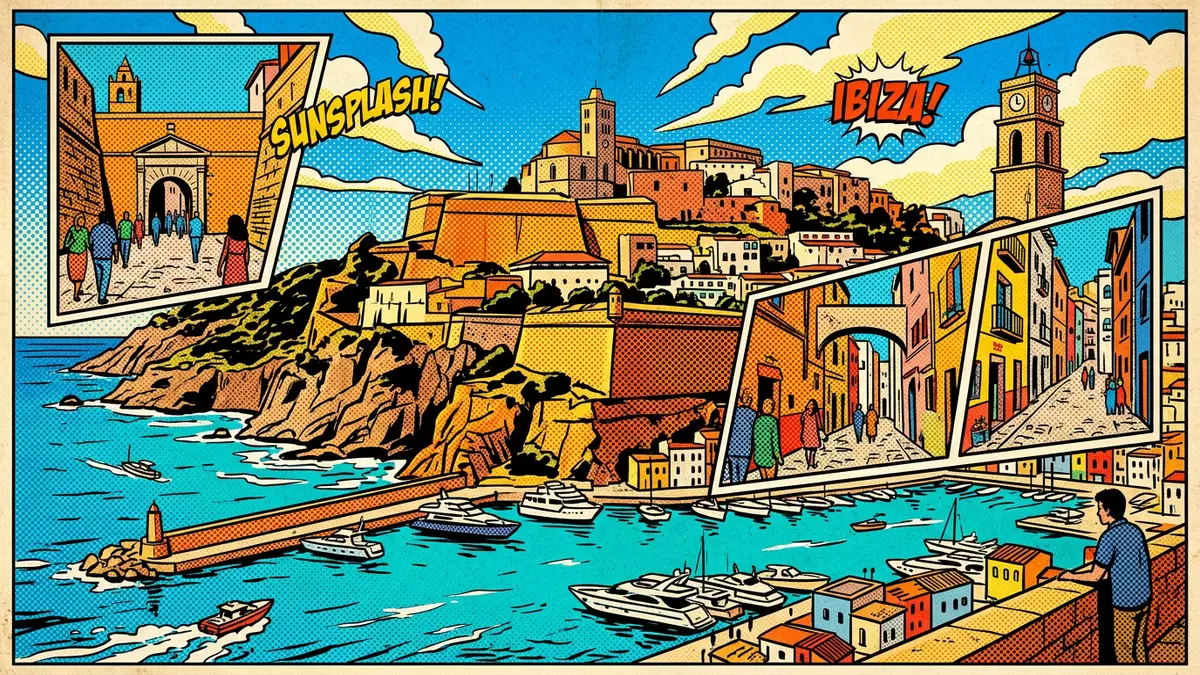
Dalt Vila is the fortified upper town of Ibiza City, rising as a walled acropolis above the harbour and the newer districts on the shoreline. It forms the historic core of Eivissa and has been part of the UNESCO World Heritage property “Ibiza, biodiversity and culture” since 1999, recognised for both its Renaissance fortifications and the archaeological depth of the site.Renaissance fortifications
A hilltop acropolis above the harbour
Dalt Vila occupies the summit of Puig de Vila, a hill that climbs from the working port to a compact plateau crowned by religious and civic buildings.Puig de Vila hilltop The elevation gives the district long views over the harbour, the surrounding coastline and out towards Formentera, while inside the walls the streets tighten into a network of cobbled lanes and stairways that follow the contours of the slope.
At the highest point of Dalt Vila stands the Cathedral of Our Lady of the Snows, a Gothic-Catalan church that has occupied the crest of the hill since the thirteenth century in one form or another.Cathedral of Our Lady of the Snows Around it sit the castle of Ibiza, sections of the old walls and the town hall, all enclosed within the Renaissance bastions that define the perimeter. Below the summit, stepped streets lead down towards the Sa Penya and La Marina quarters at sea level, marking a clear transition from the fortified acropolis to the working waterfront of Ibiza Town.Hilltop old town above harbour
Renaissance walls and bastions
The most striking feature of Dalt Vila is the ring of Renaissance-era fortifications that encircle the hill, forming an irregular heptagon reinforced by a series of bastions.Seven bastions in the wall These stone walls were ordered in the sixteenth century by Philip II of Spain and designed largely by Italian military engineer Giovanni Battista Calvi, creating a fortress system that reflects contemporary advances in artillery defence.Sixteenth-century fortifications
The walls are punctuated by named bastions and gateways that structure movement around and into the old town. Portal de ses Taules, the monumental main gate, is approached over a stone ramp and flanked by Roman statues and heraldic carvings, leading into the patio de armas and then to the Plaça de Vila, the principal open square inside the enclosure.Portal de ses Taules entrance A second gate, Portal Nou, opens on the Sant Pere bastion near the Reina Sofía park, providing another way into the interior of the fortifications.Portal Nou access Walking the perimeter along the tops of the walls reveals the scale of the engineering and sets Ibiza’s modern skyline against the mass of the stone ramparts.
Layers of history in the streets
Long before the Renaissance walls were built, the hill of Dalt Vila held a settlement that reaches back to the Phoenician foundation of Ibiza in 654 BC.Phoenician-era foundation Over successive centuries Romans, Islamic rulers and the Crown of Aragon occupied and reshaped the site, leaving physical traces that remain visible in the fabric of the streets, the layout of the fortifications and the archaeology beneath the paving.Layers of civilisation
Inside the walls, whitewashed houses, small palaces and former defensive structures line narrow passages that open occasionally into small plazas. Cultural buildings such as the Museum of Contemporary Art and the Archaeological Museum occupy restored historic premises, adding exhibition spaces to the existing masonry.Museums within the old town Shops, restaurants and galleries share the streets with residential properties, making the fortified quarter part of everyday life in Ibiza Town as well as a place where the island’s long history can be read on the walls.
Visiting Dalt Vila: what travellers from Western Europe should know
- Dalt Vila rises directly above the harbour of Ibiza Town on the hill of Puig de Vila, on the island of Ibiza in Spain. It is reached on foot from the surrounding Sa Penya and La Marina districts or by road up the access routes that approach the gates.
- The terrain inside the walls is steep, with cobbled streets, stepped alleys and sections of rampart walks that involve climbing gradients and staircases.
- Ibiza lies in Spain, where the official language is Spanish and the currency is the euro.
Searching for Dalt Vila on social platforms
These links open searches for Dalt Vila on each platform.
Frequently asked questions about Dalt Vila
Where is Dalt Vila located?
Dalt Vila is the historic walled upper town of Ibiza City on the island of Ibiza, in Spain, occupying the hill of Puig de Vila above the harbour.
What should visitors expect on a walk through Dalt Vila?
Visitors encounter steep cobbled streets, historic gateways, stretches of Renaissance wall, small squares and a cluster of significant buildings including the cathedral and castle.
What makes Dalt Vila distinctive compared with other parts of Ibiza?
The combination of sixteenth-century fortifications, a hilltop cathedral and an unbroken sequence of historic streets within a UNESCO-listed acropolis gives Dalt Vila a character distinct from the beach resorts and modern city districts.


