
Deir el-Bahari and the terraces of Hatshepsut
Published on 09/24/2026 at 03:45 | Editorial responsibility: Rafael Müller, Editor-in-Chief AD HOC NEWS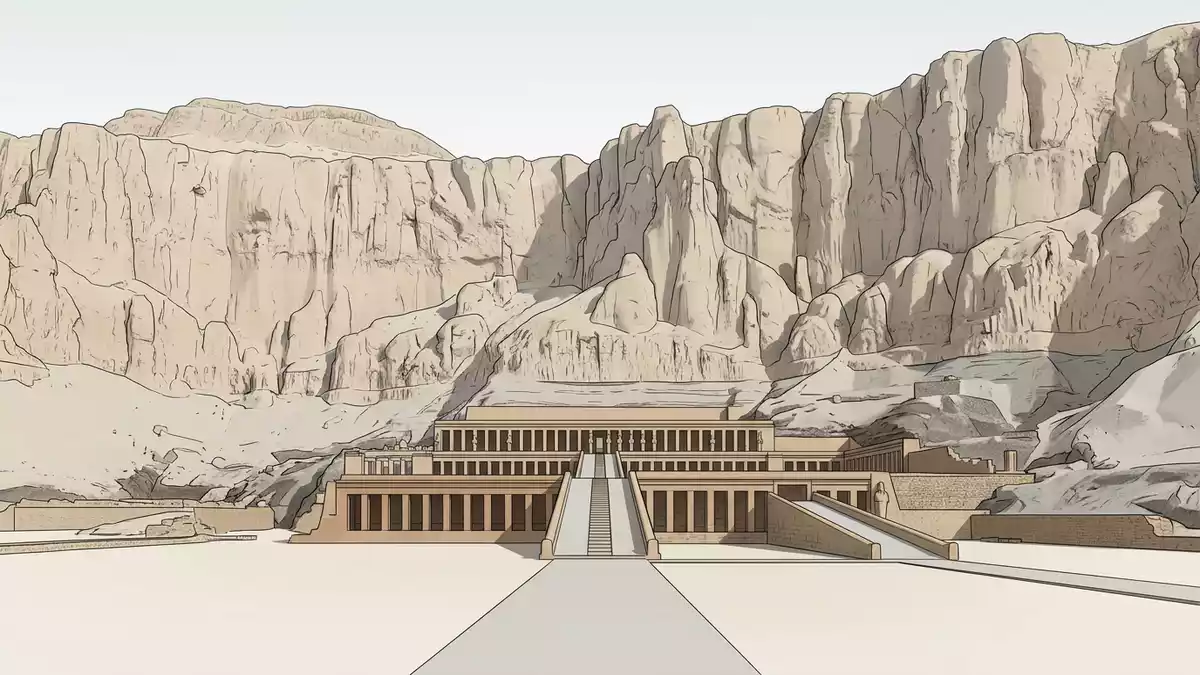
Deir el-Bahari is a funerary complex on the west bank of the Nile opposite Luxor. Its most recognisable monument is the terraced temple of Hatshepsut, whose pale colonnades rise beneath the Theban cliffs. The architecture brings broad horizontal platforms, carved stone and a steep natural wall into one scene.
Hatshepsut’s temple beneath the Theban cliffs
The principal monument is Djeser-Djeseru, a name translated as “the Holy of Holies”. Hatshepsut, a pharaoh of Egypt’s Eighteenth Dynasty, had the temple built during the fifteenth century BC. Its formal identity as a mortuary temple connects royal memory with the worship of Amun.
The building is arranged across terraced levels linked by broad ramps and colonnades. A long approach reaches the lower terrace, while higher platforms sit close to the limestone escarpment. The composition remains legible from a distance: horizontal stone bands meet the near-vertical rock face.
Stone terraces, colonnades and sacred rooms
Deir el-Bahari contains more than Hatshepsut’s temple. The complex also includes the remains of the mortuary temple of Mentuhotep II and another temple associated with the site’s long religious history. The monuments occupy the same desert basin beneath the mountain.
Hatshepsut’s temple includes a shrine to Amun and chapels connected with Anubis and Hathor. Reliefs show royal ceremonies, divine associations and the expedition to Punt. Colour survives in parts of the carved decoration, while other surfaces present the warm variation of weathered limestone. chapels and colonnades remain central to the monument’s layout.
Hatshepsut, Senenmut and the New Kingdom
Hatshepsut ruled Egypt during the Eighteenth Dynasty, within the New Kingdom. Senenmut, her chief steward and architect, is associated with the design of Djeser-Djeseru. The temple’s inscriptions present Hatshepsut with the titles and imagery of pharaonic authority.
The reliefs combine religious scenes with records of royal activity. Amun appears among the principal divine figures, while Hathor and Anubis have dedicated spaces within the complex. The temple therefore joins royal funerary practice, ritual architecture and historical imagery in a single group of terraces. Djeser-Djeseru and Senenmut identify the monument’s name and its designer.
Deir el-Bahari forms part of Ancient Thebes with its Necropolis, a UNESCO World Heritage property inscribed in 1979. Its setting links the temple complex with the wider Theban landscape, where limestone cliffs, desert ground and the Nile valley meet. the Theban World Heritage site places Deir el-Bahari within that larger historical landscape.
Visiting Deir el-Bahari: what travellers from Western Europe should know
- Deir el-Bahari lies on the west bank of the Nile opposite Luxor. Road transport from Luxor crosses the river and continues towards the Theban monuments.
- The approach crosses open desert ground before reaching the temple terraces. Ramps, steps and uneven stone surfaces form part of the visit.
- The site sits beneath the Theban cliffs, with strong changes in level between the lower platform, upper colonnades and rock face.
- The official language is Arabic and the currency is the Egyptian pound.
- Entry requirements depend on your nationality; UK travellers can check the FCDO travel advice at gov.uk/foreign-travel-advice, Irish travellers the Department of Foreign Affairs at ireland.ie.
Searching for Deir el-Bahari on social platforms
These links open searches for Deir el-Bahari on each platform.
Frequently asked questions about Deir el-Bahari
Where is Deir el-Bahari?
Deir el-Bahari is on the west bank of the Nile opposite Luxor in Egypt. The complex lies beneath the limestone cliffs of the Theban mountain.
What can travellers expect to see?
The visit includes terraced platforms, colonnades, ramps, reliefs, chapels and views across the desert basin. Uneven ground and changes in level are part of the site.
What makes Deir el-Bahari distinctive?
Its central temple combines broad stone terraces with the steep Theban cliff behind them. Hatshepsut, Senenmut, Amun, Hathor and Anubis are all connected with the monument’s surviving architecture and decoration.


