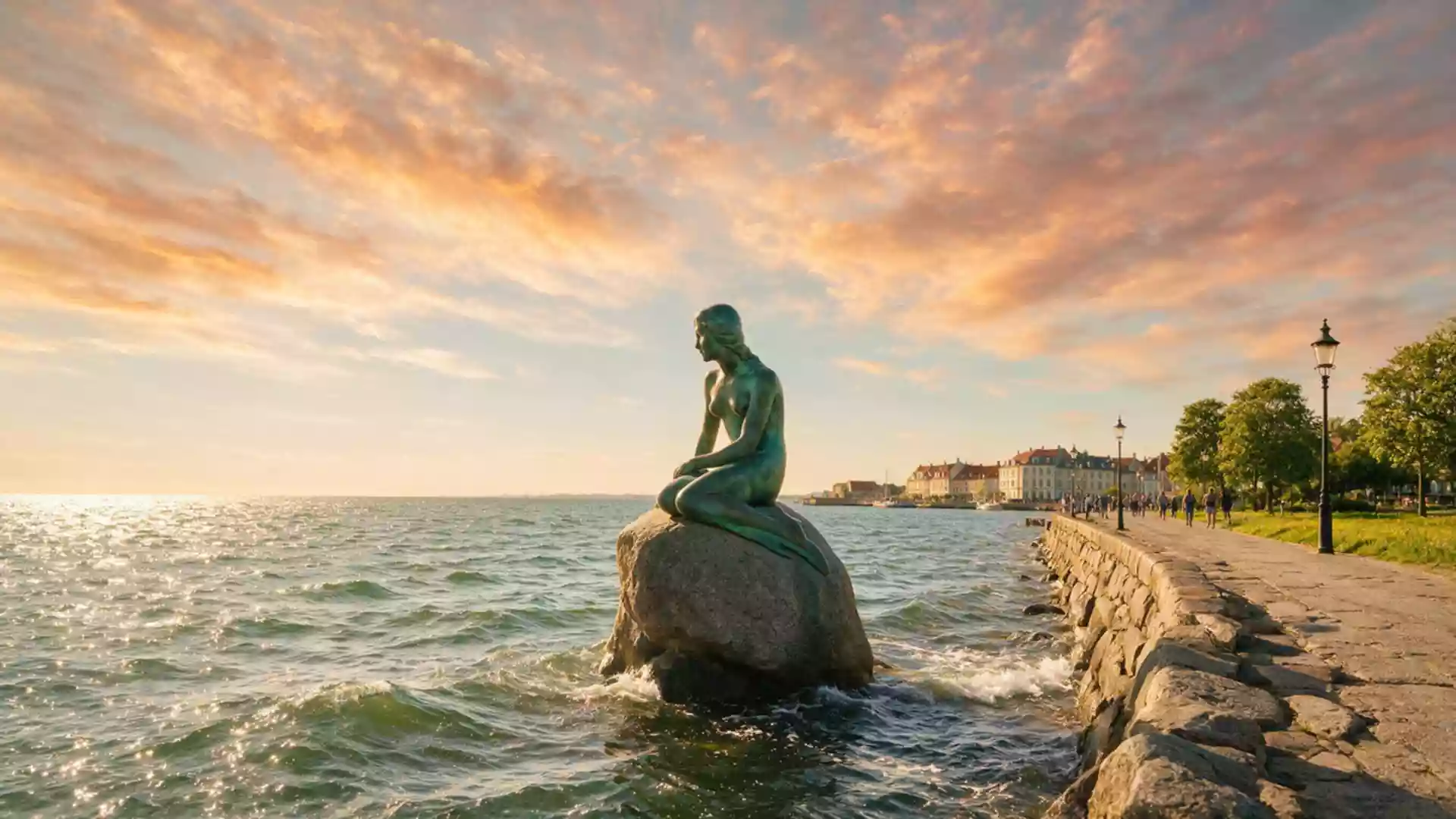
Den Lille Havfrue, a small bronze figure that anchors Copenhagen’s harbour
Published on 08/17/2026 at 13:57 | Editorial responsibility: Rafael Müller, Editor-in-Chief AD HOC NEWS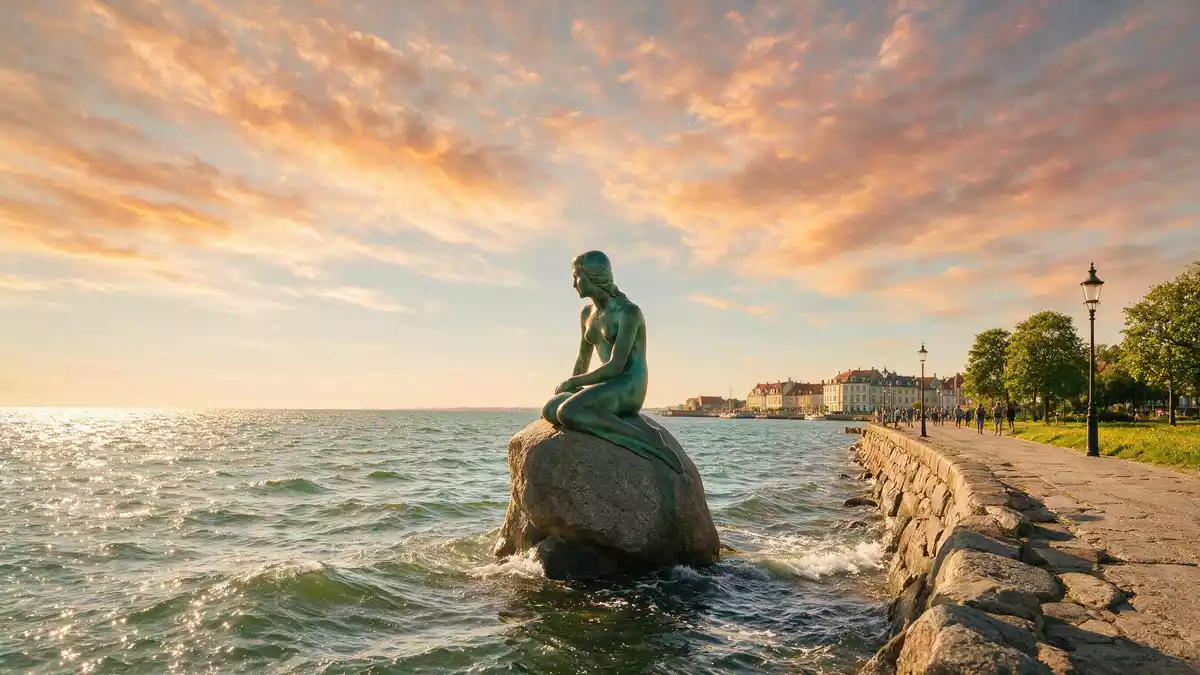
Den Lille Havfrue, known in English as the Little Mermaid, is a compact bronze figure perched on a harbour boulder at Langelinie in Kopenhagen, a permanent link between the city’s waterfront and Hans Christian Andersen’s mermaid tale from the nineteenth century. Cast in bronze and unveiled on 23 August 1913, the statue has become a fixed point on the edge of Copenhagen’s harbour rather than a grand monument in the centre of the city.
A small bronze figure on a harbour boulder
Den Lille Havfrue stands on a single natural boulder set at the water’s edge along the Langelinie promenade, with her tail folded beneath her and her gaze directed towards the harbour channel. The bronze figure is relatively small, around 1.25 m (about 4 ft) in height, and rests on a stone that rises only modestly above the surface of the water, so the statue feels almost at eye level when viewed from the pier.1.25 m bronze figure The surface of the bronze bears the smooth curves of a human torso and the distinct line where the body turns into a mermaid’s tail, echoing the transformation at the centre of Andersen’s story.bronze statue depicting a mermaid becoming human
The statue is set on a stretch of quay that was laid out as the Langelinie promenade around 1900, a waterfront walk that runs along the eastern side of Copenhagen’s inner harbour. The boulder carrying Den Lille Havfrue sits a short distance out from the edge of the pier, surrounded by smaller stones, so that the figure seems grounded in the harbour rather than isolated on a plinth.bronze sculpture on a boulder at Langelinie Ships turning into the harbour pass nearby, and the statue’s position by the fairway has helped to make it a recognisable marker of the city’s waterside.
From Hans Christian Andersen’s tale to Edvard Eriksen’s sculpture
The figure of Den Lille Havfrue is rooted in Hans Christian Andersen’s fairy tale “Den lille Havfrue”, first published in 1837, which tells of a young mermaid who longs for a human soul and gives up her life in the sea for love of a prince.fairy tale published in 1837 More than seventy years later, the story made the jump from page and stage to the harbour when Copenhagen brewer Carl Jacobsen, heir to the Carlsberg brewery and patron of the arts, commissioned a sculpture based on the mermaid after watching a ballet adaptation at the Royal Danish Theatre in 1909.commissioned by Carl Jacobsen after a 1909 ballet
Jacobsen asked the Danish sculptor Edvard Eriksen, born in 1876 and working in Copenhagen, to create the figure, and Eriksen produced the bronze mermaid that stands on the harbour boulder today.Den lille havfrue by Edvard Eriksen The finished statue was unveiled on 23 August 1913 and gifted by Jacobsen to the City of Copenhagen, becoming part of a wider programme of placing classical and historic figures in public spaces.unveiled on 23 August 1913 and gifted to the city In the decades that followed, the modest-sized mermaid became closely associated with Copenhagen’s identity, even though the statue itself remains physically small compared with monuments in other capitals.
Den Lille Havfrue in the harbour landscape of Kopenhagen
Den Lille Havfrue occupies a specific stretch of Copenhagen’s harbourfront at Langelinie, on the Østerbro side of the city, facing towards the inner harbour and the approaches from the Øresund.Langelinie Pier on the harbour The promenade behind the statue is paved and lined with railings in sections, with open views across the water to harbour installations and, further away, to the opposite shoreline. The mermaid’s boulder sits low in the water near the edge of the quay, and the surrounding stones create a small rocky outcrop that separates the figure from the main walkway.
This location at Langelinie places Den Lille Havfrue within a sequence of harbour landmarks, including quays used by cruise ships and views towards the Kastellet fort earthworks across the water. The statue’s setting amid working harbour structures, promenades and green embankments means that visitors see it in relation to both the city’s maritime infrastructure and its recreational waterfront spaces, rather than as an isolated artwork removed from everyday harbour life.harbour stretch at Langelinie on Østerbro
Visiting Den Lille Havfrue: what travellers from Western Europe should know
- Den Lille Havfrue stands on the harbourfront at Langelinie on the Østerbro side of Kopenhagen, a short walk from the railway station Østerport along the waterside promenade.
- The statue is reached by a paved promenade with some low steps and uneven stones near the water’s edge around the boulder, so firm footwear helps when approaching the immediate viewing area.
- The surrounding harbourfront combines open quays, railings and grassy embankments, and the mermaid’s boulder itself is in the water, so viewing is from the promenade rather than from beside the statue.
- The official language is Danish and the currency is the Danish krone.
Searching for Den Lille Havfrue on social platforms
These links open searches for Den Lille Havfrue on each platform.
Frequently asked questions about Den Lille Havfrue
Where exactly is Den Lille Havfrue in Kopenhagen?
Den Lille Havfrue is on the harbourfront at Langelinie on the Østerbro side of Kopenhagen, near the waterside promenade and within walking distance of Østerport station.
What should travellers expect when visiting the statue?
Travellers encounter a relatively small bronze mermaid set on a single boulder in the water beside the promenade, with open harbour views and working quays around it.
What makes Den Lille Havfrue distinctive among harbour landmarks?
The statue’s compact scale, bronze material and direct link to Hans Christian Andersen’s 1837 mermaid tale give it a literary character unusual for a harbour-side figure.