
Dendera Temple Complex and the star-filled temple of Hathor
Published on 08/25/2026 at 09:09 | Editorial responsibility: Rafael Müller, Editor-in-Chief AD HOC NEWS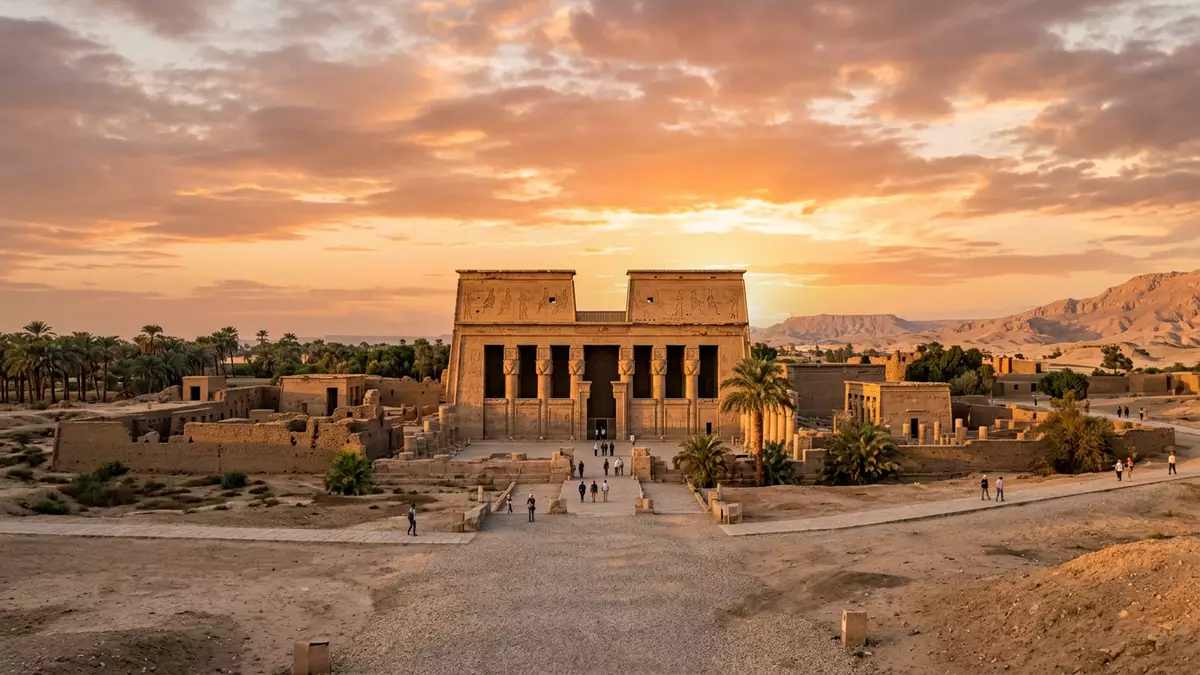
Dendera Temple Complex on the west bank of the Nile near Qena brings together stone, sky and story in one of the most complete ancient temple precincts in Egypt. At its heart stands the great Temple of Hathor, a Ptolemaic and Roman-era monument whose walls and ceilings are dense with hieroglyphs, deities and astronomical scenes that draw visitors through courts, hypostyle halls and rooftop chapels.
Hathor’s house between desert and river
Dendera Temple Complex lies in Upper Egypt, on the west bank of the Nile opposite the modern city of Qena, within a short stretch of river country that also includes Luxor downstream.Dendera in Upper Egypt The enclosure, laid out in stone and mud brick, forms a compact sacred city where the main sanctuary, subsidiary chapels and a sacred lake sit within a single walled precinct.The enclosure wall and sacred lake
The principal monument is the Temple of Hathor, begun in the first century BC under Ptolemy XII Auletes and decorated under the early Roman emperors, including Tiberius.Construction under Ptolemy XII and Tiberius It stands on ground that had been sacred for centuries, where earlier temples to Hathor, and probably to other deities, rose and fell across dynasties from the Old Kingdom onwards.A sanctuary to Hathor since the Old Kingdom
Courts, halls and crypts in carved sandstone
Approaching the Temple of Hathor, visitors pass through an open court framed by heavy stone colonnades whose capitals bear the face of Hathor, the goddess linked with music, joy and protection.Temple of Hathor at Dendera Beyond this court lies the great hypostyle hall, a forest of sandstone columns supporting a decorated ceiling, where painted figures and hieroglyphs stretch across the stone surfaces.
The plan of the temple runs from outer halls to progressively darker, more restricted chambers around the sanctuary, with side chapels and small rooms opening from the main axis.The temple’s modular plan Subterranean crypts run beneath parts of the building, reached by narrow stairways, with walls covered in raised reliefs that include the celebrated “Dendera light” scenes showing serpents emerging from lotus flowers. A stair within the masonry leads up to the roof, where chapels and open spaces give a different view of the temple and its surrounding landscape.
Star maps carved in stone
Dendera Temple Complex is closely associated with ancient Egyptian astronomy, not least through the famous Dendera Zodiac that once adorned a rooftop chapel dedicated to Osiris within the Temple of Hathor.The Dendera Zodiac bas-relief This circular sandstone relief, around 2.3 m (7.5 ft) across, shows constellations, planets and Egyptian deities arranged around a central sky figure.Circular star map in sandstone
Carved in the late Ptolemaic period, around 50 BC, the zodiac combines Babylonian-style constellations such as Taurus and Libra with Egyptian symbols, capturing the night sky in a single ordered composition.Dating of the Dendera Zodiac The original relief was removed in the nineteenth century and is now displayed in the Louvre in Paris, while a replacement occupies its position on the temple ceiling.Original zodiac now in the Louvre Inside the main hypostyle hall, another astronomical ceiling runs along the length of the chamber, adding further layers of celestial imagery to the stone canopy above.
Beyond Hathor’s sanctuary: subsidiary temples and sacred lake
The walled precinct at Dendera encompasses more than the central temple alone. To one side stands a smaller birth house, or mammisi, whose reliefs celebrate divine birth and royal legitimacy, attributed in its surviving form to the reign of Nectanebo II in the fourth century BC.Mammisi of Nectanebo II Another small temple honours Isis, reflecting the strong connections between the cults of Hathor and Isis during the late periods of Egyptian history.Subsidiary temples within the enclosure
Near these structures lies a stone-lined sacred lake, once used to supply water for ritual washing and daily temple activities, its surface reflecting the enclosure walls when filled.The sacred lake at Dendera In another corner of the precinct, ruins identified as a sanatorium suggest that pilgrims once came to sleep within the temple’s protection, seeking healing dreams related to Hathor’s attributes.
Visiting Dendera Temple Complex: what travellers from Western Europe should know
- Dendera Temple Complex stands on the west bank of the Nile opposite Qena in Upper Egypt, reached by road from Qena and by excursion routes from Luxor.
- The main temple and enclosure are built in sandstone and mud brick, with uneven floors, narrow staircases, crypt passages and roof access reached by long flights of stone steps.
- The site forms part of Upper Egypt, where Arabic is the official language and the currency is the Egyptian pound.
- Entry requirements depend on your nationality; UK travellers can check the FCDO travel advice at gov.uk/foreign-travel-advice, Irish travellers the Department of Foreign Affairs at ireland.ie.
Searching for Dendera Temple Complex on social platforms
These links open searches for Dendera Temple Complex on each platform.
Frequently asked questions about Dendera Temple Complex
Where is Dendera Temple Complex in relation to Qena and Luxor?
Dendera Temple Complex stands on the west bank of the Nile near Qena in Upper Egypt, upstream from Qena’s bridge crossings and north of Luxor.
What can visitors expect to see inside the complex?
Visitors encounter the large sandstone Temple of Hathor with its carved halls, crypts and rooftop chapels, as well as a sacred lake, a birth house and smaller temples.
What makes Dendera Temple Complex distinctive among Egyptian temples?
Dendera Temple Complex combines a well-preserved Ptolemaic and Roman-era temple of Hathor with rich astronomical ceilings, including the celebrated Dendera Zodiac, and subsidiary structures within one enclosure.


