
Dinh Doc Lap, Ho-Chi-Minh-Stadt’s palace of independence
Published on 08/22/2026 at 20:18 | Editorial responsibility: Rafael Müller, Editor-in-Chief AD HOC NEWS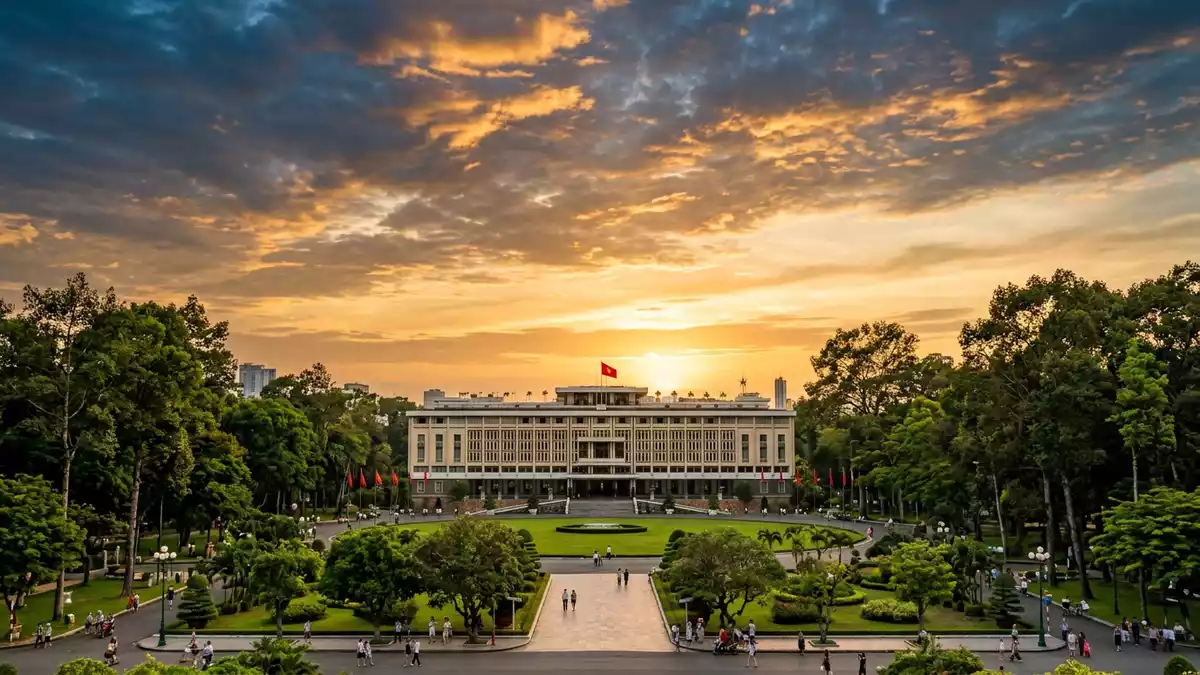
Dinh Doc Lap in Ho-Chi-Minh-Stadt, known in English as the Independence Palace or Reunification Palace, is a modernist presidential residence turned national historic site where Vietnam’s twentieth-century history is written into the fabric of the building. Completed in the 1960s for the president of South Vietnam and now recognised as a special national relic, it stands on Nam Ky Khoi Nghia Street in District 1 and preserves the rooms and furnishings of a former seat of power.
A modernist palace at the heart of Saigon
Dinh Doc Lap occupies a large city block in central Ho-Chi-Minh-Stadt, framed by major streets including Nam Ky Khoi Nghia, Huyen Tran Cong Chua, Nguyen Thi Minh Khai and Nguyen Du.The site at 135 Nam Ky Khoi Nghia Street lies within B?n Thành Ward in District 1, making the palace part of the city’s civic core.The Independence Palace national historic site describes the compound as a defined rectangle bordered on all sides by traffic, yet set back behind lawns and trees that soften the approach.
The current palace was designed by architect Ngo Viet Thu, a Vietnamese laureate of the Grand Prix de Rome, and dates from the 1960s, when it replaced an earlier colonial residence on the same block.Independence Palace is built in reinforced concrete with a long, horizontal façade articulated by repeating vertical fins and glazed bays, a form that expresses the confident geometry of mid-twentieth-century modernism. The building’s broad frontage faces a circular lawn and fountain, with a straight driveway leading to the main entrance, and its overall composition combines clean structural lines with decorative motifs drawn from Vietnamese tradition.
From presidential residence to historic monument
The story of Dinh Doc Lap begins in the nineteenth century, when the French colonial administration built the Norodom Palace as a governor’s residence on this site.Afar’s account of the Independence Palace traces how the complex later served Japanese officials during the Second World War and then became the home of the president of South Vietnam. After damage in the 1960s, the colonial building gave way to the present modernist structure, which became the official presidential palace of the Republic of Vietnam until April 1975.
On 30 April 1975, North Vietnamese tanks breached the gates of Dinh Doc Lap, an episode widely known as the Fall of Saigon and remembered as the symbolic end of the Vietnam War.The Vietnamese-language entry on Dinh ??c L?p notes that the palace has since been classified as a specially protected national historic site. Its official administrative name, Hoi Truong Thong Nhat – Reunification Hall – reflects this role as a place where state ceremonies, conferences and cultural events sit alongside museum functions, making the building both a working convention hall and a preserved monument.
Inside the preserved rooms and subterranean bunker
Visitors walking through Dinh Doc Lap encounter a sequence of formal spaces that remain furnished largely as they were in the final years of South Vietnam. Reception rooms, banquet halls and office suites display period décor, from polished timber furniture and patterned carpets to chandeliers and sculptural screens. The layout presents an ordered progression from the grand ground-floor halls used for ceremonial gatherings up to more private spaces, including the presidential living quarters and rooftop terrace.
One of the most striking contrasts lies between the airy upper rooms and the utilitarian structures below ground. Beneath the palace, an underground bunker complex was constructed as a command centre, with narrow corridors, communications rooms and reinforced concrete walls documented in site descriptions.Equatorial Ho Chi Minh City’s overview of the palace highlights the preserved war rooms and the rooftop helicopter pad as part of a tour that reveals how the building functioned during the conflict years. Exhibits of documents, maps and artefacts reinforce the sense of a place where decisions were taken and history unfolded, while the architecture itself communicates the priorities of its era.
Visiting Dinh Doc Lap: what travellers from Western Europe should know
- Dinh Doc Lap stands in District 1 of Ho-Chi-Minh-Stadt at 135 Nam Ky Khoi Nghia Street, within walking distance of several other central landmarks and easily reached by urban transport.
- The palace complex covers an extensive plot with lawns and internal courtyards; visits involve moving through multiple storeys, including staircases and, for those who choose to descend, narrow corridors in the bunker.
- The country’s official language is Vietnamese and the currency is the Vietnamese dong; English-language information panels are present in many exhibition areas.
- Entry requirements depend on your nationality; UK travellers can check the FCDO travel advice at gov.uk/foreign-travel-advice, Irish travellers the Department of Foreign Affairs at ireland.ie.
Searching for Dinh Doc Lap on social platforms
These links open searches for Dinh Doc Lap on each platform.
Frequently asked questions about Dinh Doc Lap
Where is Dinh Doc Lap located in Ho-Chi-Minh-Stadt?
Dinh Doc Lap is in District 1 at 135 Nam Ky Khoi Nghia Street, within the B?n Thành area of central Ho-Chi-Minh-Stadt.
What can visitors expect on a visit to Dinh Doc Lap?
Visitors move through preserved ceremonial rooms, private quarters, exhibition spaces and an underground bunker, with period furnishings and historical displays throughout the complex.
What makes Dinh Doc Lap distinctive among Vietnam’s historic sites?
The palace combines 1960s modernist architecture by Ngo Viet Thu with intact interiors and a documented role in major twentieth-century events, giving it a dual identity as museum and functioning convention hall.


