
Drottningholms slott, a royal island world west of Stockholm
Published on 08/18/2026 at 14:46 | Editorial responsibility: Rafael Müller, Editor-in-Chief AD HOC NEWS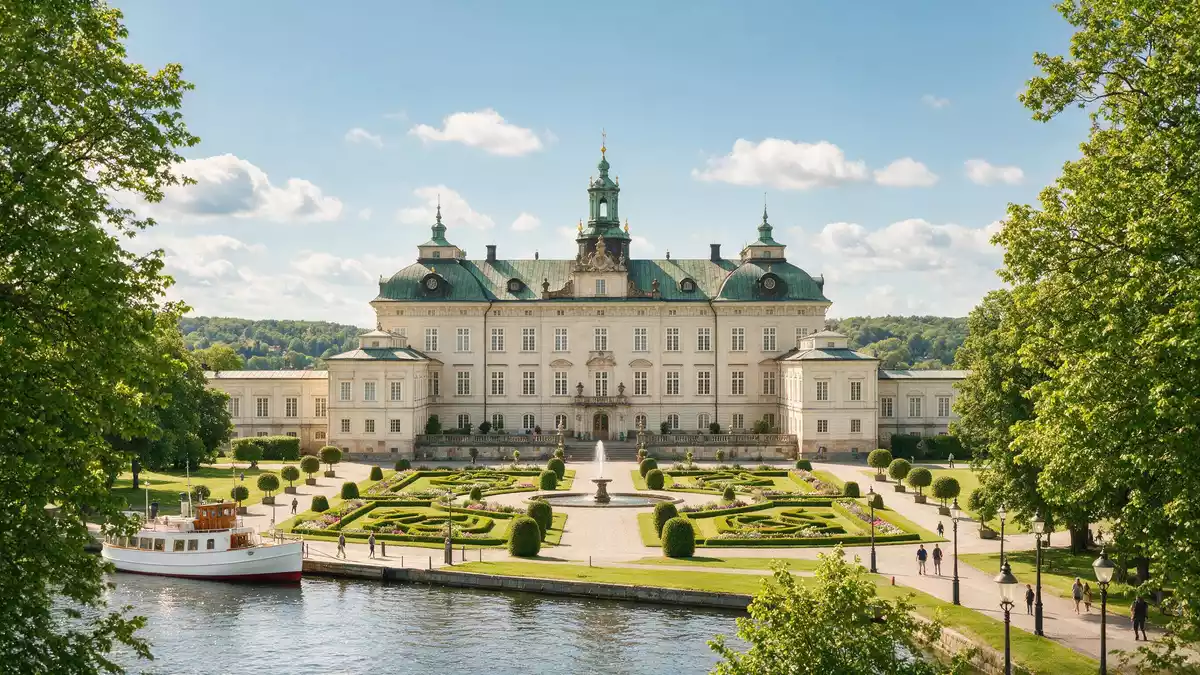
Drottningholms slott, known in English as Drottningholm Palace, occupies the island of Lovön in Lake Mälaren just west of Stockholm and forms a complete royal world of palace, theatre, pavilion and gardens woven together over several centuries. The Royal Domain was inscribed on the UNESCO World Heritage List in 1991, recognising a setting that still reflects seventeenth- and eighteenth-century European court life.
A seventeenth-century palace shaped by European courts
The core of Drottningholms slott is the palace itself, a seventeenth-century royal residence built in stone with a broad, horizontal form and mansard roofs looking out over the water of Lake Mälaren. The present palace was commissioned for Queen Hedvig Eleonora after a previous building on the site was destroyed, and main construction began in the 1660s under the Swedish architect Nicodemus Tessin the Elder, later continued by his son Nicodemus Tessin the Younger as the complex grew.Drottningholm Palace The palace combines influences from France and Italy with Swedish building traditions, creating a residence that stands as one of the most intact royal castles of the 1600s in Sweden.Royal Domain of Drottningholm
Symmetry governs the main façades of Drottningholms slott: central entrance bays, ordered rows of windows and projecting corner pavilions lead the eye along a formal sequence from water to palace and onwards into the gardens. Inside, state rooms retain stucco ceilings, painted wall panels and tapestries that reflect the ceremonial life of the Swedish court, while private apartments show changing tastes over the eighteenth and nineteenth centuries. The palace also serves as the permanent home of the Swedish king and queen, with parts reserved as a private residence and other wings and halls accessible as a museum of royal interiors.The Drottningholm Palace residence
Gardens in three European styles
The grounds around Drottningholms slott unfold in a sequence of distinct garden types, each tied to a period and a royal patron. Closest to the palace lies a Baroque parterre created in the late seventeenth century under Queen Hedvig Eleonora, guided by Nicodemus Tessin the Elder and Nicodemus Tessin the Younger.Baroque garden at Drottningholm Axial paths, clipped hedges, water basins and carefully aligned sculptures create a strict, ordered composition influenced by contemporary palace gardens in France.
Further from the palace, the character softens around the Chinese Pavilion, a mid-eighteenth-century pleasure pavilion designed by Carl Fredrik Adelcrantz at the request of Queen Lovisa Ulrika.Chinese Pavilion ensemble Here chestnut-lined avenues, smaller bosquets and ornamental buildings introduce rococo garden ideas, with winding walks and framed views. Beyond these, an English-style landscape park was laid out to the north of the Baroque garden in the late eighteenth century, developed after Gustav III took over Drottningholm in 1777 and commissioned Fredrik Magnus Piper to create a more naturalistic park. Meadows, free-growing trees and water features form long perspectives, giving visitors a sense of moving through three centuries of European garden design in a single continuous walk.History of Drottningholm gardens
The palace theatre and Chinese Pavilion
Drottningholms slott is inseparable from its specialised buildings, notably the Drottningholm Palace Theatre and the Chinese Pavilion. The theatre, completed in 1766 beside the palace, is renowned for its preserved eighteenth-century stage machinery, decorations and auditorium, forming one of the most complete historic court theatres in Europe.Palace Theatre at Drottningholm Wooden winches, pulleys and painted flats remain capable of creating rapid scene changes and special effects in the original manner, and the building continues to host performances that draw on this historic equipment.
The Chinese Pavilion, with its gilded ornament and chinoiserie interiors, stands as a testament to eighteenth-century fascination with East Asian art and architecture. The pavilion sits within its own cluster of small service buildings sometimes referred to as Canton Village, all integrated into the surrounding gardens.Royal Domain ensemble Together with the palace, theatre and park, these structures form the Royal Domain of Drottningholm, recognised by UNESCO under criterion (iv) as an outstanding example of a north European royal residence influenced by the Palace of Versailles and representative of European architecture of the seventeenth and eighteenth centuries.UNESCO statement of value
Visiting Drottningholms slott: what travellers from Western Europe should know
- Drottningholms slott stands on the island of Lovön in Lake Mälaren, west of central Stockholm, and is reached by road and by boat from the city’s waterfront.
- The palace complex and gardens extend over gently varied ground; paths pass formal terraces, long avenues and lawns, with some longer walks across the English-style park.
- The palace and park lie within Sweden, where the official language is Swedish and the currency is the Swedish krona.
Searching for Drottningholms slott on social platforms
These links open searches for Drottningholms slott on each platform.
Frequently asked questions about Drottningholms slott
Where is Drottningholms slott?
Drottningholms slott is on the island of Lovön in Lake Mälaren, west of Stockholm, within the municipality of Ekerö in Sweden.
What can visitors expect at Drottningholms slott?
Visitors encounter a seventeenth-century royal palace with historic interiors, extensive formal and landscape gardens, and access to specialised buildings such as the palace theatre and the Chinese Pavilion.
What makes Drottningholms slott distinctive among European palaces?
Drottningholms slott forms an unusually complete ensemble of palace, theatre, pavilion and gardens, recognised as a UNESCO World Heritage Site for its well-preserved seventeenth- and eighteenth-century royal setting.


