
Dujiangyan and the dam-free river that shaped Chengdu
Published on 08/23/2026 at 07:33 | Editorial responsibility: Rafael Müller, Editor-in-Chief AD HOC NEWS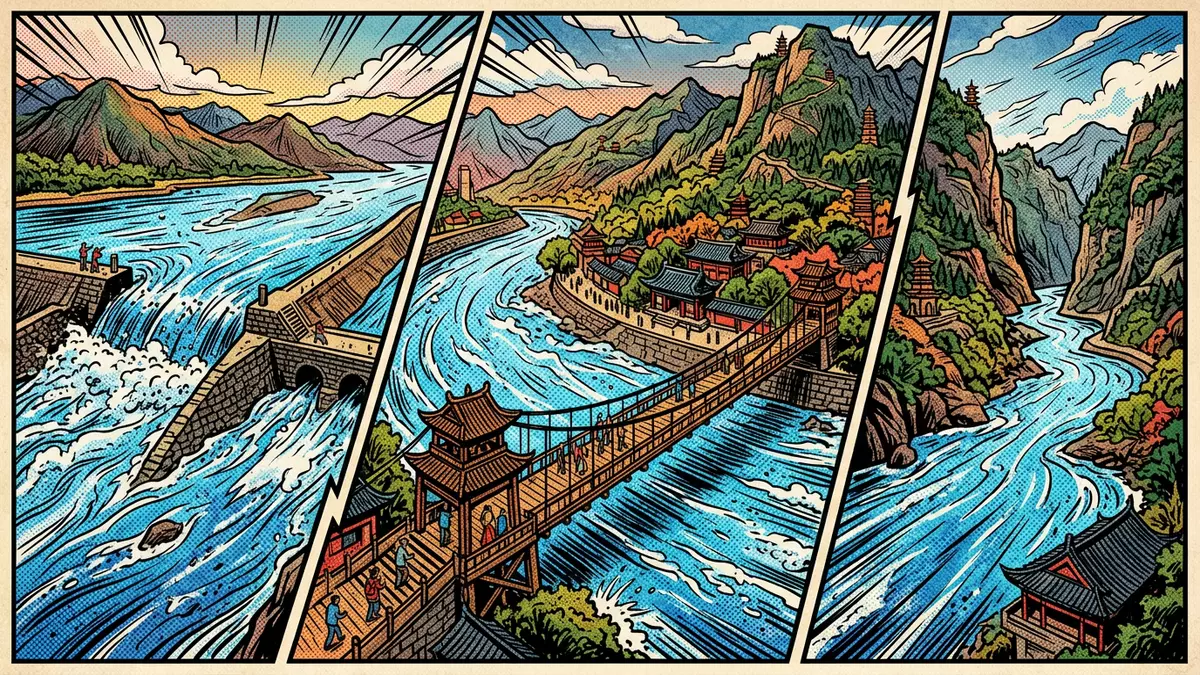
On the western edge of the Chengdu Plain in China, Dujiangyan shows how an ancient river can be steered without a dam. The irrigation system, begun in the third century BC under the Qin official Li Bing, still divides and tames the Minjiang River for the lowland fields of Sichuan.
An ancient river project in the Chengdu Plain
Dujiangyan stands where the Minjiang River descends from the highlands towards the broad basin around Chengdu, at the transitional zone between the Qinghai–Tibet Plateau and the Sichuan Basin. The scheme took shape around 256 BC, when Li Bing, then governor of Shu Prefecture under the Qin state, oversaw the construction of a hydraulic system that worked with the existing river rather than blocking it.constructed around 256 BC
The core of Dujiangyan lies near the present-day city that shares its name, north-west of Chengdu, along the middle reaches of the Minjiang River.located near Dujiangyan City in Sichuan From this headwork area, a controlled share of the river flows into channels that spread across the Chengdu Plain, feeding an irrigated landscape that has supported agriculture for over two millennia.in operation for about 2,300 years
Three stone works instead of a dam
The striking feature of Dujiangyan is what it does not have: there is no solid wall across the Minjiang River. Instead, the system centres on three linked works known as Yuzui, Feishayan and Baopingkou, which together divide, spill and direct the flow.three main structures shape the flow
Yuzui, often translated as the Fish Mouth, is a long, curved embankment that projects into the river and splits it into an inner and an outer channel. Feishayan, sometimes called the Flying Sand Weir, lies downstream as a low overflow that lets excess water and sediment escape back towards the outer channel. Baopingkou, the Bottle-Neck Channel cut through the rocky spur of Yulei Mountain, forms a narrowed opening where the inner river enters the irrigation area.headworks of the Dujiangyan Irrigation Scheme
A living World Heritage landscape of water and stone
Dujiangyan functions both as engineering work and as a cultural landscape in its own right. The headworks and the irrigated area together form part of the World Heritage property “Mount Qingcheng and the Dujiangyan Irrigation System”, inscribed on the UNESCO List in 2000 for their significance in the history of water management and for their association with Chinese thought.inscribed as World Heritage in 2000
Within the site, terraces and embankments of stone and packed earth line the channels, and paths trace the edges of the works, giving clear views of the river, the weirs and the cut through Yulei Mountain. From vantage points around the headworks, visitors can see how the river divides around the Yuzui embankment and how the inner channel leads away towards the Chengdu Plain, with the forested slopes of Mount Qingcheng rising further to the west.World Heritage landscape of Mount Qingcheng and Dujiangyan
Visiting Dujiangyan: what travellers from Western Europe should know
- Dujiangyan lies to the north-west of Chengdu in Sichuan Province, and the headworks area stands near the modern Dujiangyan City on the Minjiang River.
- The terrain around the headworks combines riverside paths, stone embankments and stepped approaches on the slopes beside Yulei Mountain.
- The official language is Chinese and the currency is the Chinese yuan.
- Entry requirements depend on your nationality; UK travellers can check the FCDO travel advice at gov.uk/foreign-travel-advice, Irish travellers the Department of Foreign Affairs at ireland.ie.
Searching for Dujiangyan on social platforms
These links open searches for Dujiangyan on each platform.
Frequently asked questions about Dujiangyan
Where is Dujiangyan?
Dujiangyan lies on the Minjiang River in Sichuan Province, north-west of Chengdu on the edge of the Chengdu Plain.
What can visitors expect at Dujiangyan?
Visitors see an ancient hydraulic system made of embankments, spillways and channels, with paths along the river and views towards the slopes of Mount Qingcheng.
What makes Dujiangyan distinctive?
Dujiangyan is a large ancient irrigation and flood-control project that works without a dam, begun around 256 BC and recognised as part of a UNESCO World Heritage site.


