
Duomo di Milano and its forest of marble pinnacles
Published on 08/18/2026 at 14:18 | Editorial responsibility: Rafael Müller, Editor-in-Chief AD HOC NEWS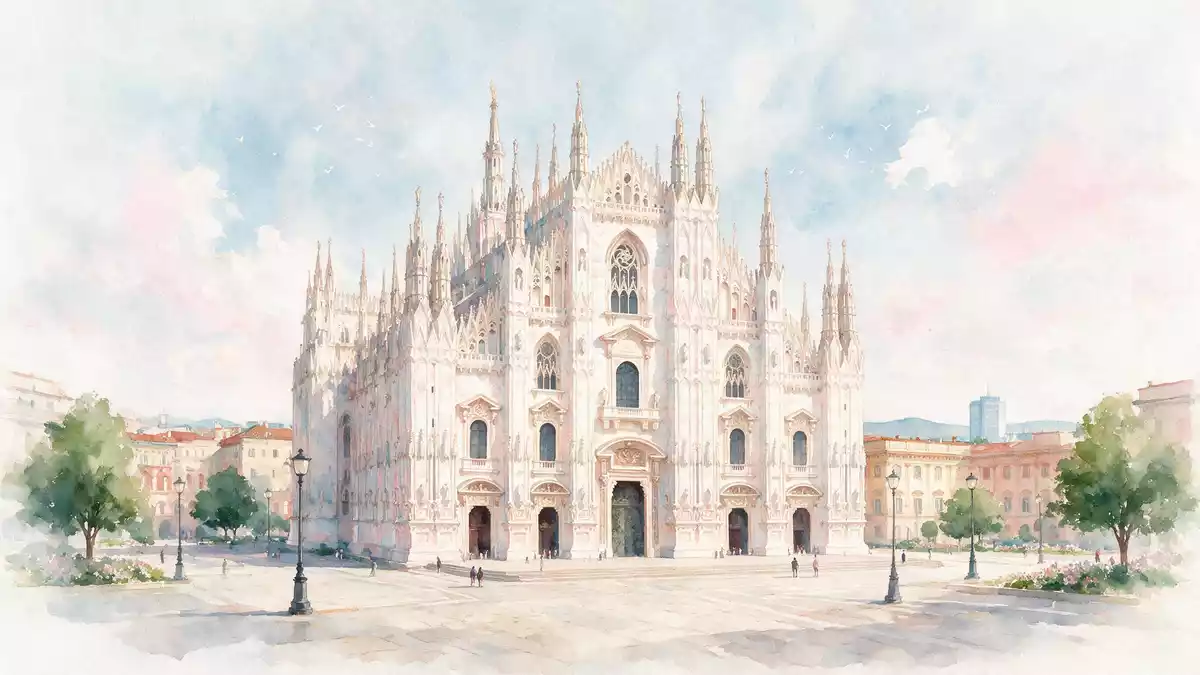
Duomo di Milano rises over the main square of Mailand as a pale marble mass that turns into a forest of pinnacles and statues when seen up close. Construction of this Gothic cathedral began in 1386 under Gian Galeazzo Visconti, and the building reached formal completion only in the twentieth century, giving it a layered character that spans late medieval to modern craftsmanship.Construction work on the Duomo began in 1386
A Gothic mountain of Candoglia marble
From the square, Duomo di Milano appears almost like a carved mountain of stone, yet the material is carefully chosen Candoglia marble rather than rough rock. The cathedral stretches to an external length of about 158 m (518 ft), with a broad façade that carries vertical lines of buttresses, pinnacles and statues that pull the eye upwards.Outer length of 158 metres The main body follows a Latin cross layout with a long nave and a transept, typical of Gothic cathedrals in Europe.Cruciform Gothic plan with nave and transept
The surface of the building is crowded with sculpted figures. Thousands of statues cling to façades, niches and pinnacles, including prophets, saints, fantastical creatures and decorative foliage motifs.Thousands of statues inside and outside the Duomo Above the crossing rises the main spire, completed in the eighteenth century, which carries the gilded statue of the Virgin Mary known as the Madonnina, a landmark figure that glows against the sky in clear weather.The Madonnina statue crowns the main spire
Six centuries of building on a sacred site
The ground beneath Duomo di Milano has served as a religious centre since late Roman times, long before the Gothic cathedral took shape. In the fourth century, the area carried early Christian basilicas, and the site remained central to the city’s religious life as Mailand grew into a regional power.The patch of ground has been sacred for about 1,700 years When Archbishop Antonio da Saluzzo and Gian Galeazzo Visconti launched the new cathedral in 1386, they did so on this already hallowed ground.
Work on Duomo di Milano extended across around six centuries, with major phases in the Gothic era, the Counter-Reformation, the eighteenth century and the nineteenth century, and final decorative work in the 1960s.Construction began in 1386 and final details were completed in 1965 The façade integrates Gothic forms with later Neoclassical elements, while the roofscape preserves the original vision of dense pinnacles and flying buttresses rising above the city.Façade with Gothic and Neoclassical phases
Interior space, stained glass and rooftop perspectives
Inside, Duomo di Milano forms a vast five-aisled hall, lined with massive pillars and tall pointed arches that support the high vaults.A five-aisled basilica in the late French Gothic style The nave stretches for about 148 m (486 ft), and the ceiling height emphasises verticality, echoing the exterior’s upward emphasis.Internal length of around 148 metres Light filters through large stained-glass windows in the apse and chapels, many of them filled with coloured scenes from biblical narratives.
Travellers who climb or take a lift to the terraces encounter Duomo di Milano as a walkable piece of sculpture. Pathways thread among the marble pinnacles and flying buttresses, bringing visitors level with statues that from the square appear tiny.Roof terraces among pinnacles and spires From this height, the Madonnina stands slightly above, and the regular grid of Mailand’s surrounding streets spreads out around the piazza dominated by the cathedral.City streets radiate from the cathedral square
Visiting Duomo di Milano: what travellers from Western Europe should know
- Duomo di Milano stands on Piazza del Duomo in the centre of Mailand, with Milano Centrale railway station linked by metro lines that stop at the nearby Duomo station.
- The cathedral’s interior is mostly level stone paving, but access to the terraces involves staircases as well as lift options, and the rooftop pathways pass between dense rows of marble pinnacles.
- To the west of Duomo di Milano, the nineteenth-century Galleria Vittorio Emanuele II opens off the square, forming a covered passage lined with shops and cafés beneath a glass and iron roof.
- The official language is Italian and the currency is the euro.
Searching for Duomo di Milano on social platforms
These links open searches for Duomo di Milano on each platform.
Frequently asked questions about Duomo di Milano
Where is Duomo di Milano located?
Duomo di Milano stands on Piazza del Duomo in the historic centre of Mailand, in northern Italy, surrounded by major shopping streets and civic buildings.
What can visitors expect inside the cathedral?
Visitors enter a vast five-aisled Gothic interior with towering pillars, stained-glass windows, chapels along the sides and a main altar set before the deep eastern apse.
What makes Duomo di Milano distinctive among European cathedrals?
The cathedral combines a long construction history from 1386 to the twentieth century with an exceptionally dense array of marble pinnacles, statues and rooftop walkways above the city.


