
Duomo di Orvieto and its striped stone masterpiece
Published on 08/22/2026 at 18:37 | Editorial responsibility: Rafael Müller, Editor-in-Chief AD HOC NEWS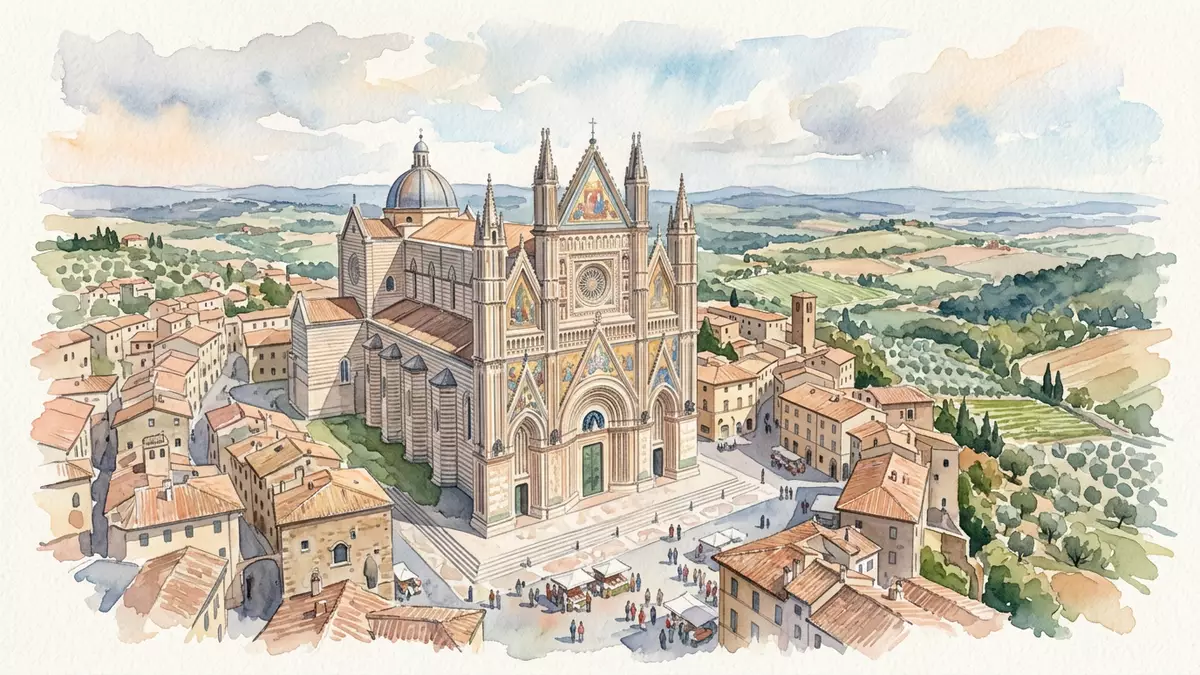
Duomo di Orvieto dominates the tufa plateau of Orvieto with its striped stone walls, gilded facade and a vast interior shaped over centuries of Italian Gothic design. Construction began in 1290 under Pope Nicholas IV, bringing together architects such as Arnolfo di Cambio, Lorenzo Maitani and later Ippolito Scalza in a project that blended Romanesque and Gothic forms into a single cathedral dedicated to Santa Maria Assunta.
A striped cathedral carved from black and white stone
At first glance, Duomo di Orvieto is defined by bands of dark basalt and pale travertine running horizontally along its flanks and apse, giving the entire cathedral a striped, almost textile-like surface that stands out against the brown rock of the hill.The building was constructed as an Italian Gothic cathedral whose long walls are articulated by pilasters, tall windows and projecting chapels rather than flying buttresses.
The building phase began with a foundation stone laid in 1290, when Pope Nicholas IV blessed the new cathedral as a replacement for earlier churches on the same square and as a grand seat for the bishop of Orvieto.The original design is attributed to Arnolfo di Cambio and Fra Bevignate of Perugia, with Lorenzo Maitani documented as master builder from 1310, reshaping the structure towards a more unified Gothic form over the following decades.
A gilded facade of mosaics, bas-reliefs and rose window
The west front presents Duomo di Orvieto as a monumental stone screen, divided into vertical sections by slender pilasters and crowned by triangular gables, each surface layered with sculpture, mosaic and inlaid marble.Work on this facade began in the early fourteenth century and continued into the sixteenth century, when Ippolito Scalza completed the side spires, giving the front its distinctive combination of medieval structure and later sculptural detail.
The lower zone is anchored by three great portals framed by carved bas-reliefs that narrate scenes from the Bible and flanked by slender columns, while the upper levels carry glittering mosaics depicting episodes from the life of the Virgin Mary against a gold ground.A large rose window set in the central bay draws the eye towards the centre of the facade, surrounded by an intricate stone frame that adds depth and shadow to the otherwise planar surface.
Interior chapels and fresco cycles by Renaissance masters
Inside, the striped stone continues along the nave arcade and walls, where tall columns carry pointed arches and a timber roof spans the main space, giving the interior a clear rhythm from west entrance to high altar.The cathedral was built to house the cathedral chapter and to provide a grand liturgical space for the city of Orvieto, and over the centuries side chapels were enriched with sculpture, altarpieces and painted decoration that reward slow exploration.
On the right side of the choir stands the Cappella di San Brizio, a chapel whose walls and vaults carry a celebrated cycle of frescoes on the Last Judgement and related themes.The programme was begun by Fra Angelico in 1447 and completed by Luca Signorelli between 1499 and 1504, whose powerful figures and detailed studies of the human body make this space one of the high points of Renaissance painting in central Italy.
Visiting Duomo di Orvieto: what travellers from Western Europe should know
- Duomo di Orvieto stands in Piazza del Duomo on the summit of the tufa plateau above Orvieto’s historic centre, a short walk from the upper station of the funicular railway that climbs from Orvieto’s lower railway station on the Rome–Florence main line.
- The approach from the surrounding streets involves short slopes and sections of paving in stone, and the interior includes steps around the chapels and choir that may affect how long visitors spend exploring different areas.
- Orvieto lies in Umbria in central Italy, and the official language is Italian while the currency is the euro.
- Entry requirements depend on your nationality; UK travellers can check the FCDO travel advice at gov.uk/foreign-travel-advice, Irish travellers the Department of Foreign Affairs at ireland.ie.
Searching for Duomo di Orvieto on social platforms
These links open searches for Duomo di Orvieto on each platform.
Frequently asked questions about Duomo di Orvieto
Where is Duomo di Orvieto located?
Duomo di Orvieto stands in Piazza del Duomo at the top of the historic hill town of Orvieto in Umbria, central Italy.
What can visitors expect inside the cathedral?
Visitors encounter striped stone arcades, a spacious nave with a timber roof, richly decorated side chapels and the frescoed Cappella di San Brizio by Fra Angelico and Luca Signorelli.
What makes Duomo di Orvieto distinctive among Italian cathedrals?
The combination of black-and-white stone striping, a richly decorated Gothic facade shaped by Lorenzo Maitani and later Ippolito Scalza, and Renaissance fresco cycles gives the cathedral a distinctive character.


