
Edinburgh Castle and the volcanic rock beneath it
Published on 09/23/2026 at 04:15 | Editorial responsibility: Rafael Müller, Editor-in-Chief AD HOC NEWS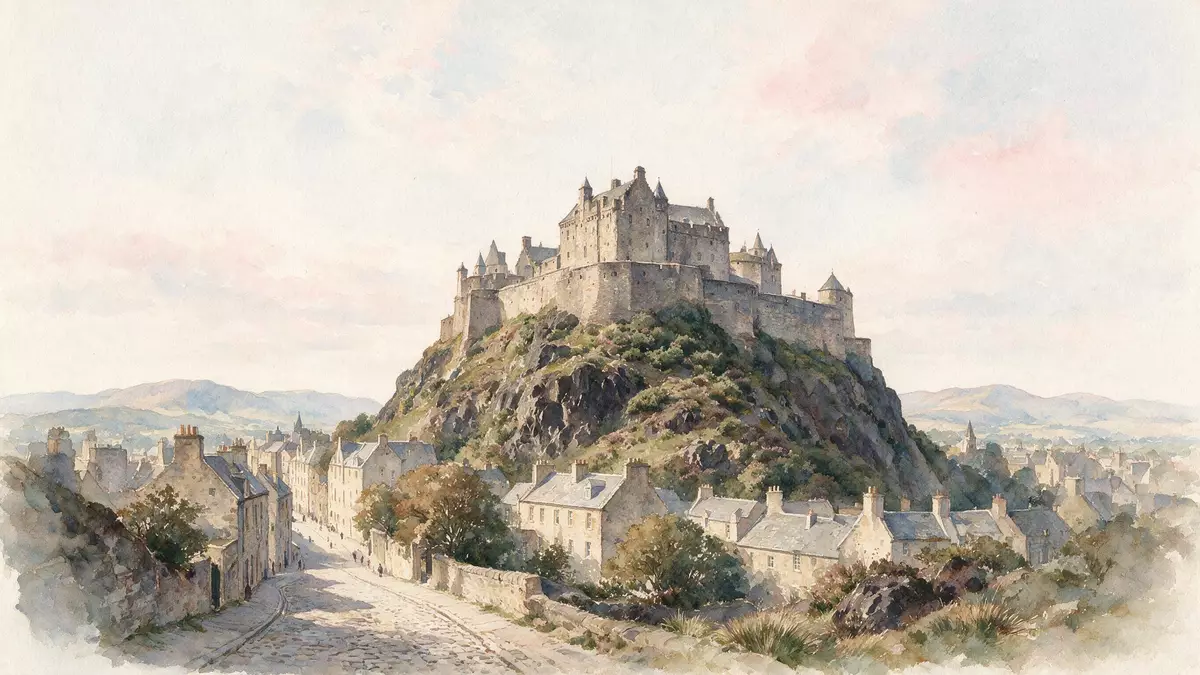
Edinburgh Castle occupies the summit of Castle Rock, a volcanic plug above Scotland’s capital. Its buildings gather royal apartments, military defences, a medieval hall and St Margaret’s Chapel within one fortified complex.
Castle Rock and the shape of Edinburgh Castle
The rock is the castle’s defining physical feature. Its dark volcanic mass rises from the Old Town ridge, while the fortress occupies the summit and extends across the upper, middle and lower wards.
The approach passes through the Esplanade and the Portcullis Gate before reaching the inner areas. Crown Square forms the central open space of the Upper Ward, enclosed by the Palace, the Great Hall, the Scottish National War Memorial and the Queen Anne Building. Crown Square’s surrounding buildings show how royal and military functions share the summit.
Royal rooms, chapel and the Scottish crown
Edinburgh Castle’s royal history reaches back to the eleventh century, when Malcolm III is connected with the first documented royal castle on the rock. Scottish monarchs used the fortress as a residence, and successive kings added halls, chambers and defences.
St Margaret’s Chapel dates from around 1130 and is associated with David I, who dedicated it to his mother, Margaret. The small Romanesque building stands apart from the larger structures around Crown Square. It is Edinburgh’s oldest surviving building. St Margaret’s Chapel history connects the castle’s stone fabric with Scotland’s medieval monarchy.
The Great Hall was built around 1510 for James IV. Its late-medieval interior contains a high timber roof and displays associated with Scotland’s military past. The Royal Palace contains the Crown Room, where the Honours of Scotland are displayed. The collection includes the crown, sceptre and sword of state, together with the Stone of Destiny.
A fortress filled with military history
The castle’s walls, batteries and artillery record centuries of conflict. The Half Moon Battery curves around the eastern side, while the Western Defences face the slopes beyond the main entrance. These elements belong to a complex that changed repeatedly through siege warfare and military occupation.
Mons Meg is a six-tonne fifteenth-century siege gun made in the Low Countries. Philip the Good, Duke of Burgundy, gave it to James II in 1457. The cannon remains beside the castle’s older buildings, linking European arms production with Scottish royal history. Mons Meg and the defences form part of the visible military character of the site.
Royal residence, fortress, garrison and prison are all represented within Edinburgh Castle. The Great Hall and Palace preserve ceremonial spaces, while barracks, gun positions and prison areas document the later military role. The complex is part of the Old and New Towns of Edinburgh World Heritage Site, inscribed in 1995. Edinburgh’s World Heritage setting places the medieval fortress within a wider historic city landscape.
Visiting Edinburgh Castle: what travellers from Western Europe should know
- Edinburgh Castle stands on Castle Rock at the western end of Edinburgh’s Old Town. Castlehill rises from the Royal Mile to the Esplanade and the main entrance.
- The route crosses steep ground and includes stone surfaces, slopes and steps. The castle’s wards occupy a rocky summit, with further stairs inside several historic buildings.
- The castle lies within the Old and New Towns of Edinburgh World Heritage Site. Nearby landmarks include the Royal Mile, St Giles’ Cathedral and Princes Street Gardens.
- The official language is English and the currency is the pound sterling.
Searching for Edinburgh Castle on social platforms
These links open searches for Edinburgh Castle on each platform.
Frequently asked questions about Edinburgh Castle
Where is Edinburgh Castle?
Edinburgh Castle stands on Castle Rock at the western end of Edinburgh’s Old Town. The entrance is reached from Castlehill, the upper section of the Royal Mile.
What can visitors expect inside?
The complex contains royal rooms, Crown Square, the Great Hall, St Margaret’s Chapel, military defences, museums and historic artillery. Stone paths, slopes and steps connect its different wards.
What makes Edinburgh Castle distinctive?
Its volcanic summit combines a royal palace, a medieval chapel and a large military fortress within one urban landmark. Mons Meg and the Honours of Scotland add named objects to the castle’s architectural history.


