
Eje Cafetero where coffee fields climb the Andes
Published on 09/23/2026 at 01:23 | Editorial responsibility: Rafael Müller, Editor-in-Chief AD HOC NEWS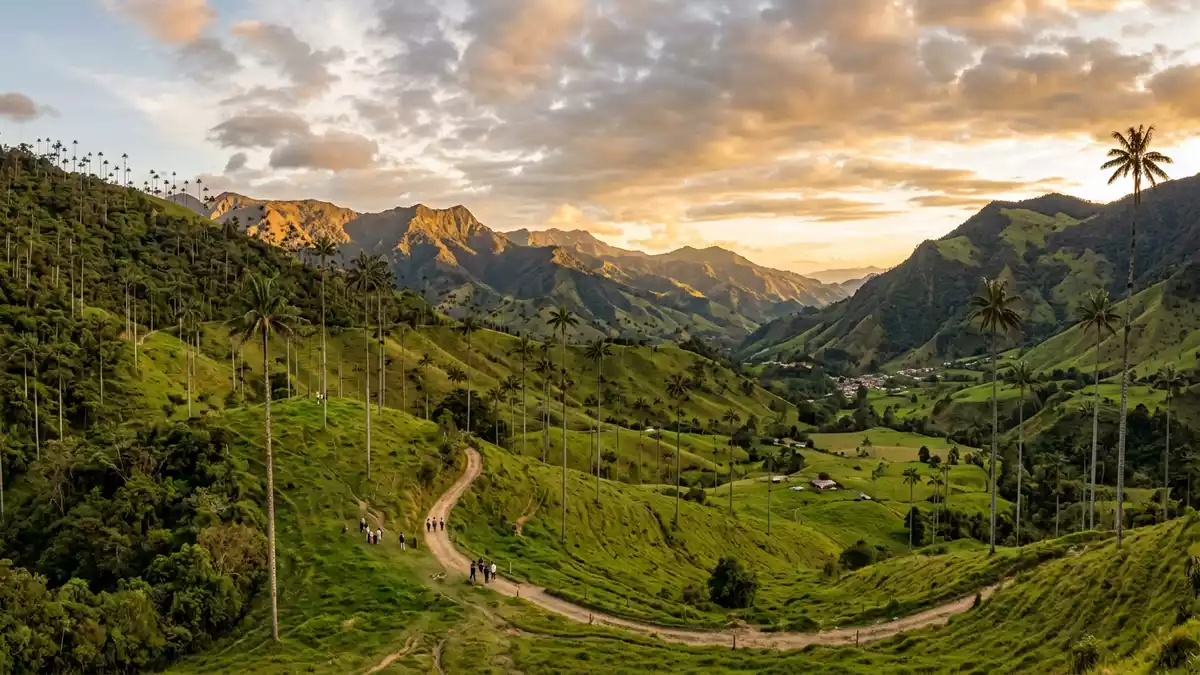
Eje Cafetero is a living coffee landscape in Colombia’s central Andes, with Salento in the department of Quindío. Coffee plots climb steep hills around settlements of painted façades, clay-tiled roofs and traditional bahareque walls.
Fields, villages, roads and forests appear together across a mountainous region. The result is not a single attraction, but a cultural landscape where coffee farming remains visible in the land and in the towns.
Coffee fields on steep Andean slopes
Eje Cafetero extends through Caldas, Quindío, Risaralda and parts of Valle del Cauca. The broader Coffee Cultural Landscape of Colombia includes six farming landscapes and 18 urban centres in the western part of the country.
Its coffee plots occupy mountain slopes, with cultivated land meeting high forest, river valleys and settlements on relatively level hilltops. The terrain is visibly agricultural, yet the landscape also contains habitats, watercourses and wooded areas.
The coffee farms are associated with small-scale production and family labour. Coffee is grown alongside crops such as plantain, maize and beans, creating a patchwork of colours and textures across the hills.
Salento provides a clear point of access to this landscape. Its streets, central square and painted houses sit within a rural setting where coffee farms and mountain vegetation remain close to the town.
Salento and the architecture of coffee country
Salento belongs to a chain of Andean settlements shaped by Antioquian colonisation in the nineteenth century. Their architecture combines Spanish colonial patterns with local materials and building methods.
Bahareque walls use a framework of cane covered with earth or plaster. Clay tiles cover many roofs, while timber appears in doors, balconies and decorative details. Central patios organise traditional houses, which may contain living spaces and small commercial activities.
The layout of a town is particularly visible from its central square. Streets rise and fall with the terrain, while brightly painted façades create a strong urban pattern against the surrounding green slopes.
Salento is also associated with the Cocora Valley, a high Andean valley near the town. Wax palms rise among grassland and cloud-forest vegetation, forming a landscape distinct from the coffee plots on lower slopes.
Regional culture extends beyond buildings. The muleteer, the yipao jeep, the aguadeño hat, the ruana and the carriel belong to the visual vocabulary of coffee country. Music, food, craft traditions and local legends add further layers to the agricultural setting.
A cultural landscape recognised in 2011
The Coffee Cultural Landscape of Colombia entered the UNESCO World Heritage List in 2011. The designation covers selected areas rather than the entire Eje Cafetero, linking rural coffee land with historic urban centres.
The recognised landscape reflects a coffee-growing tradition with roots in the nineteenth century. Antioquian settlers established small farms in difficult mountain terrain, and coffee culture developed through family work, local institutions and inherited farming knowledge.
The formal property includes areas in four Colombian departments and covers around 141,000 hectares. Its significance lies in the combination of productive land, settlement patterns, architecture and cultural practices.
Traditional construction remains visible in many towns. Stone, timber, cane, earth and clay tiles form a material connection between houses, public buildings and the rural landscape. The architecture is therefore part of the same cultural setting as the plantations.
Coffee production also has an institutional history. The Colombian Coffee Growers’ Federation was created in 1927, while Cenicafé, the national coffee research centre, was established in 1938. Their work belongs to the wider story of Colombian coffee production, alongside growers, cooperatives and rural communities.
Eje Cafetero combines a working agricultural region with a recognised heritage landscape. Salento offers the clearest introduction through its streets and nearby valleys, while the wider region continues through Caldas, Risaralda and Valle del Cauca.
Visiting Eje Cafetero: what travellers from Western Europe should know
- Salento lies in Quindío, in Colombia’s central Andes. Road connections link the town with Armenia and Pereira.
- The region is mountainous, with steep coffee slopes, uneven streets and highland terrain around Salento and the Cocora Valley.
- The official language is Spanish and the currency is the Colombian peso.
- The wider heritage landscape includes rural farms, historic town centres, cloud forest, river valleys and highland vegetation.
Searching for Eje Cafetero on social platforms
These links open searches for Eje Cafetero on each platform.
Frequently asked questions about Eje Cafetero
Where is Eje Cafetero?
Eje Cafetero lies in Colombia’s central Andes, especially across Caldas, Quindío and Risaralda, with selected areas in Valle del Cauca. Salento is in Quindío.
What can travellers expect in Eje Cafetero?
The region combines coffee farms, steep mountain roads, painted towns, traditional houses, cloud forest and the Cocora Valley. Salento provides an urban base among these landscapes.
What makes Eje Cafetero distinctive?
Coffee production, Andean terrain, bahareque architecture and inherited rural traditions form a single cultural landscape. Selected areas received World Heritage status in 2011.


