
Ellora Caves and the architecture carved from basalt
Published on 09/23/2026 at 16:06 | Editorial responsibility: Rafael Müller, Editor-in-Chief AD HOC NEWS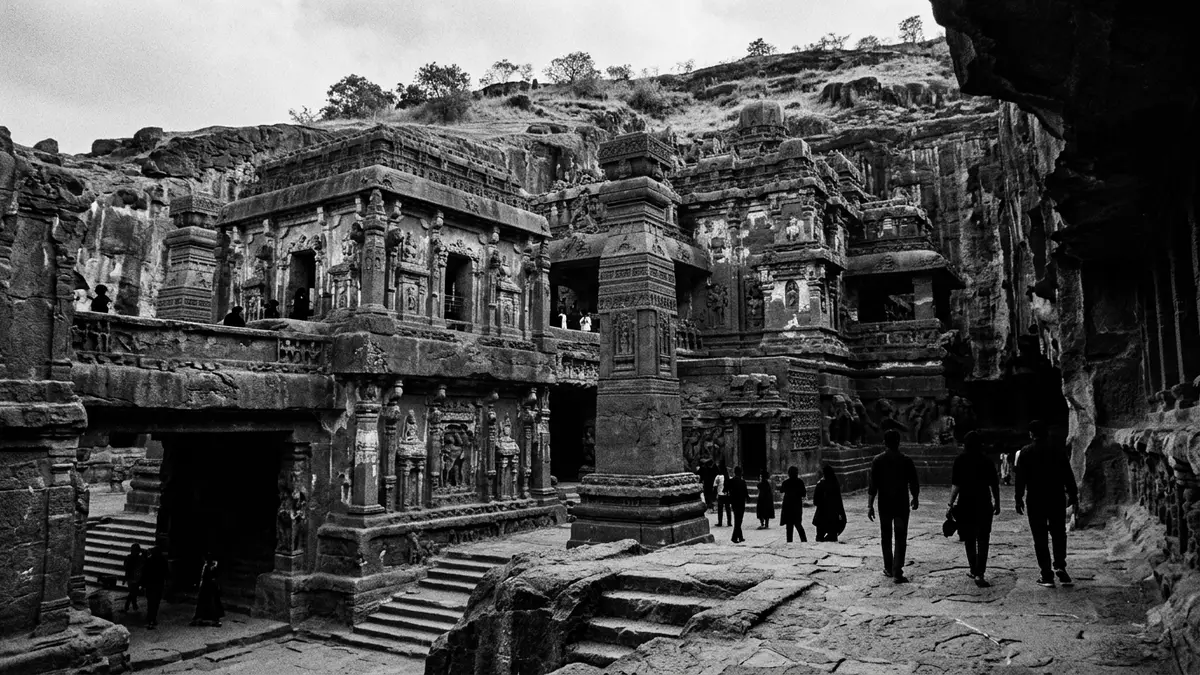
Ellora Caves form a long band of rock-cut monasteries and temples near Aurangabad in Maharashtra, India. Buddhist, Hindu and Jain monuments stand along a basalt cliff, making the site a sequence of carved interiors, courtyards and open structures.
Ellora Caves: thirty-four monuments in basalt
The complex contains 34 recognised monasteries and temples extending along more than 2 km of cliff. Their architecture belongs to an uninterrupted sequence dated from AD 600 to 1000, with chambers, pillars, façades, shrines and sculpted surfaces cut directly into volcanic rock.
The caves are arranged in religious groups. Buddhist monuments occupy the southern part, Hindu monuments form the central group, and Jain monuments stand towards the north. This arrangement places different traditions within one archaeological landscape without reducing them to a single style.
Basalt gives Ellora its material identity. The cliff face becomes wall, ceiling, column and image surface, while several complexes open into courtyards exposed to the sky. The result is not a row of identical chambers, but a changing succession of spaces shaped from the same geological mass.
From Buddhist monasteries to Jain sanctuaries
The earliest monuments belong to the Buddhist group, whose spaces include monastic halls and shrine chambers. Pillars divide the interiors, while carved figures and architectural details mark the religious use of the rooms. The stone preserves the connection between daily monastic life and ceremonial space.
Hindu monuments occupy the central section and include temples with large sculptural programmes. Their surfaces show deities, mythological scenes and architectural forms translated into basalt. The largest complex in this group is Kailasa Temple, a free-standing temple carved from the surrounding rock.
Kailasa is associated with the eighth century and the Rashtrakuta dynasty. Its form includes a temple, gateways, sculpted walls and a courtyard, all cut from one rock mass. Elephant sculptures and reliefs line parts of the complex, while the central shrine gives the monument a clear vertical focus.
The Jain group belongs to the northern section and includes temples with detailed façades, pillars and devotional imagery. These later monuments add another architectural language to the site, with carefully worked interiors and figures associated with Jain belief.
Kailasa Temple at the centre of the cliff
Kailasa Temple changes the way Ellora is read. The surrounding caves are entered through rock faces, but Kailasa occupies an excavated courtyard as a complete architectural composition. Its carved surfaces connect roof, wall, column and sculpture.
The temple is dedicated to Shiva and carries the name Kailasa, associated with the deity’s mountain abode. Its sculptural programme includes figures from Hindu mythology, while elephants appear at the base of the structure. The monument is a Hindu temple expressed through excavation rather than assembled masonry.
Ellora’s significance also lies in the relationship between the traditions represented there. Buddhism, Hinduism and Jainism each have dedicated monuments within the same cliff complex. UNESCO inscribed Ellora Caves on the World Heritage List in 1983, recognising the site’s cultural and architectural importance.
The complex belongs to the Charanandri hills, a landscape of basalt formations in western India. Across the cliff, the visitor encounters dark rock, shaded chambers, open courtyards and sculpted façades. Ellora’s defining image is therefore geological as well as religious: a mountain wall transformed into architecture.
Visiting Ellora Caves: what travellers from Western Europe should know
- Ellora Caves lie north-west of Aurangabad in Maharashtra. Road travel from Aurangabad follows the route towards the village of Ellora.
- The site extends along a cliff for more than 2 km. Visiting involves walking between separate monuments, with steps, uneven rock surfaces and changing levels inside the complex.
- The official language is Marathi, and the currency is the Indian rupee.
- The wider region includes Ajanta Caves, another major rock-cut site in Maharashtra, but Ellora’s monuments belong to a different sequence and include Buddhist, Hindu and Jain groups.
Searching for Ellora Caves on social platforms
These links open searches for Ellora Caves on each platform.Frequently asked questions about Ellora Caves
Where are Ellora Caves?
Ellora Caves are in Maharashtra, India, near Aurangabad. The monuments occupy a basalt cliff in the Charanandri hills.
What can visitors expect at Ellora?
The complex contains rock-cut monasteries, temples, courtyards, pillars and sculptures. Walking between the groups reveals Buddhist, Hindu and Jain architecture across the same cliff.
What makes Ellora distinctive?
Ellora combines 34 monuments with a continuous historical sequence from AD 600 to 1000. Kailasa Temple adds a large Hindu temple carved from a single rock mass.


