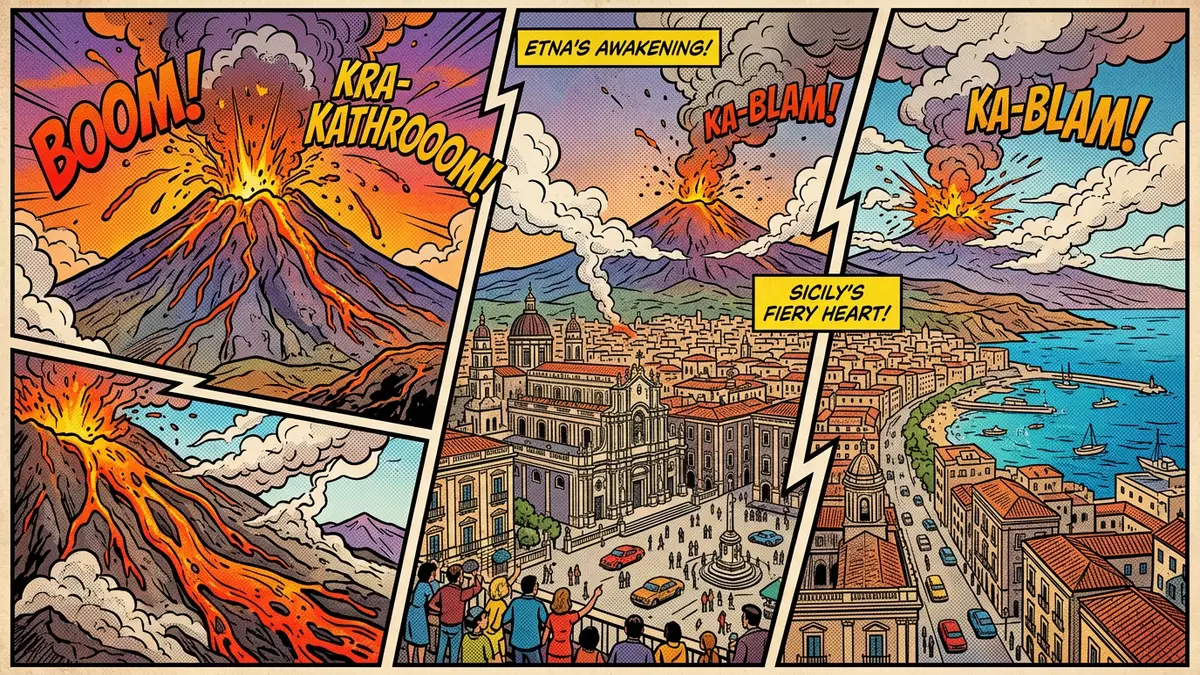
Etna and its lava-built slopes above Catania
Published on 08/07/2026 at 15:02 | Editorial responsibility: Rafael Müller, Editor-in-Chief AD HOC NEWS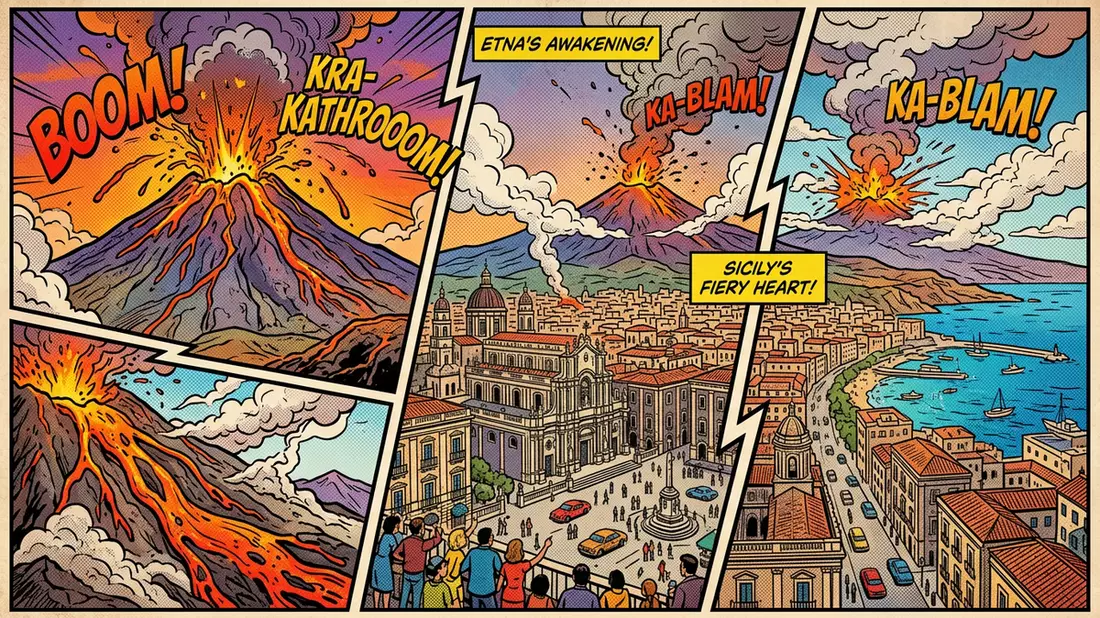
Etna rises above Catania as a broad volcanic massif of lava, ash and cratered slopes. It is one of Sicily’s defining landforms, and its summit zone changes character from cultivated lower flanks to bare volcanic terrain.
Etna’s lava fields and cratered summit
The mountain is dominated by volcanic rock in many forms, from dark lava flows to loose ash and scoria. Its profile is not a single smooth cone but a large volcanic system with ridges, hollows and summit craters.
Etna is the highest active volcano in mainland Europe, and its mass is visible from far across eastern Sicily. The mountain has shaped the visual identity of Catania, where black volcanic stone appears in many buildings and streets.
Etna in Sicilian history
The volcano enters the historical record through Greek and Roman writers, and it has long been part of life in eastern Sicily. Greek myth linked the mountain to Hephaestus and the forge beneath the earth, while the Roman world associated it with fire, upheaval and divine power.
In 2013, Mount Etna was inscribed as a UNESCO World Heritage site. That recognition reflects its volcanic activity, its scientific interest and its long cultural presence in Sicily.
Land, stone and settlement around Catania
Etna’s lower slopes support orchards, vineyards and villages before the ground turns rougher and more exposed. The mountain’s stone has also been used in Catania, where lava blocks give the city a dark, compact appearance.
The relationship between volcano and city is direct: Etna rises inland, while Catania sits on the coast below it. From the city, the mountain is a constant horizon feature, large enough to dominate orientation and weather watching alike.
Visiting Etna: what travellers from Western Europe should know
- The site is reached from Catania by road, and the mountain is also approached from other eastern Sicilian towns.
- Admission arrangements and opening hours are set by the site's operator and change with the season; the official website is the only binding source.
- Late spring and early autumn are often the most comfortable periods for the lower slopes, while higher ground can feel exposed in any season.
- The site itself involves altitude, uneven volcanic ground and stretches of walking on loose material.
- Italian is the main language on site, and cash and cards are both useful in towns on the route.
- Entry requirements depend on your nationality. UK travellers should check the FCDO travel advice at gov.uk/foreign-travel-advice; Irish travellers the Department of Foreign Affairs at ireland.ie; EU and EEA citizens their own national foreign ministry.
Searching for Etna on social platforms
These links open searches for Etna on each platform.
Frequently asked questions about Etna
Where is Etna?
Etna is on the east side of Sicily, inland from Catania in Italy. It rises above the Ionian coast and dominates the landscape between the sea and the central part of the island.
What should a visit involve?
Expect volcanic terrain, changing ground conditions and strong contrasts between settled lower slopes and rough summit zones. Walking routes, road access and mountain facilities vary by area.
What makes Etna distinctive?
Its scale, active volcano status and long cultural presence make it one of Sicily’s defining places. The lava-based landscape and the city below form a clear geographic pair.