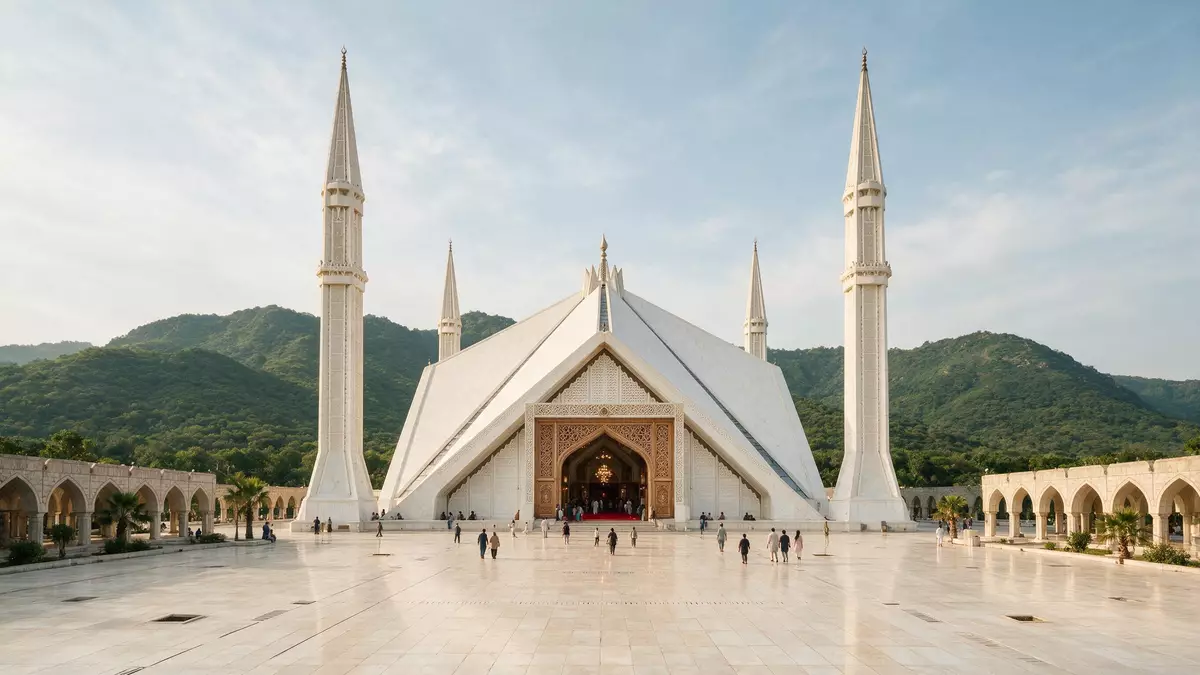
Faisal Masjid and its tent-like silhouette above Islamabad
Published on 08/12/2026 at 14:07 | Editorial responsibility: Rafael Müller, Editor-in-Chief AD HOC NEWS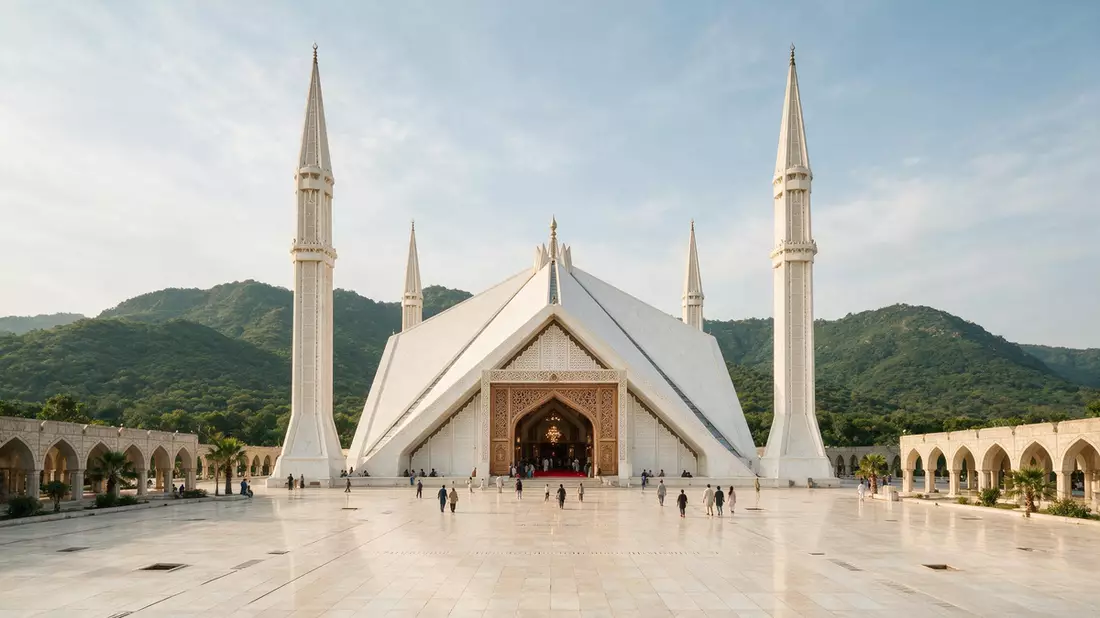
Faisal Masjid rises at the edge of Islamabad, Pakistan’s planned capital, with a striking tent-like profile and four needle-like minarets set against the Margalla Hills. Completed in 1986, it serves as the national mosque of Pakistan and carries the name of King Faisal bin Abdulaziz of Saudi Arabia, whose support anchored the project in the late twentieth century.
Tent-inspired modernism on the Margalla foothills
Faisal Masjid stands on Shah Faisal Avenue at the northern edge of Islamabad, where the city grid meets the first slopes of the Margalla Hills. The complex occupies a broad platform above the surrounding streets, so the main prayer hall and minarets appear framed by low forested ridges rather than dense urban towers.Shah Faisal Ave, E-8 is a formal address for the mosque and situates it within a district planned around governmental and educational institutions.
The Turkish architect Vedat Dalokay won an international competition in 1969 to design a national mosque for Islamabad, bringing a distinctly modernist approach to Islamic architecture.Vedat Dalokay's design replaces the traditional central dome with an eight-sided concrete shell whose steep planes meet in sharp ridges, producing the outline of a vast desert tent. Four tall minarets rise from the corners of the prayer hall platform, echoing classical Ottoman forms but expressed as clean, vertical shafts clad in pale material. The main hall’s shell reaches about 40 m (131 ft) in height above the plinth, assertive yet low compared with the minarets.
From competition to national mosque
The idea of building a major mosque for Pakistan’s new capital gathered pace in the 1960s, and an international competition was organised in 1969 with proposals from architects across several countries.The competition held in 1969 selected Dalokay’s tent concept, which broke with the expectation of a dome yet kept familiar elements such as minarets and a spacious courtyard. Construction began in 1976 under Pakistani contractors and extended across roughly a decade, with the mosque opened to worshippers in 1986.Opened in 1986, Faisal Masjid has since been integrated into Islamabad’s civic and religious life as a symbol of the capital.
The mosque is named after King Faisal bin Abdulaziz Al Saud, reflecting Saudi Arabia’s financial support for the project and political ties with Pakistan.King Faisal's name is inscribed in the identity of the building, and the alternative name Shah Faisal Masjid is also used in Pakistan. The period of its construction in the late 1970s and 1980s connects it with a wider movement of large-scale mosque building across the Islamic world, yet Faisal Masjid’s angular silhouette and absence of a dome make it one of the most recognisable modern mosques in South Asia.
Inside the concrete shell and its courtyards
Within the eight-sided shell, the main prayer hall forms a broad, uncluttered volume suspended beneath steeply sloping concrete roofs. The hall is lined with white marble panels, giving the interior a pale, reflective surface that picks up light from high-level glazing and from the large Turkish-style chandelier hanging from the centre of the space.White marble cladding continues onto the outer surfaces of the shell, so the mosque reads as a single light-coloured object from a distance.
Decorative elements inside include mosaics and extensive Arabic calligraphy, notably work attributed to the Pakistani artist Sadequain, whose geometric and flowing scripts span across the hall’s surfaces.Late twentieth century decoration blends modern abstraction with traditional Quranic texts. Outside the hall, wide paved courtyards extend towards the Margalla Hills, edged by colonnades that frame views of the surrounding landscape. The mosque complex as a whole covers several hectares, combining indoor worship space with expansive outdoor areas used for prayer rows during large congregations.
Visiting Faisal Masjid: what travellers from Western Europe should know
- Faisal Masjid is located on Shah Faisal Avenue in sector E-8 of Islamabad, at the southern foot of the Margalla Hills, north of the city’s governmental core.
- The complex is set on an elevated platform reached by broad flights of steps; walking across the courtyards involves crossing extensive paved surfaces without shade.
- The official language in Pakistan is Urdu and the currency is the Pakistani rupee.
- Entry requirements depend on your nationality; UK travellers can check the FCDO travel advice at gov.uk/foreign-travel-advice, Irish travellers the Department of Foreign Affairs at ireland.ie.
Searching for Faisal Masjid on social platforms
These links open searches for Faisal Masjid on each platform.
Frequently asked questions about Faisal Masjid
Where is Faisal Masjid located within Islamabad?
Faisal Masjid stands on Shah Faisal Avenue in sector E-8 at the foot of the Margalla Hills, on the northern side of Islamabad’s urban area.
What can visitors expect when exploring the mosque complex?
Visitors encounter a large prayer hall under a steep tent-like roof, extensive marble-clad surfaces, calligraphic decoration, and open courtyards with views towards the Margalla Hills.
What makes Faisal Masjid distinctive among Pakistan’s mosques?
Its eight-sided concrete shell without a central dome, the four tall corner minarets, and its role as Pakistan’s national mosque give Faisal Masjid a distinctive modern profile.