
Faisal Masjid and its tent-like silhouette in Islamabad
Published on 08/15/2026 at 14:58 | Editorial responsibility: Rafael Müller, Editor-in-Chief AD HOC NEWS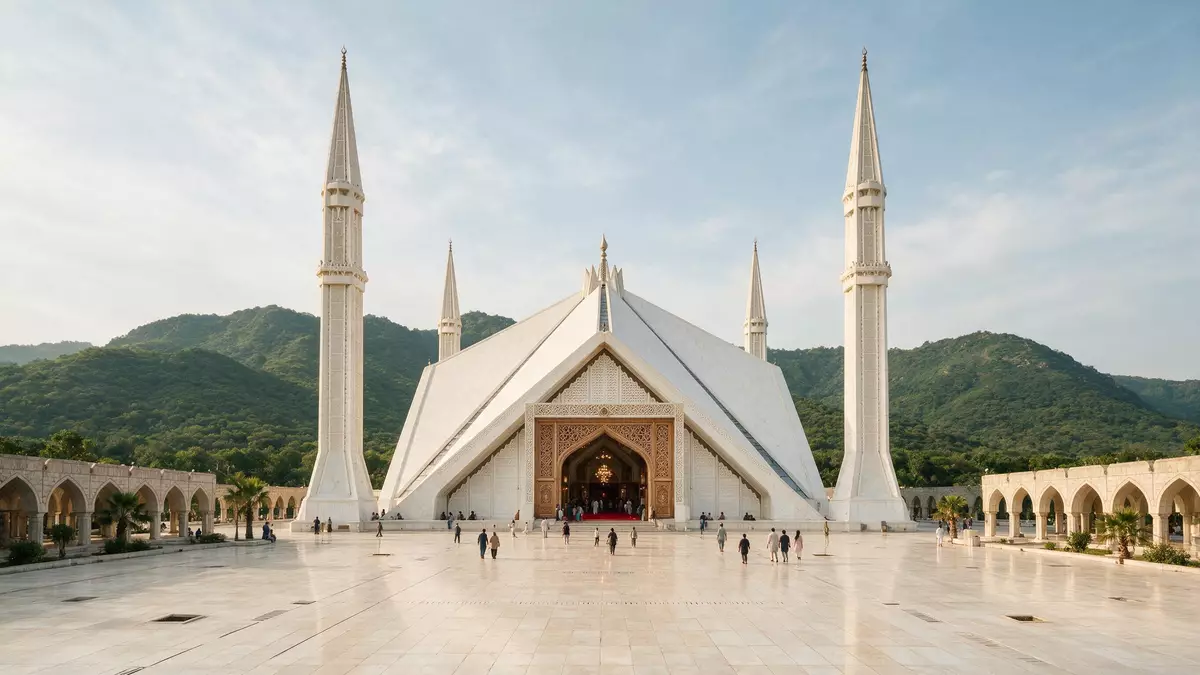
Faisal Masjid in Islamabad is Pakistan’s national mosque, a striking modern structure whose tent-like profile stands against the backdrop of the Margalla Hills and marks the edge of the capital’s urban grid.
A modern national mosque shaped like a vast tent
Faisal Masjid occupies a prominent site on the northern side of Islamabad, at the foot of the Margalla Hills where the planned avenues of the city give way to rising ground and open views. The mosque’s form is immediately recognisable: instead of a traditional central dome, its prayer hall is enclosed within a vast, angular shell that recalls a desert tent, its planes sloping steeply upwards to a sharp ridge line. This dramatic canopy sits on a broad platform that lifts the complex above the surrounding streets and gardens, reinforcing the sense that the mosque is both part of the city and slightly apart from it.national mosque of Pakistan
The design was the outcome of an international architectural competition held in 1969, in which architects from many countries submitted proposals for a national mosque in the new capital. The winning scheme was by Turkish architect Vedat Dalokay, whose unconventional proposal set aside the familiar Mughal dome-and-courtyard composition and instead explored sharp triangular geometry and exposed structural ribs as a way of expressing Islamic forms in a late twentieth-century language.international competition in 1969 Four tall minarets rise from the corners of the main platform, their slender shafts echoing elements of Turkish mosque architecture and framing the central tent-like volume.Turkish architect Vedat Dalokay
From royal patronage to completion in the 1980s
The idea of building a grand mosque for Islamabad emerged in the 1960s, as Pakistan planned and developed its new capital. In 1966, Saudi Arabia’s King Faisal bin Abdul-Aziz supported the initiative during an official visit, pledging substantial funding for a national mosque whose name would later honour him.King Faisal bin Abdul-Aziz The project advanced after the architectural competition, and construction began in 1976 under National Construction Limited of Pakistan, working to Dalokay’s design on the prominent site at the city’s northern edge.construction started in 1976
Building such a large concrete and marble complex on rising terrain was a long undertaking, and Faisal Masjid was completed in 1986, marking it as a relatively young landmark compared with historic mosques in Lahore or Karachi.construction completed in 1986 From its inauguration in 1986 until the early 1990s, Faisal Masjid was the largest mosque in the world, before larger complexes in Morocco and Saudi Arabia took that title.largest mosque from 1986 to 1993 It remains the largest mosque in Pakistan, and its scale is evident in the broad plaza, capacious prayer hall and the way the complex dominates views from many parts of Islamabad.
Geometry, materials and setting against the Margalla Hills
Dalokay’s design treats the mosque as an eight-sided concrete shell with sharply defined edges, resting on a platform that incorporates terraces and circulation routes. The concrete structure is clad in light-coloured marble, which intensifies the crisp lines of the main roof and helps the mosque stand out against the dark green of the Margalla Hills behind.eight-sided concrete shell The tall minarets at the corners of the platform reinforce the composition, their verticality counterbalancing the broad, sloping planes of the roof and marking the mosque clearly in distant views across the city.
The complex occupies an address on Shah Faisal Avenue in the E-8 sector of Islamabad and sits where the gridded urban plan meets the first ridges of the Margalla Hills, a location that gives the mosque an open foreground and a dramatic natural backdrop.foothills of Margalla Hills Within the precinct, paved areas, steps and planted terraces create a transition from the city streets to the elevated platform of the prayer hall. The overall effect is of a composition that uses geometry, light-coloured materials and setting against the hills to give Islamabad a recognisable religious landmark aligned with the capital’s ordered layout.
Visiting Faisal Masjid: what travellers from Western Europe should know
- Faisal Masjid stands in the northern part of Islamabad at the foot of the Margalla Hills, with access from Shah Faisal Avenue in the E-8 sector by city roads and local transport.
- The mosque complex is raised on a broad platform reached by exterior steps and paved approaches, and movement within the precinct involves staircases and open terraces rather than level corridors.
- Margalla Hills rise immediately behind the mosque, so views from the surrounding terraces take in both the angular mosque structure and the wooded slopes of the range.
- The official language is Urdu and the currency is the Pakistani rupee.
- Entry requirements depend on your nationality; UK travellers can check the FCDO travel advice at gov.uk/foreign-travel-advice, Irish travellers the Department of Foreign Affairs at ireland.ie.
Searching for Faisal Masjid on social platforms
These links open searches for Faisal Masjid on each platform.
Frequently asked questions about Faisal Masjid
Where is Faisal Masjid located in Islamabad?
Faisal Masjid is in the E-8 sector of Islamabad, on Shah Faisal Avenue at the foot of the Margalla Hills on the city’s northern side.
What should visitors expect when entering the mosque complex?
Visitors encounter exterior steps, paved terraces and a large raised platform leading to the tent-like prayer hall, with the angular roof and tall minarets dominating the space.
What makes Faisal Masjid distinctive among mosques in Pakistan?
Its modern, dome-less, tent-inspired form, the four tall corner minarets and its role as Pakistan’s national mosque together make Faisal Masjid a distinctive landmark in Islamabad.


