
Faneuil Hall and Boston’s enduring meeting hall
Published on 09/24/2026 at 11:50 | Editorial responsibility: Rafael Müller, Editor-in-Chief AD HOC NEWS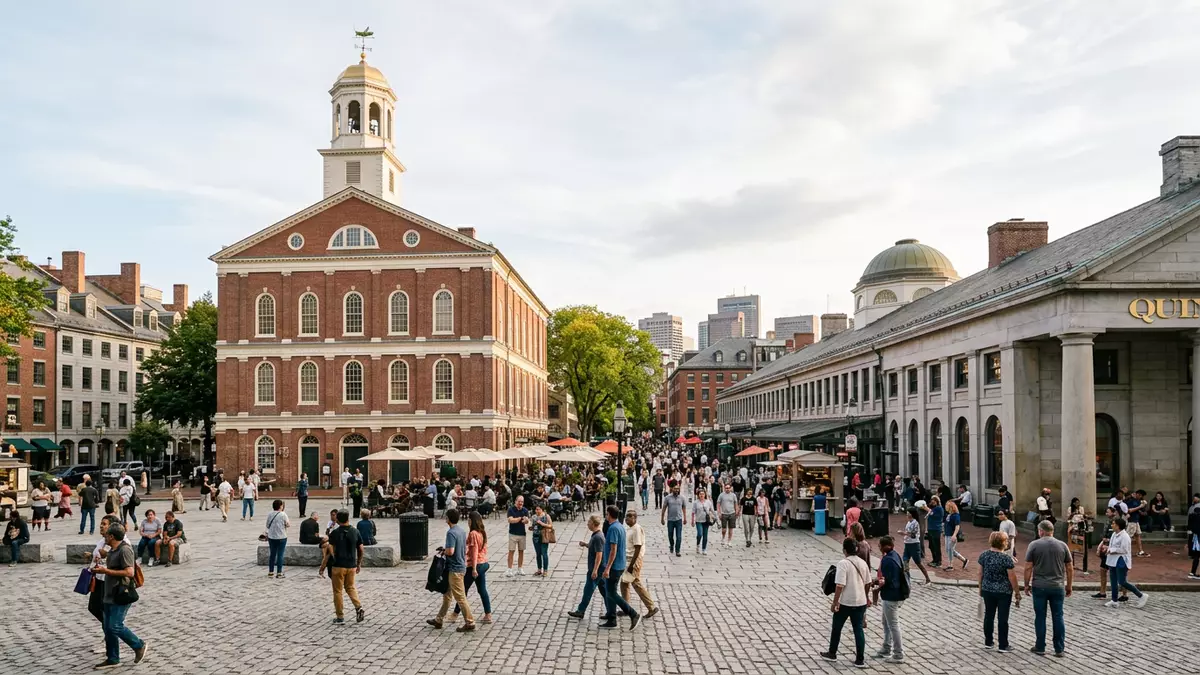
Faneuil Hall combines a market, a meeting hall and a civic gallery within one brick building at Dock Square in Boston. Opened in 1742, it carries the name of merchant Peter Faneuil and remains associated with public debate.
Faneuil Hall began as a market and town hall
Peter Faneuil funded the building as a gift to Boston. John Smibert prepared the original design, which joined an open market space on the ground floor with meeting rooms above.
The building’s early identity was therefore practical and civic at once. Goods changed hands below, while Boston’s town government and public meetings occupied the upper level. The arrangement placed commerce and local politics within the same address.
Fire, expansion and the Bulfinch interior
A fire in 1761 destroyed much of Faneuil Hall, leaving the brick shell. Thomas Dawes led the rebuilding, and the meeting space reopened in 1763.
Charles Bulfinch expanded the building in 1805 and 1806. The enlarged structure created the Great Hall, whose galleried auditorium, classical columns and tiered seating define the principal interior. The Bulfinch expansion also shaped the exterior seen around Dock Square.
Alexander Parris altered the entrance in 1827. Restoration and fireproofing followed in 1898 and 1899, with Frank W. Howard and Francis W. Chandler connected to that work. Brick, iron, steel and plaster record the building’s successive phases.
The Great Hall preserves a public forum
The Great Hall is a galleried room with portraits, busts, paintings and civic objects arranged around its stage and walls. George Washington, John Adams, Daniel Webster, Frederick Douglass and Lucy Stone appear among the historical figures represented.
Faneuil Hall became a meeting place for revolutionary protest before the American Revolution. Samuel Adams, John Hancock and other colonial voices used the hall for public gatherings and arguments about British authority.
Its civic history continued through abolitionist meetings, opposition to fugitive slave laws, women’s suffrage gatherings and labour reform. The building’s designation as a National Historic Landmark reflects this association with public debate.
The gilded grasshopper on the cupola is another visible marker of Faneuil Hall. Shem Drowne made the copper weathervane in 1742, linking the building’s skyline with Boston’s commercial history.
Visiting Faneuil Hall: what travellers from Western Europe should know
- Faneuil Hall stands at Dock Square in central Boston, beside Quincy Market and within the city’s Freedom Trail.
- The building has a market level, a Great Hall above and an exhibition area on the lower level. The upper floors are reached through the building’s stairways or lift.
- Boston’s official language is English and the currency is the US dollar.
- Faneuil Hall forms part of Boston National Historical Park and remains a civic site as well as a historic building.
Searching for Faneuil Hall on social platforms
These links open searches for Faneuil Hall on each platform.
Frequently asked questions about Faneuil Hall
Where is Faneuil Hall?
Faneuil Hall is at Dock Square in central Boston, Massachusetts. Quincy Market stands beside it, and the building forms part of the Freedom Trail.
What does a visit include?
A visit brings together the market level, the Great Hall, civic exhibits and architectural details from several building phases. The interior includes portraits, sculptures, galleries and classical columns.
What makes Faneuil Hall distinctive?
Its identity rests on the combination of a 1742 market, a public meeting hall and a long record of political gatherings. Peter Faneuil’s original building and Charles Bulfinch’s 1805–1806 expansion remain central to its appearance.


