
Faneuil Hall, Boston’s brick marketplace of liberty
Published on 09/09/2026 at 18:07 | Editorial responsibility: Rafael Müller, Editor-in-Chief AD HOC NEWS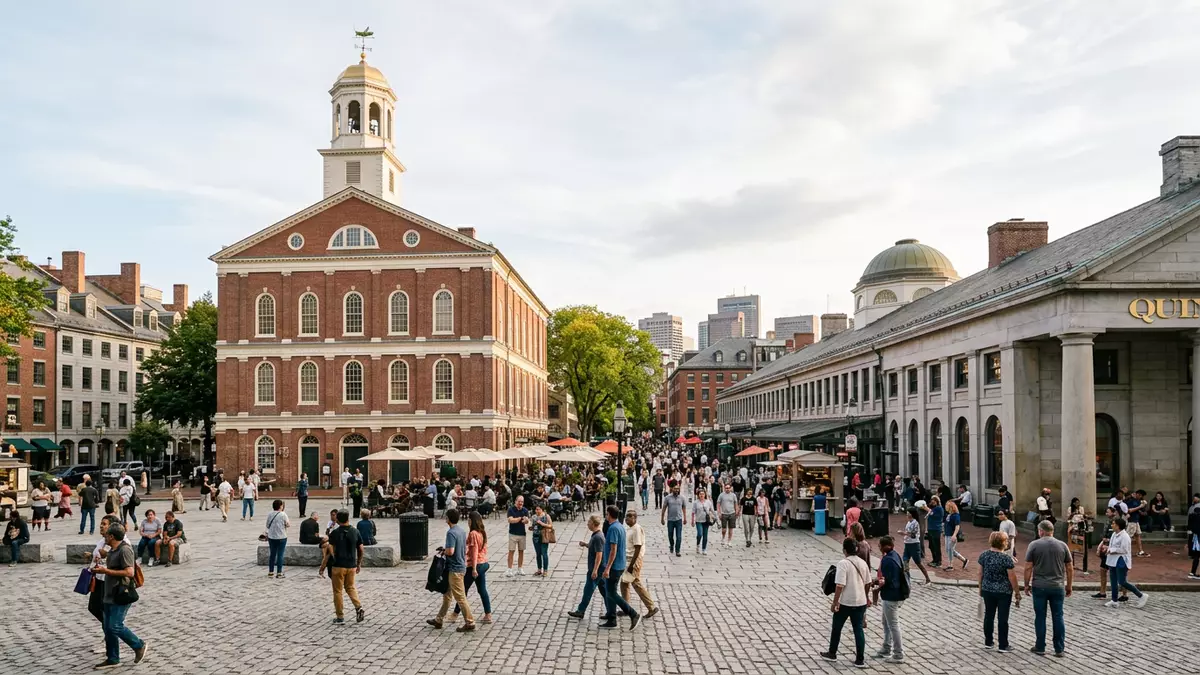
In the centre of Boston’s historic waterfront district stands Faneuil Hall, a brick market building and meeting house first completed in the 1740s that has hosted city commerce and political debate for generations. Gifted to the town by merchant Peter Faneuil and designed by artist John Smibert, it established a covered marketplace at Dock Square with an assembly room above, a layout that still defines the building’s presence in the city.
A Georgian brick hall on reclaimed harbour land
Faneuil Hall rises from ground that Boston created by filling a small cove and extending its town dock into the harbour, placing the building directly within the eighteenth?century trading quarter.ground reclaimed from the sea The structure itself is a rectangular brick hall with stone trim and a pitched roof, characteristic of Georgian civic architecture in the British colonies.red brick building The lower level was laid out as rows of market stalls, while the upper floor forms a single large meeting chamber with timber framing overhead.
The building stands beside what later became the Quincy Market and the North and South Market buildings, which extended the commercial district in the 1820s as Boston’s trade expanded.Quincy Market and market buildings Together these brick structures form a continuous run of façades around paved squares, with passageways between them leading towards the waterfront. Above the main entrance of Faneuil Hall a grasshopper weather vane has become a distinctive feature of the roofline, a small detail that ties the hall visually to Boston’s maritime past.grasshopper weather vane
From gift to marketplace and town hall
In 1742 Peter Faneuil, one of Boston’s wealthiest merchants, funded the construction of the hall as a gift to the town, providing a permanent indoor market and an upper meeting space for local government.gift to the city in 1742 John Smibert’s design placed the market at street level, where traders in meat, produce and fish could operate under cover, while town meetings and public gatherings took place above.designed by John Smibert This dual role as commercial hall and civic chamber has remained central to the building’s identity.
A devastating fire in January 1761 destroyed much of the structure, leaving only the brick outer walls standing.1761 fire and rebuilding The town rebuilt and reopened the hall in 1763, restoring its market and meeting functions. At the start of the nineteenth century architect Charles Bulfinch enlarged the building, adding height and expanding the interior to suit a growing city.Bulfinch expansion in 1805–1806 Later nineteenth?century works further strengthened and fireproofed the structure, preserving the original brick walls while updating the fabric.
“Cradle of Liberty” and a stage for protest
Over the eighteenth century the upper hall became a focal point for Boston’s town meetings, where residents debated measures imposed by the British Parliament and organised responses that led towards the American Revolution.protests against the Sugar and Stamp Acts Figures such as Samuel Adams and James Otis spoke here against taxation without representation, and gatherings were held to protest legislation including the Sugar Act, Stamp Act and Townshend duties.meetings and speeches before independence These episodes established the building’s reputation as the “Cradle of Liberty”, a nickname that reflects its association with early American demands for political rights.
The hall’s role as a site for public debate continued into the nineteenth century, when abolitionists, women’s suffrage campaigners and labour organisers used the chamber to argue for social change.abolitionist and reform meetings It also became part of the National Park Service’s Underground Railroad Network to Freedom, recognised for meetings connected to cases such as George Latimer in 1842 and Anthony Burns in 1854.Network to Freedom designation Through these successive eras Faneuil Hall has remained both marketplace and civic stage, linking everyday trading on the ground floor with contested ideas discussed under its timber roof.
Visiting Faneuil Hall: what travellers from Western Europe should know
- The hall stands in downtown Boston close to the waterfront, at Dock Square within the historic commercial district and along the city’s Freedom Trail walking route.
- Inside, the ground floor market occupies a relatively level stone surface, while access to the upstairs meeting hall involves staircases that climb between the trading area and the timber?roofed chamber.
- Faneuil Hall forms part of Boston National Historical Park and also functions as a visitor centre for the National Parks of Boston, where orientation materials and interpretive displays about the city’s history are presented.
- The official language is English and the currency is the United States dollar.
Searching for Faneuil Hall on social platforms
These links open searches for Faneuil Hall on each platform.
Frequently asked questions about Faneuil Hall
Where is Faneuil Hall located within Boston?
Faneuil Hall stands at Dock Square in downtown Boston, close to the waterfront and within Boston National Historical Park as a designated historic site.
What can visitors expect inside Faneuil Hall?
The ground floor contains market spaces, while the upper level houses a large assembly hall used for talks, ceremonies and interpretive programmes about Boston’s past.
What makes Faneuil Hall distinctive among Boston landmarks?
Its combination of Georgian brick market hall, continuous role in city commerce and long history as a venue for political debate gives the building a particular civic character.


