Fernando de Noronha, a volcanic marine world off Brazil
Published on 08/24/2026 at 18:11 | Editorial responsibility: Rafael Müller, Editor-in-Chief AD HOC NEWS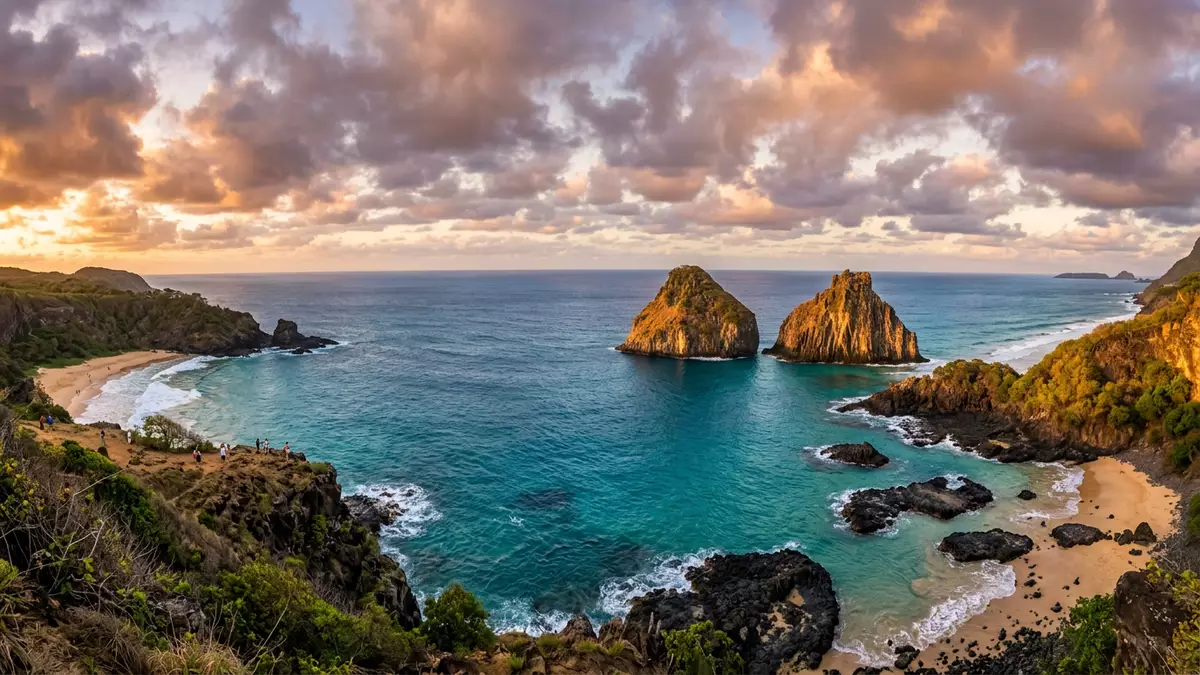
Fernando de Noronha is a Brazilian archipelago in the South Atlantic, a remote volcanic chain of islands rising from deep ocean and enclosed by protected marine waters. The main island forms part of the state of Pernambuco and, together with the surrounding marine national park, it belongs to the serial World Heritage Site known as the Brazilian Atlantic Islands: Fernando de Noronha and Atol das Rocas Reserves, inscribed in 2001.
Volcanic islands shaped by an ancient ridge
Fernando de Noronha consists of an archipelago of islands and islets that are the exposed peaks of a submerged mountain chain linked to the South Atlantic ridge.submerged mountain chain The islands lie several hundred kilometres off the north-eastern coast of Brazil, giving the whole group an isolated ocean setting that is unusual among Brazilian destinations.off the Brazilian coast
Geologically the main island exposes volcanic rocks from the Upper Miocene and Upper Pliocene, representing at least two major eruptive episodes identified as the Remédios and Quixaba formations.Remédios and Quixaba formations These formations consist of pyroclastic deposits intruded by alkaline magmatic bodies, overlain by flows of nefelinic ultrabasic rocks, giving Fernando de Noronha an unusually alkaline volcanic character among oceanic islands.alkaline volcanic character On the surface this geology appears as sharp peaks such as Morro do Pico, narrow plateaus and coastal rock platforms.
Marine national park and World Heritage waters
A large part of Fernando de Noronha’s surrounding waters forms the Fernando de Noronha Marine National Park, protecting reefs, beaches and open ocean that serve as feeding grounds for tuna, sharks, sea turtles and marine mammals.Marine National Park Together with Atol das Rocas Biological Reserve, the park belongs to the Brazilian Atlantic Islands: Fernando de Noronha and Atol das Rocas Reserves, recognised as a natural World Heritage Site under criteria that include scenic beauty and ecological value.World Heritage inscription
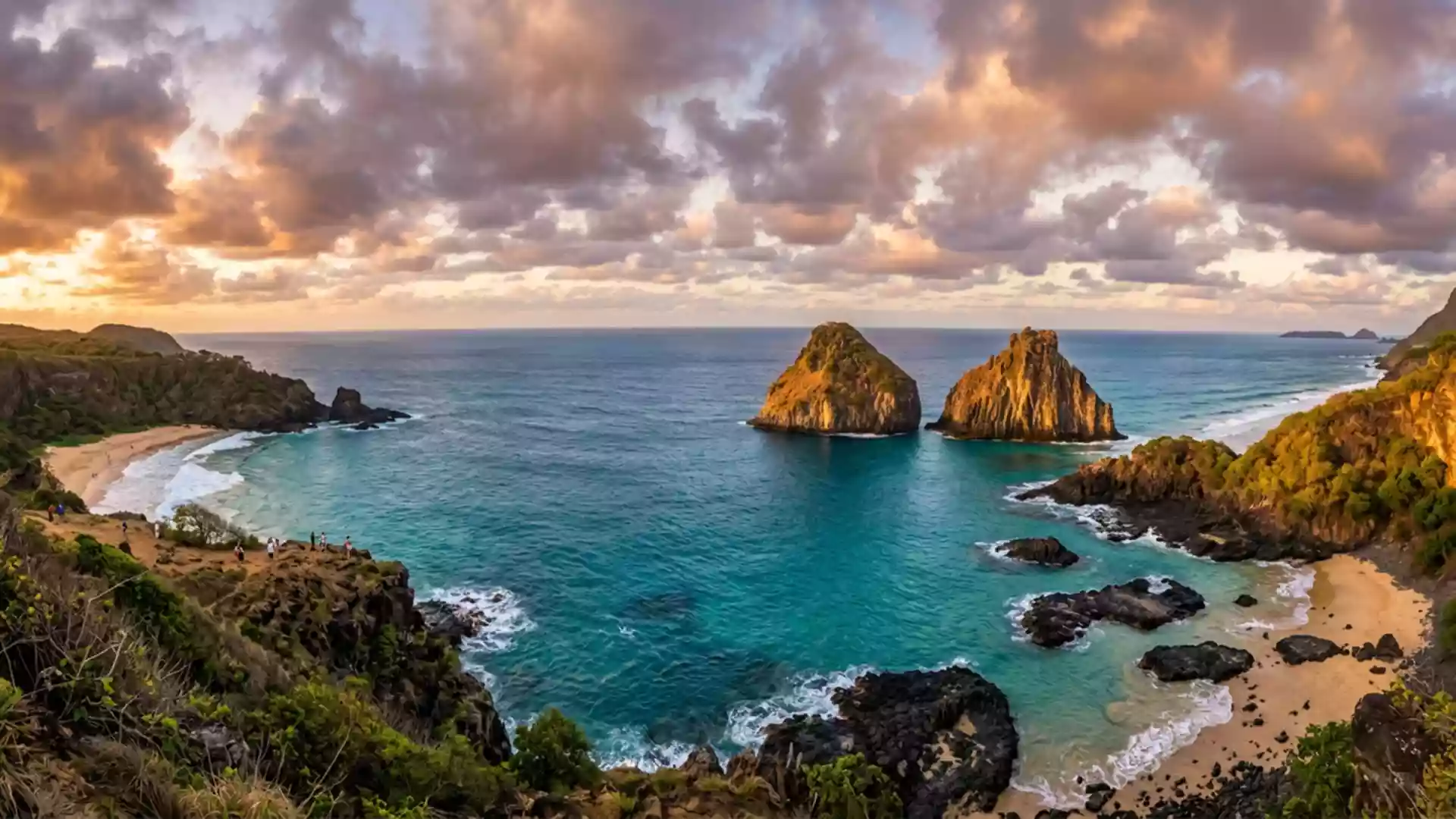
Within these waters, the islands form part of a volcanic ridge that rises about 4,000 m (13,123 ft) from the ocean floor, leaving only a small fraction of its mass above sea level.4,000 m from the ocean bed This setting produces steep coastal cliffs, enclosed bays and offshore rock stacks surrounded by clear Atlantic water. Beaches, tidal pools and rocky promontories around the islands provide varied coastal scenery within relatively short distances on land.
Life, settlement and landscapes on the main island
The main island of Fernando de Noronha hosts the district’s settlement, with villages, small harbour structures and roads arranged along the central plateau and coastal slopes.State District of Fernando de Noronha From this settled interior, routes lead towards the island’s beaches and viewpoints, where volcanic outcrops meet sand and surf. Inland, the raised coral plateau described by geologists forms one of the island’s distinctive landforms, standing above lower coastal areas as a relatively flat surface with cliffs at its seaward edge.raised coral plateau
On a visit, the contrast between volcanic peaks and low sandy coves is immediately visible. Dark, alkaline rocks form headlands and stacks, while lighter beach sands and low vegetation occupy the spaces between. Trails and access paths frequently cross uneven ground, with sections of steps, dirt tracks and exposed rock, reflecting the island’s volcanic origin rather than any planned, level layout.
Visiting Fernando de Noronha: what travellers from Western Europe should know
- Fernando de Noronha lies in the South Atlantic off north-eastern Brazil and is reached by flights from mainland Brazilian cities to the island’s airport, followed by local road transfers.
- The terrain includes steep slopes, coastal cliffs and rough volcanic ground, and reaching some viewpoints or beaches involves walking over uneven surfaces and climbing stairways.
- The archipelago belongs to Brazil, where the official language is Portuguese and the currency is the Brazilian real.
- Entry requirements depend on your nationality; UK travellers can check the FCDO travel advice at gov.uk/foreign-travel-advice, Irish travellers the Department of Foreign Affairs at ireland.ie.
Searching for Fernando de Noronha on social platforms
These links open searches for Fernando de Noronha on each platform.Frequently asked questions about Fernando de Noronha
Where is Fernando de Noronha located?
Fernando de Noronha is an archipelago in the South Atlantic, part of the Brazilian state of Pernambuco and situated several hundred kilometres off the mainland coast.
What can travellers expect when visiting Fernando de Noronha?
Travellers encounter volcanic island landscapes with cliffs, peaks, plateaus and beaches, together with coastal settlements and protected marine areas where land and ocean environments are closely intertwined.
What makes Fernando de Noronha distinctive among Brazilian destinations?
Fernando de Noronha combines an alkaline volcanic archipelago, a raised coral plateau and a marine national park recognised as part of a natural World Heritage Site, giving it an unusual mix of geology and ocean ecology.