
Fes el Bali and the layered city within Fes
Published on 09/23/2026 at 18:05 | Editorial responsibility: Rafael Müller, Editor-in-Chief AD HOC NEWS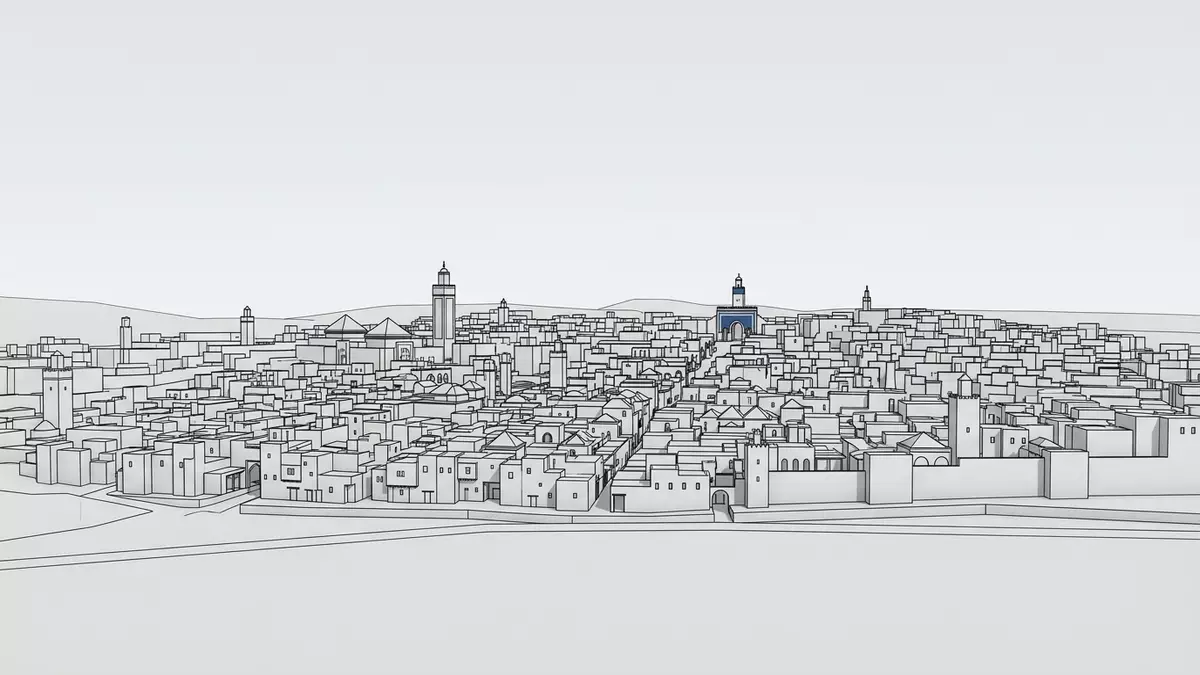
Fes el Bali is the walled historic core of Fes, a dense urban quarter where narrow lanes connect mosques, madrasas, souks, homes and workshops. Founded as the capital of the Idrisid dynasty between 789 and 808, it remains an urban landscape shaped by many centuries of religious, commercial and domestic life.
Fes el Bali: a city formed around the Fez River
The first settlement grew on both banks of the Fez River. Its early quarters were fortified and distinct, with communities associated with Andalusia and Kairouan recorded in the history of the city. The river valley remains part of the quarter’s physical identity, with lanes, bridges and buildings packed into a compact historic landscape.
Under the Almoravids, the separate settlements were joined within a single defensive circuit. The Almohad period brought further growth, while the Merinid dynasty founded Fes Jdid in 1276 to the west. Fes el Bali therefore belongs to a wider historic city, but retains the character of the older settlement. The Idrisid foundation dates place its beginnings in the late eighth and early ninth centuries.
Souks, madrasas and the craft of everyday space
Fes el Bali is not arranged around a single monumental avenue. Its urban fabric gathers around passages, small squares, fountains, religious buildings, market streets and covered souks. Many lanes are too narrow for cars, and movement through the quarter takes place on foot or with handcarts and pack animals.
The quarter’s buildings reveal a close relationship between public and private space. Doorways open into houses organised around courtyards, while shops and workshops face the lanes. Religious architecture includes mosques, shrines and madrasas, with carved plaster, zellij tilework, cedar wood and painted surfaces appearing across historic interiors and façades.
The Bou Inania Madrasa is a Merinid monument with a prayer hall, a courtyard and a minaret visible from the surrounding streets. The Qarawiyyin mosque and university form another major centre within the medina. Founded in 859 by Fatima al-Fihri, the institution is associated with Fes’s long history as a place of Islamic learning. The historic architectural ensemble includes religious, residential, civic and defensive buildings.
The medina as a working historic quarter
Fes el Bali is protected as part of the Medina of Fez, which entered the UNESCO World Heritage List in 1981. The designation covers Fes el Bali and Fes Jdid, recognising the survival of a pre-modern urban pattern and a substantial collection of historic buildings.
Its identity comes from use as much as from monuments. Food sellers, metalworkers, leather craftsmen, weavers, carpenters and other trades occupy workshops along the lanes. The Chouara Tannery, beside the river, is associated with traditional leather production and stone dyeing vats. From nearby upper terraces, the working complex appears as a cluster of coloured basins within the surrounding masonry.
Historic gates mark transitions between the medina and the streets beyond its walls. Bab Bou Jeloud is the best-known western entrance, with blue and green tilework framing its arches. Inside, the route divides towards the Bou Inania Madrasa, Tala’a Kebira and the dense commercial streets leading towards the Qarawiyyin quarter. The World Heritage map identifies Fès El Bali as a distinct component of the listed property.
Visiting Fes el Bali: what travellers from Western Europe should know
- Fes el Bali lies within Fes, in northern Morocco. Rail travellers arrive through Fes railway station, while the medina’s historic core is reached from the surrounding city streets.
- The interior is a pedestrian quarter of narrow, winding lanes. Uneven paving, steps and crowded passageways are part of the physical character of the historic fabric.
- Bab Bou Jeloud provides a recognisable western entrance. The Fez River and Chouara Tannery are useful landmarks within the eastern part of the quarter.
- The official language is Arabic and the national currency is the Moroccan dirham.
- Entry requirements depend on your nationality; UK travellers can check the FCDO travel advice at gov.uk/foreign-travel-advice, Irish travellers the Department of Foreign Affairs at ireland.ie.
Searching for Fes el Bali on social platforms
These links open searches for Fes el Bali on each platform.
Frequently asked questions about Fes el Bali
Where is Fes el Bali?
Fes el Bali is the oldest historic quarter of Fes in northern Morocco. It forms part of the Medina of Fez with Fes Jdid.
What can visitors expect inside?
Visitors encounter pedestrian lanes, souks, courtyards, mosques, madrasas, fountains, workshops and historic gates. The terrain includes uneven paving, steps and narrow passages.
What makes Fes el Bali distinctive?
Its distinctive character comes from the coexistence of an early Islamic urban plan, living craft districts and monuments from the Idrisid, Almohad and Merinid periods. Its World Heritage status records the importance of the wider Medina of Fez.


