
Flamsbana, the steep mountain railway down to the fjord
Published on 08/13/2026 at 14:05 | Editorial responsibility: Rafael Müller, Editor-in-Chief AD HOC NEWS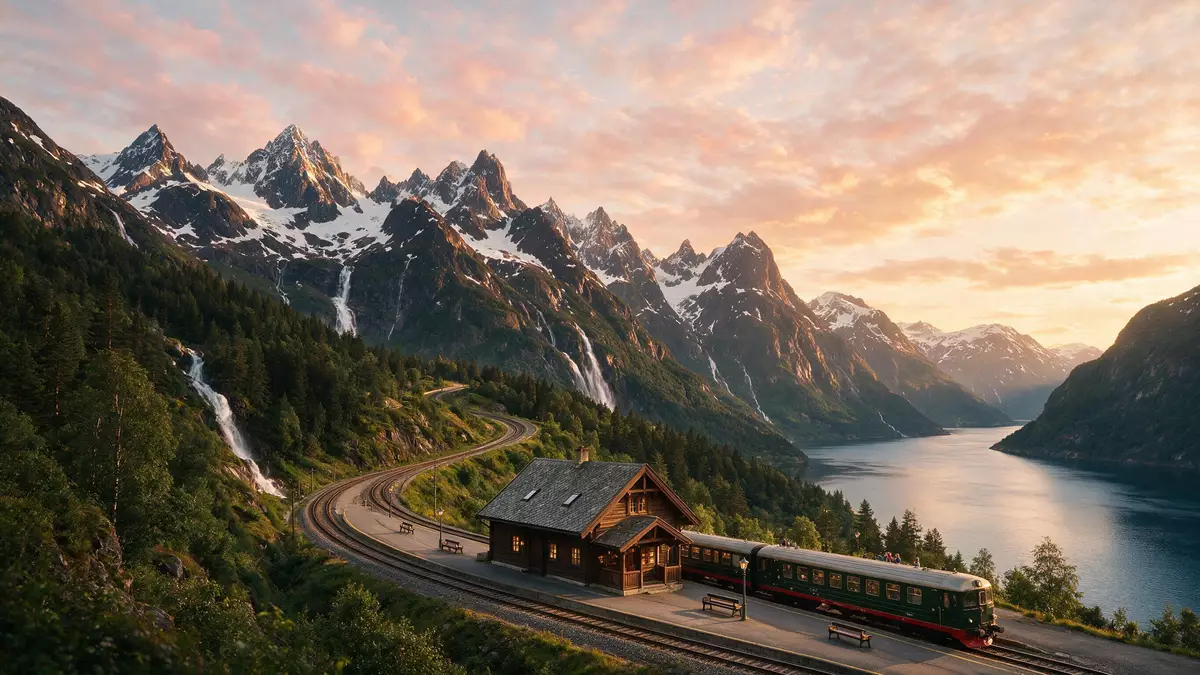
Flamsbana, the Flåm Railway, is a standard-gauge mountain line in western Norway that drops from the high junction at Myrdal down to Flam on Aurlandsfjord. Built in the first half of the twentieth century, it turns a short branch of track into a concentrated journey from upland plateau to fjord-side village.
A branch line between mountain and fjord
The Flamsbana runs between Myrdal, a station on the Bergen Line, and the village of Flam at the head of Aurlandsfjord in Vestland county. It is a single-track railway with termini at both ends, forming a connection between the long-distance Bergen Line and local services and cruises on the inner reaches of Sognefjord.branch line of the Bergen Line From the high plateau at Myrdal the line drops to near sea level at Flam, following the valley of Flåmsdalen where the terrain narrows and the slopes steepen.
The scale of that descent is one of the line’s defining features. Over a distance of a little more than 20 km (12.4 mi), the track loses in the region of 860 m (2,822 ft) in elevation, making Flamsbana among the steepest adhesion-worked standard-gauge railways in the world.descent of around 865 metres in about 20 km The result is a line where gradients are a constant presence and where the relationship between mountain and fjord is visible from carriage windows almost throughout.
Engineering a steep line without rack or cable
Planning for Flamsbana dates back to the early decades of the twentieth century, with construction beginning in the 1920s and continuing over roughly twenty years.construction began in the 1920s and the line opened in 1940 The line opened to steam-hauled trains in 1940 and was later electrified, bringing it into line with the rest of the Bergen corridor.opened for steam traffic in 1940 and electrified in 1944 Much of the work was done by hand, including the excavation of tunnels through hard rock, at a time when heavy machinery was limited on such steep slopes.
The technical character of the line is unusually demanding. Instead of using rack-and-pinion or cable systems, Flamsbana relies on ordinary adhesion between steel wheel and steel rail, yet reaches gradients of around 5.5%, or about 1 in 18, along significant stretches.maximum gradient of about 5.5% To achieve this while keeping the line manageable for mainline rolling stock, the engineers threaded the track through numerous tunnels, some with curves inside the mountain to gain extra length, and aligned it along ledges and shelves above the valley floor. Around twenty tunnels punctuate the route, many cut directly into the rock, giving the journey a rhythm of enclosed sections and sudden openings to waterfalls and slopes.about 20 tunnels were dug by hand
The journey from Myrdal to Flam
Travelling on Flamsbana is a compact cross-section of western Norwegian terrain. Departing Myrdal, the train leaves a high-altitude junction station where mainline trains between Oslo and Bergen pause, then begins to follow the valley of Flåmsdalen downward.journey stretches from Myrdal on the Bergen Line down to Flam at the head of Aurlandsfjord The upper sections pass rock walls and snowfields in colder months, while lower parts of the valley carry woods, farms and small clusters of houses around intermediate stations such as Berekvam, Vatnahalsen and Kjosfossen.stations along the route include Flåm, Berekvam, Vatnahalsen and Kjosfossen
Water is a constant presence along the line. Streams drop from side valleys, and one of the most noted features is Kjosfossen, a powerful waterfall close to the tracks that passengers can see from the train and from a dedicated viewing area beside the line.Flåm Railway described as one of the world's most beautiful train rides Further down, the valley widens, and the train reaches Flam station near the water, where ferries and cruise boats serve Aurlandsfjord and the greater Sognefjord basin.
Visiting Flamsbana: what travellers from Western Europe should know
- Flamsbana runs between Myrdal, on the Bergen Line between Oslo and Bergen, and Flam on Aurlandsfjord in western Norway. Travellers commonly reach Myrdal by mainline train and Flam by fjord boat or local road connections.
- The railway follows steep valley slopes and ledges, and the terrain along the route includes tunnels, short platforms at intermediate stops and sections where the line passes close to cliffs and waterfalls.
- Flam lies in Norway, where the official language is Norwegian and the currency is the Norwegian krone.
- Entry requirements depend on your nationality; UK travellers can check the FCDO travel advice at gov.uk/foreign-travel-advice, Irish travellers the Department of Foreign Affairs at ireland.ie.
Searching for Flamsbana on social platforms
These links open searches for Flamsbana on each platform.Frequently asked questions about Flamsbana
Where is Flamsbana located?
Flamsbana is a railway in Vestland county in western Norway, running between Myrdal station on the Bergen Line and Flam on Aurlandsfjord.
What can travellers expect on a Flamsbana journey?
The journey brings steep gradients, numerous tunnels and views of waterfalls, farms and valley slopes before reaching the fjord-side terminus at Flam.
What makes Flamsbana distinctive among railways?
Flamsbana combines standard-gauge track with gradients of around 5.5% and a descent of more than 800 m, achieved without rack or cable systems.


