
Fo Guang Shan Fojitu Jinianguan and its avenue of pagodas
Published on 09/24/2026 at 05:33 | Editorial responsibility: Rafael Müller, Editor-in-Chief AD HOC NEWS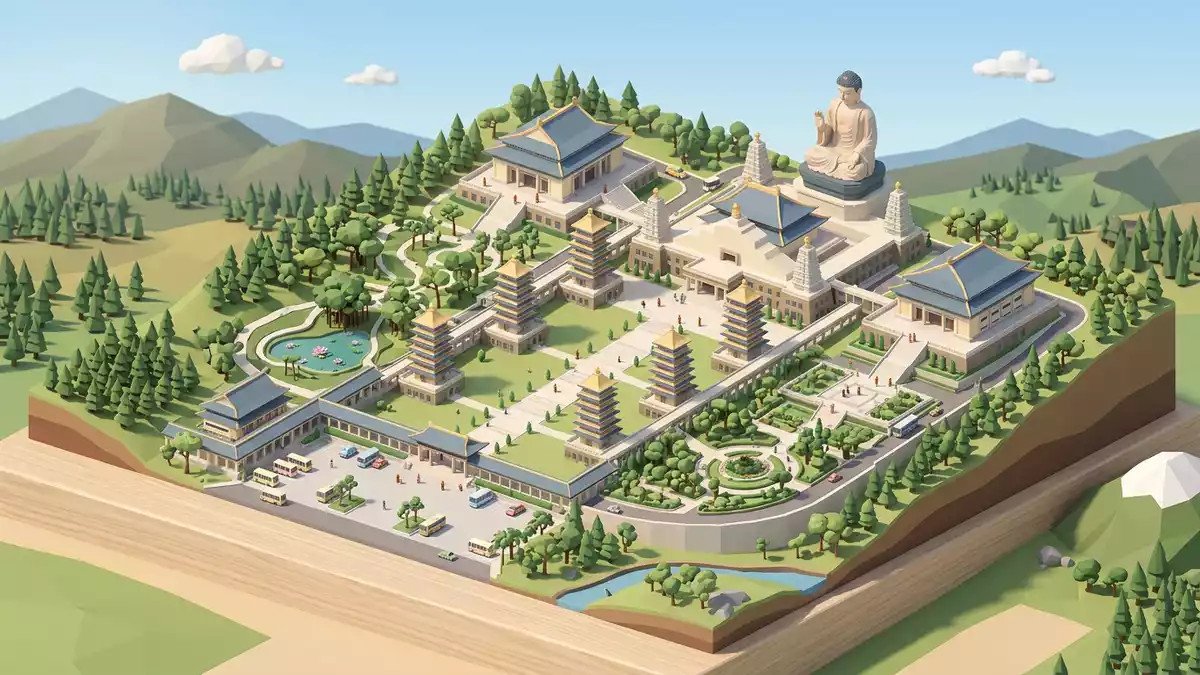
Fo Guang Shan Fojitu Jinianguan is a Buddhist museum and memorial complex in Dashu District, Kaohsiung, Taiwan. Its most legible feature is a long central route lined with pagodas, leading towards the Main Hall and the Fo Guang Big Buddha.
The complex opened on 25 December 2011. Its buildings combine Indian Buddhist forms, Chinese pagoda architecture and contemporary exhibition spaces beside Fo Guang Shan Monastery.
Fo Guang Shan Fojitu Jinianguan: a central path framed by pagodas
The approach begins at the Front Hall and continues along the Great Path to Buddhahood. Eight pagodas stand beside the route, arranged as a sequence between the entrance and the Main Hall.
The pagodas represent the Noble Eightfold Path. Their names are the One Teaching Pagoda, Two Assemblies Pagoda, Three Goodness Pagoda, Four Givings Pagoda, Five Harmonies Pagoda, Six Perfections Pagoda, Seven Admonishments Pagoda and Eightfold Path Pagoda. Each tower is a square, seven-storey structure measuring 38 metres (125 ft) in height, with reinforced concrete, yellow sandstone and marble surfaces.Eight pagodas of the complex
Beyond the towers, the route reaches the Grand Photo Terrace and the Bodhi Wisdom Concourse. Statues associated with Buddhist traditions appear along this central space, linking the entrance sequence with the Main Hall.
The Main Hall, relic shrine and Fo Guang Big Buddha
The Main Hall forms the architectural centre of Fo Guang Shan Fojitu Jinianguan. It rises 50 metres (164 ft) and covers about 14,190 square metres. Yellow sandstone covers its exterior, while its form refers to the Indian stupa tradition.
The hall contains the Buddha’s tooth relic, shrines, exhibitions and the Great Enlightenment Auditorium. The building has a basement and three floors above ground, bringing religious objects, galleries and educational spaces into one complex.Main Hall architecture and layout
At the far end of the main axis stands the Fo Guang Big Buddha. The surrounding arrangement includes Vulture Peak to the south and Jetavana Grove to the north, names drawn from Buddhist geography and teaching traditions.
The museum’s principal relic connects the site with Sakyamuni Buddha, the historical founder of Buddhism. Its presence gives the complex a devotional function alongside its role as a museum, cultural centre and place for Buddhist education.
Fo Guang Shan’s Taiwanese Buddhist setting
Fo Guang Shan began in Taiwan under Master Hsing Yun, who founded the movement in 1967. Its headquarters developed in Kaohsiung, and the Buddha Memorial Centre was built beside the monastery in Dashu District.
The memorial centre belongs to the tradition of Humanistic Buddhism associated with Fo Guang Shan. This tradition places Buddhist teaching alongside education, culture, charitable activity and community life.
Construction began in 2003, and the completed complex opened in 2011. Its scale is expressed through the long avenue, the repeated towers, the broad courtyards and the Main Hall rising behind them.the 2011 opening
The complex is not a single shrine isolated from public life. Its halls contain displays, religious objects and teaching spaces, while the route through the grounds presents Buddhist ideas through names, statues and architecture.
Visiting Fo Guang Shan Fojitu Jinianguan: what travellers from Western Europe should know
- Fo Guang Shan Fojitu Jinianguan stands at No. 1 Tongling Road in Dashu District, Kaohsiung. Bus services connect the complex with Kaohsiung Railway Station, Fengshan Railway Station and Zuoying High Speed Railway Station.
- The principal approach follows the Great Path to Buddhahood from the Front Hall towards the Main Hall. The route passes the Eight Pagodas, the Grand Photo Terrace and the Bodhi Wisdom Concourse.
- The complex lies beside Fo Guang Shan Monastery. The monastery and memorial centre form separate but closely connected parts of the Buddhist site.
- The official language is Mandarin Chinese and the currency is the New Taiwan dollar.
- Entry requirements depend on your nationality; UK travellers can check the FCDO travel advice at gov.uk/foreign-travel-advice, Irish travellers the Department of Foreign Affairs at ireland.ie.
Searching for Fo Guang Shan Fojitu Jinianguan on social platforms
These links open searches for Fo Guang Shan Fojitu Jinianguan on each platform.
Frequently asked questions about Fo Guang Shan Fojitu Jinianguan
Where is Fo Guang Shan Fojitu Jinianguan?
Fo Guang Shan Fojitu Jinianguan is in Dashu District, Kaohsiung, Taiwan. It stands beside Fo Guang Shan Monastery.
What can visitors see there?
The complex includes the Front Hall, Eight Pagodas, Grand Photo Terrace, Bodhi Wisdom Concourse, Main Hall and Fo Guang Big Buddha.
What makes the complex distinctive?
Its central avenue links eight named pagodas with a relic-bearing Main Hall and a large Buddha statue. The arrangement joins Buddhist symbolism, architecture and museum spaces.


