
Frauenkirche, Dresden’s stone dome reborn from wartime ruins
Published on 08/15/2026 at 14:25 | Editorial responsibility: Rafael Müller, Editor-in-Chief AD HOC NEWS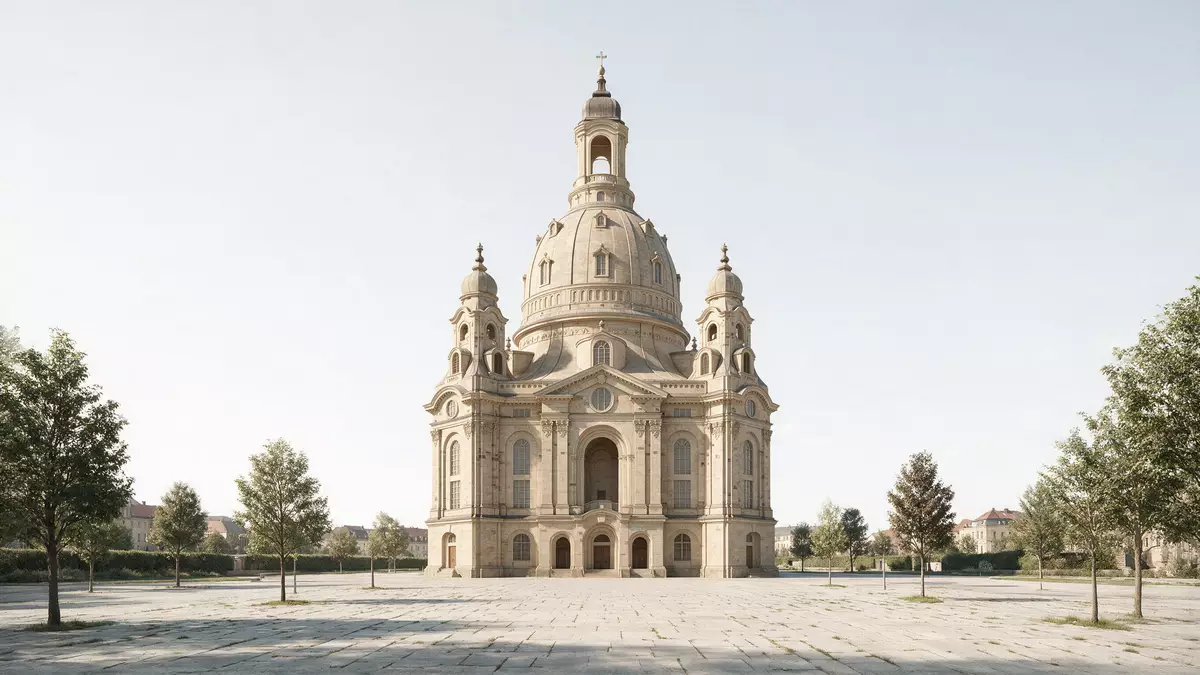
Frauenkirche is the Lutheran “Church of Our Lady” in Dresden, a Baroque sandstone landmark whose great dome collapsed in 1945 and was rebuilt by 2005 as a symbol of the city’s resilience.
A Baroque central church above the Neumarkt
Frauenkirche stands on the Neumarkt square in the historic centre of Dresden, surrounded by rebuilt townhouses that echo the city’s pre-war streetscape. The church is a centralised building with an emphasis on a single dominant volume rather than a long nave, a layout created in the eighteenth century for a growing Lutheran congregation.centralised building Master builder George Bähr, born in 1666, was commissioned by Dresden’s city council in the 1720s and developed a plan that brought the altar, pulpit and organ into a shared focus within the interior.George Bähr
The Baroque church was constructed between 1726 and 1743, replacing earlier medieval buildings that had already carried the name Frauenkirche.built between 1726 and 1743 Its exterior rises from a comparatively compact ground plan in pale sandstone, pushing upwards into a massive dome that made the church one of the most recognisable silhouettes in Dresden for roughly two centuries.cityscape of Dresden The dome earned the nickname “Stone Bell”, and its stacked profiles and lantern are still visible from many points across the Elbe valley.
From medieval parish to wartime ruin
A church dedicated to Our Lady stood on this site since at least the eleventh century, when a Romanesque building outside the early city walls served the local parish and the surrounding graveyard.eleventh century church As Dresden grew in the twelfth century, Frauenkirche became the town’s parish church and later adopted Protestant worship during the Reformation, reflecting the wider shift in Saxony.parish church of the town
The eighteenth-century Baroque Frauenkirche survived conflicts such as the Seven Years’ War and the Napoleonic campaigns, remaining a dominant feature of Dresden’s skyline.survived earlier wars During the Allied air raids on Dresden on 13 and 14 February 1945, incendiary bombs ignited fires across the city centre and the intense heat weakened the internal supports that held the stone dome.February 1945 air raids On 15 February 1945 the dome and main structure collapsed into a heap of sandstone blocks, leaving only fragments and burnt remains where the church had stood.
Reconstruction and a renewed city landmark
For decades after the Second World War, the rubble of Frauenkirche remained on the Neumarkt as a memorial rather than being cleared.mountain of rubble Following German reunification, Dresden’s city council approved reconstruction in 1992 and the foundation stone for the new building was laid in 1994.foundation stone in 1994 The rebuilding process extended into the early twenty-first century, using as many original stones as possible, identified and catalogued to return them to their approximate positions.
The reconstructed church reached its full height in the early 2000s and was consecrated in October 2005, restoring a major element of Dresden’s historic skyline.consecrated in October 2005 Donations from Germany and abroad supported the project, and the renewed Frauenkirche has become a symbol of peace and reconciliation as well as an active place of worship.symbol of peace and reconciliation Inside, the light-coloured sandstone, tiered galleries and reconstructed altar create a cohesive Baroque interior, framed by the soaring volume under the dome.
Visiting Frauenkirche: what travellers from Western Europe should know
- Frauenkirche stands on Neumarkt in central Dresden, south of the Elbe river, a short walk from tram stops and from the historic bridges that cross the river.
- The church interior is reached by broad entrances from the square, and climbing towards viewpoints inside involves staircases and levels arranged within the thick masonry of the dome.
- Dresden is in Germany, where the official language is German and the currency is the euro.
Searching for Frauenkirche on social platforms
These links open searches for Frauenkirche on each platform.Frequently asked questions about Frauenkirche
Where is Frauenkirche located?
Frauenkirche stands on Neumarkt in the historic centre of Dresden, south of the Elbe river and close to other rebuilt Baroque streets and squares.
What can visitors expect inside Frauenkirche?
Visitors encounter a light sandstone interior with tiered galleries, an altar rebuilt in Baroque style and the vast volume beneath the reconstructed dome.
What makes Frauenkirche distinctive among churches in Dresden?
Frauenkirche is distinctive for its eighteenth-century centralised Baroque design and its reborn stone dome, reconstructed after collapsing during the 1945 air raids.


