
Frauenkirche in Dresden and its towering stone dome
Published on 08/23/2026 at 13:23 | Editorial responsibility: Rafael Müller, Editor-in-Chief AD HOC NEWS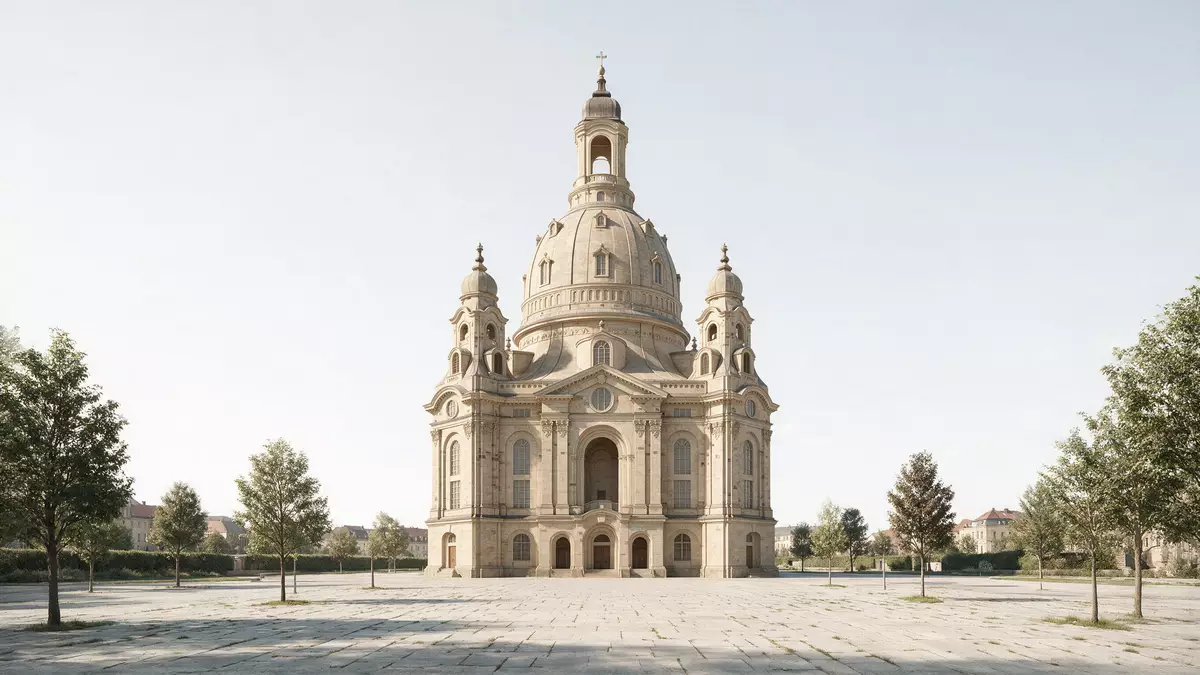
Frauenkirche in Dresden is a Lutheran Baroque church whose vast stone dome dominates the Neumarkt and the skyline of Germany’s Saxon capital. Built in the eighteenth century and reconstructed in the early twenty-first century after wartime destruction, it combines historic masonry with modern precision to create one of the city’s most recognisable forms.
A baroque church built around a stone dome
The present Frauenkirche stands on Neumarkt in Dresden’s Old Town, rising as a tall sandstone mass crowned by a distinctive bell-shaped dome. The church in its baroque form was built between 1726 and 1743 under the direction of architect George Bähr, who designed a central-plan church dominated by masonry rather than by traditional Gothic supports.built between 1726 and 1743
The building reaches a height of about 91 m (298 ft), with the dome itself forming a large stone volume above the main body of the church.Height of the church The dome has been described as a “stone bell”, a bulbous form of sandstone blocks stacked without internal iron framework, resting on a drum that rises above the nave.stone bell dome This masonry mass gives the church a compact vertical profile distinct from the spired silhouettes of many other European city churches.
Destruction in 1945 and decades of ruins
In February 1945, during the air raids that devastated central Dresden near the end of the Second World War, Frauenkirche was severely damaged. The intense heat generated by incendiary bombs caused the interior to burn and weakened the stone structure until the dome and walls collapsed into a mound of rubble on 15 February 1945.air raids in February 1945
For nearly half a century, these ruins remained in place on Neumarkt as a stark stone heap marking the site of the church. The blackened fragments of sandstone from the collapsed dome and walls formed a rough outline of the original footprint and became part of the city’s war-scarred landscape.pile of rubble for almost 50 years The foundations and remains of supports were left untouched for decades, turning the site into a memorial as much as a ruin of an earlier baroque structure.
Reconstruction and a skyline reborn
After German reunification, plans to rebuild Frauenkirche gathered momentum and the Dresden City Council approved reconstruction in 1992.approval for reconstruction in 1992 Clearing of the rubble started in 1993, and workers carefully sorted thousands of sandstone blocks, identifying and labelling many of them for reuse in the future walls and dome.stones identified and reused
The first new stone was placed in May 1994, beginning a reconstruction that followed baroque-era outlines while using modern surveying and stone-cutting techniques.first stone in May 1994 The exterior of the church was largely complete by 2004, and the interior followed, leading to the consecration of the rebuilt Frauenkirche on 30 October 2005.consecrated on 30 October 2005 Around 46 percent of the original stones were integrated into the new fabric, their darker colour visible in patches across the pale façade and dome.
Interior space and the “stone bell” above
Inside, the reconstructed Frauenkirche preserves the spatial idea of an eighteenth-century Lutheran Baroque church, with a centralised plan gathering the congregation beneath the dome. Galleries run around the interior, and the high altar and organ occupy the eastern side of the space, framed by restored baroque ornament.
The dome’s engineering remains one of the church’s most striking features. It reaches roughly 24 m (79 ft) in height as a masonry shell above its supporting structure, with a diameter of about 23.5 m (77 ft).dome dimensions During reconstruction, stone blocks were laid on a temporary wooden frame, echoing the eighteenth-century methods before the timber support was removed.dome rebuilt on a wooden structure The result is a massive stone canopy above the church interior that has restored the baroque skyline element long absent from Dresden after 1945.
Visiting Frauenkirche: what travellers from Western Europe should know
- Frauenkirche stands on Neumarkt in Dresden’s Old Town, close to landmarks such as the Residenzschloss and the Brühl’s Terrace on the Elbe.
- The church rises as a tall stone structure topped by a masonry dome, and visits to the interior involve stairways and galleries rather than level floors alone.
- Frauenkirche is reached by Dresden tram services that stop at Altmarkt near the Kulturpalast, from where the Neumarkt and the church lie a short walk away.
- The official language is German and the currency is the euro.
Searching for Frauenkirche on social platforms
These links open searches for Frauenkirche on each platform.
Frequently asked questions about Frauenkirche
Where is Frauenkirche located in Dresden?
Frauenkirche stands on Neumarkt in Dresden’s historic Old Town, close to the Elbe and major sights such as the Residenzschloss.
What can visitors expect inside Frauenkirche?
Visitors encounter a centrally planned baroque church with galleries, a high altar and organ, all gathered beneath the reconstructed stone dome.
What makes Frauenkirche distinctive among city churches?
Its tall sandstone body crowned by the “stone bell” dome, rebuilt after wartime destruction using thousands of original blocks, gives Frauenkirche a singular profile in Dresden’s skyline.


