
French Quarter, New Orleans: a compact city of ironwork and courtyards
Published on 09/08/2026 at 10:12 | Editorial responsibility: Rafael Müller, Editor-in-Chief AD HOC NEWS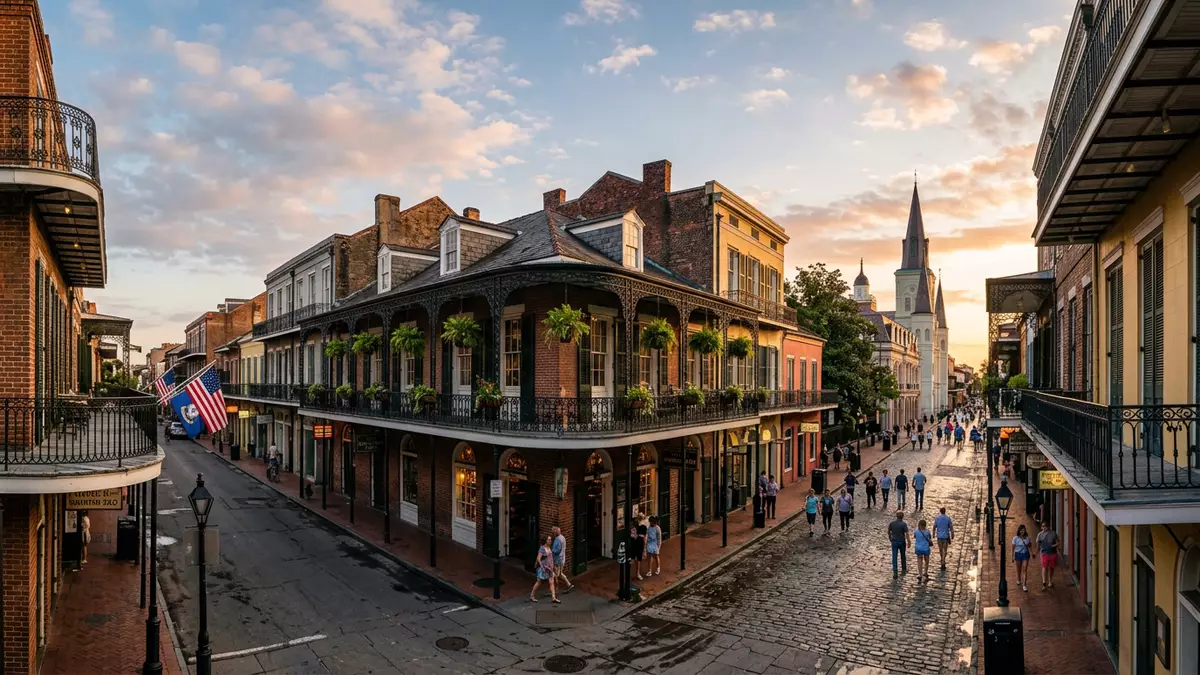
French Quarter in New Orleans is a compact historic district where a tight eighteenth-century street grid carries layers of French, Spanish, Creole and American architecture, framed by ironwork balconies and shaded courtyards. Founded as the original city of New Orleans in 1718 under Jean-Baptiste Le Moyne de Bienville, it later became known as the Vieux Carré, a name still used for the historic district today.
The original city on the Mississippi bend
French Quarter occupies the early colonial footprint of New Orleans on a curve of the Mississippi River, laid out as a planned settlement in the early eighteenth century. In 1721 royal engineer Adrien de Pauger set out the rectilinear street pattern, naming thoroughfares after French royal houses and Catholic saints, including the now-famous Bourbon Street.Adrien de Pauger set out the rectilinear street pattern Within this grid the original twenty or so blocks clustered around the central square then known as Place d’Armes, later renamed Jackson Square, forming the nucleus from which the city expanded.Place d’Armes later became Jackson Square
The district is widely referred to by its French name Vieux Carré, meaning “Old Square”, and its compact plan and mixed building stock led to formal recognition as a historic district. The Vieux Carré Historic District was designated a National Historic Landmark on 21 December 1965, and state law in Louisiana created the Vieux Carré Commission in 1936 to oversee changes to its buildings and streetscape.Vieux Carré Historic District was designated a National Historic Landmark Behind the balconies and shutters many properties still retain central courtyards, carriage passages and mixed use layouts that reflect the district’s long life as both a residential and commercial quarter.
Creole townhouses, Spanish rebuilding and iron galleries
Although the name suggests French origins, much of the architecture that defines French Quarter dates from the late eighteenth and nineteenth centuries and carries strong Spanish colonial and Creole influences. Extensive fires in 1788 and 1794 destroyed large parts of the earlier French-built town, after which new structures rose with fire-resistant brick, stucco and tile and with features such as courtyards and specific window forms associated with Spanish builders.Extensive fires in 1788 and 1794 destroyed large parts of the earlier town The result is a streetscape where French, Spanish, African and American influences blend into what became known in New Orleans as Creole architecture.French, Spanish, African and American influences blend into Creole architecture
A characteristic building type in the district is the Creole townhouse, usually two or three storeys high and built directly to the pavement with a commercial ground floor and living quarters above. Many of these townhouses incorporate carriageways leading from the street to interior courtyards, backing onto secondary service wings and outbuildings.A characteristic building type is the Creole townhouse From the nineteenth century onwards, decorative iron galleries were added to upper levels, projecting over the pavements and visually tying different facades together; the Pontalba Buildings on Jackson Square, completed in 1851, are often cited among the earliest multi-storey examples with continuous ironwork. The wider mix of forms includes Creole cottages, double shotgun houses and three-storey masonry houses with intermediate entresol levels, making the Quarter a compact catalogue of regional building types.French Quarter includes Creole cottages and double shotgun houses
Jackson Square, St Louis Cathedral and city institutions
At the centre of French Quarter, Jackson Square forms a landscaped plaza facing an ensemble of civic and religious buildings that has become one of the most recognisable groupings in New Orleans. The square began as Place d’Armes, a parade ground and focal space for the colonial town, and was later named after Andrew Jackson following the Battle of New Orleans in the early nineteenth century.Jackson Square began as Place d’Armes In 1856 an equestrian statue of Jackson by sculptor Clark Mills was installed, adding a monument that still frames views along the axial paths and towards the river.An equestrian statue of Jackson was installed in 1856
On the north side of Jackson Square stands St Louis Cathedral, the city’s Roman Catholic cathedral and a prominent landmark with its central tower and flanking spires. The cathedral is widely described as the oldest Roman Catholic cathedral in continuous use in the United States.St Louis Cathedral is described as the oldest Roman Catholic cathedral in continuous use in the United States Beside it the historic Cabildo and Presbytère, former civic buildings associated with Spanish and later American administration, line the square with arcaded facades. Elsewhere in the Quarter, institutions such as The Historic New Orleans Collection occupy a series of historic properties, using interconnected buildings around their own courtyards to house archives, galleries and visitor facilities.The Historic New Orleans Collection occupies multiple historic buildings
Visiting French Quarter: what travellers from Western Europe should know
- French Quarter lies on the Mississippi River in the eastern part of New Orleans, Louisiana, and is reached by city streets that connect directly into its rectilinear grid.
- The streets are generally narrow and straight, with pavements running beside continuous building fronts; many properties are arranged around interior courtyards reached through passageways.
- New Orleans is in the United States of America; the official language is English and the currency is the US dollar.
- Entry requirements depend on your nationality; UK travellers can check the FCDO travel advice at gov.uk/foreign-travel-advice, Irish travellers the Department of Foreign Affairs at ireland.ie.
Searching for French Quarter on social platforms
These links open searches for French Quarter on each platform.
Frequently asked questions about French Quarter
Where is French Quarter in New Orleans located?
French Quarter occupies the early street grid of New Orleans beside a bend in the Mississippi River in the state of Louisiana, forming the city’s historic core.
What should visitors expect when walking through French Quarter?
Visitors encounter narrow streets lined with Creole townhouses, ironwork galleries and courtyards, alongside civic buildings around Jackson Square and the prominent St Louis Cathedral.
What makes French Quarter distinctive among historic districts?
French Quarter combines an eighteenth-century planned grid with a dense mix of French, Spanish and Creole architecture, recognised through its Vieux Carré National Historic Landmark designation.


