
Fujian Tulou and the architecture of communal courtyards
Published on 09/22/2026 at 21:52 | Editorial responsibility: Rafael Müller, Editor-in-Chief AD HOC NEWS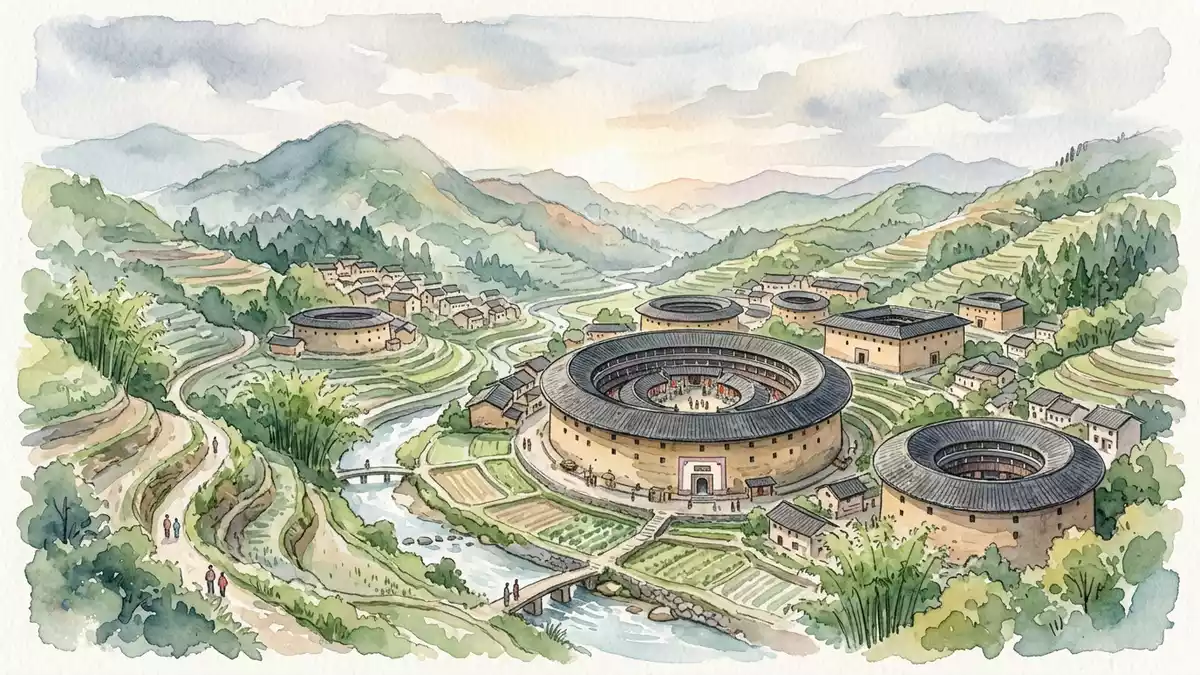
Fujian Tulou is a landscape of multi-storey earthen houses in Yongding, Fujian Province, China. Their thick walls form circular or square residential buildings around open courtyards, bringing homes, ancestral spaces and communal life into one architectural form.
Yongding’s earthen houses and open courtyards
The name tulou means “earthen building”. Fujian Tulou buildings use rammed earth for their substantial outer walls, with timber forming much of the interior structure. Tiled roofs extend above the walls, while the courtyard remains the shared centre of each compound.
The buildings vary in plan, including circular, square and other related forms. Their exterior surfaces can appear almost fortress-like, while the interior contains domestic rooms, wooden galleries, stairways and ancestral halls. The contrast between the massive outer wall and the open centre defines the experience of the architecture.
Hakka communities across Fujian’s mountain valleys
Fujian Tulou is associated with Hakka communities in the uplands of southern Fujian. Extended families occupied the buildings as village units, with living spaces arranged around shared areas and agricultural landscapes. Rice, tea and tobacco fields appear among the valleys and wooded hills surrounding the tulou.
The protected heritage property contains 46 buildings distributed across south-western Fujian over about 120 km. Its buildings date from the fifteenth to the twentieth century, recording a long development of earthen construction and communal residence. Fujian Tulou’s World Heritage listing places the buildings within a broader cultural landscape rather than treating them as isolated houses.
From defensive walls to recognised heritage
The outer walls contain few openings at ground level, while windows appear higher in the building. This arrangement gives the tulou a clear defensive character, although the buildings also contain kitchens, storage areas, family rooms and ritual spaces.
UNESCO inscribed Fujian Tulou on the World Heritage List in 2008. The designation covers buildings in Yongding, Nanjing and Hua’an, including well-known Yongding clusters such as Hongkeng, Gaobei and Chuxi. the 2008 heritage inscription records the buildings as examples of communal living and defensive organisation in relationship with their environment.
Yongding provides a concentrated setting for understanding the tradition. A tulou is not only an earthen shell, but also a residential plan, a family compound and a place for shared customs. the Yongding tulou landscape includes fortified mud walls, tiled roofs and rural fields across the surrounding countryside.
Visiting Fujian Tulou: what travellers from Western Europe should know
- Fujian Tulou lies in Yongding County, in south-western Fujian Province. Road travel from nearby Fujian towns connects the tulou clusters with the regional transport network.
- The buildings stand in hilly rural valleys, where approaches can include uneven ground, slopes, steps and internal stairways.
- The official language is Mandarin Chinese and the currency is the renminbi.
- Entry requirements depend on your nationality; UK travellers can check the FCDO travel advice at gov.uk/foreign-travel-advice, Irish travellers the Department of Foreign Affairs at ireland.ie.
Searching for Fujian Tulou on social platforms
These links open searches for Fujian Tulou on each platform.Frequently asked questions about Fujian Tulou
Where is Fujian Tulou?
Fujian Tulou is in south-western Fujian Province, with important groups in Yongding County. The buildings occupy rural valleys inland from the Taiwan Strait.
What can visitors expect to see?
Visitors encounter thick earthen walls, tiled roofs, courtyards, timber galleries, family rooms and ancestral halls. The surrounding landscape includes wooded hills and cultivated fields.
What makes Fujian Tulou distinctive?
Its distinctive feature is the combination of a large earthen residential wall with a shared open courtyard. The buildings unite communal living, family organisation and defensive architecture.


