
Fujian Tulou in Yongding: communal earthen fortresses
Published on 08/24/2026 at 21:32 | Editorial responsibility: Rafael Müller, Editor-in-Chief AD HOC NEWS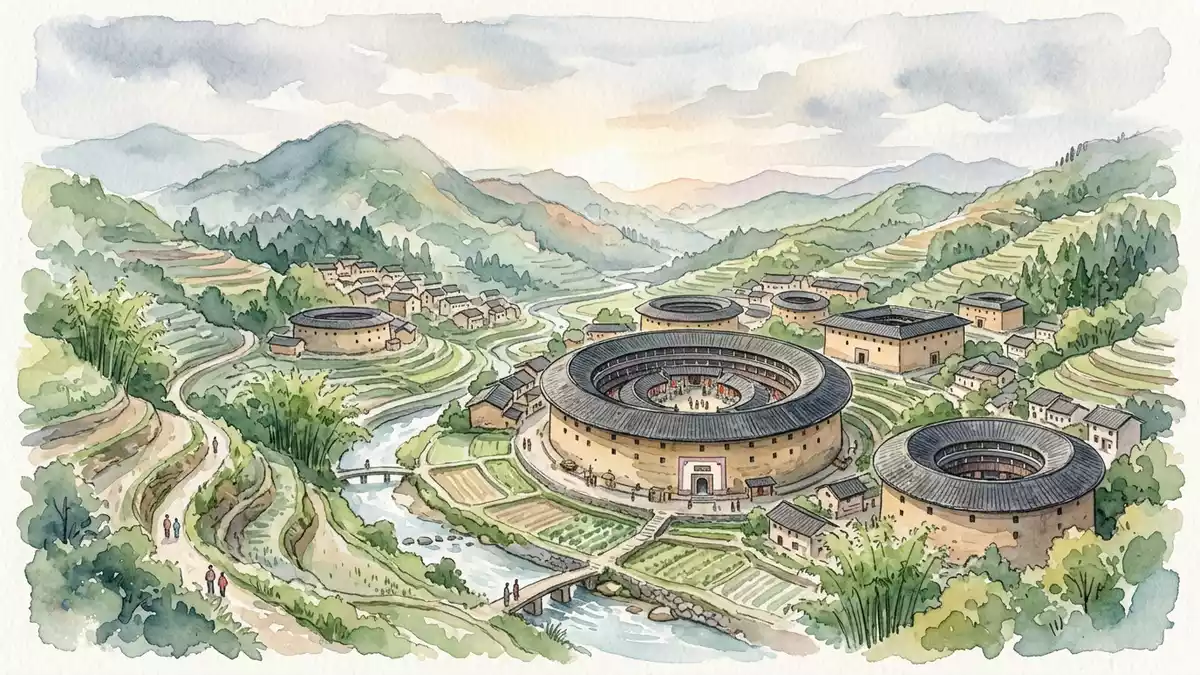
In the hills around Yongding in Fujian, China, Fujian Tulou rise from the terraces as immense communal dwellings built of rammed earth and timber, enclosing entire Hakka clans within fortified rings or blocks. Recognised as a World Heritage cultural landscape since 2008, these earthen structures combine residential life, defence and village identity inside a single building.
Earthen rings in the Fujian mountains
Fujian Tulou are found across the mountainous inland of Fujian province, especially in Yongding District of Longyan City, where thousands of earthen buildings stand scattered along river valleys and slopes.villages of Yongding The cluster inscribed on the UNESCO World Heritage List includes selected examples in Yongding and neighbouring counties, recognised in 2008 as “exceptional examples” of fortified communal living in harmony with the landscape.UNESCO World Heritage List
Yongding Tulou sit among terraced fields, tea hills and river corridors, their outer walls forming pronounced silhouettes above the surrounding houses and orchards. Many follow the valley lines of the Ting and Yongding Rivers, while others are tucked against low ridges or gentle slopes, creating compact clusters where several earthen buildings stand within short walking distance of one another.Ting and Yongding Rivers
Architecture of an earth building
The defining element of a tulou is its outer wall, built using rammed earth on stone foundations and tied together with a timber framework. Builders compact subsoil mixed with lime and sand between removable wooden formwork in successive horizontal layers, producing walls that can reach several metres thick at ground level and taper towards the top.rammed earth technique Stone footings raise the base slightly above the ground, while overhanging tiled roofs help protect the wall surface from heavy rain.stone footings and tiled roofs
Inside, tulou are organised as multi-storey rings or blocks around a central open space, often with lower internal buildings or ancillary structures set within the courtyard. Timber posts, beams and balconies create radial or linear frameworks leaning against the earthen wall, dividing the interior into stacked rooms reached by staircases and galleries.radial inner structure Many tulou combine circular and square forms across a settlement, with the majority of Yongding examples described as square, complemented by rarer circular rings along parts of the river basin.square and circular variants
Hakka communal life and World Heritage status
Fujian Tulou are closely associated with Hakka and Minnan clans who settled in Fujian between the twelfth and twentieth centuries, bringing collective rammed-earth construction techniques from earlier periods into this border landscape.Hakka and Minnan clans Generations of related families live or have lived within a single building, each room or vertical stack of rooms belonging to a household, while shared courtyards and ancestral halls form the communal heart.
The Fujian Tulou ensemble was formally inscribed on the World Heritage List in 2008, with 46 representative buildings selected across Nanjing and Yongding counties in recognition of their combined architectural, social and defensive significance.46 buildings selected Yongding contains a substantial portion of these inscribed examples alongside many more unlisted tulou, making the district a concentration of earthen communal architecture and a living record of clan-based settlement patterns in southern China.Yongding Tulou
Visiting Fujian Tulou: what travellers from Western Europe should know
- Fujian Tulou in Yongding lie in inland Fujian, south-west of the coastal city of Xiamen, reached by regional road and bus routes into Longyan and onward to Yongding districts.
- The terrain around Yongding Tulou combines river valleys and low hills; once at individual sites, expect compact villages with earthen buildings linked by short, uneven lanes and steps.
- Several tulou clusters in Yongding stand near one another; walking between them involves minor gradients and stone or packed-earth surfaces rather than long mountain paths.
- The official language is Chinese and the currency is the yuan (renminbi).
- Entry requirements depend on your nationality; UK travellers can check the FCDO travel advice at gov.uk/foreign-travel-advice, Irish travellers the Department of Foreign Affairs at ireland.ie.
Searching for Fujian Tulou on social platforms
These links open searches for Fujian Tulou on each platform.
Frequently asked questions about Fujian Tulou
Where are Fujian Tulou located?
Fujian Tulou are scattered across inland Fujian province in south-eastern China, with major clusters in Yongding District of Longyan City and neighbouring Nanjing County.
What should visitors expect inside a tulou?
Visitors encounter multi-storey earthen buildings arranged around open courtyards, with timber galleries, staircases and ancestral spaces forming a dense communal layout within the enclosing wall.
What makes Fujian Tulou distinctive among traditional dwellings?
Fujian Tulou combine thick rammed-earth construction, large-scale enclosed forms and clan-based communal occupation, creating single buildings that function simultaneously as village, residence and fortified shell.


